

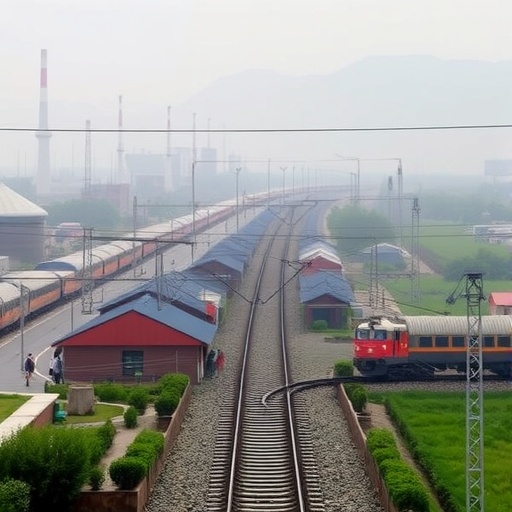
Air pollution has long been framed predominantly as an urban challenge, a crisis demanding immediate attention within bustling metropolises where industrial activities, vehicular emissions, and dense populations converge. However, emerging research from China challenges this entrenched narrative, illuminating the overlooked yet equally critical air quality issues in rural regions. Contrary to popular assumptions, rural areas in China exhibit levels of air pollution comparable to their urban counterparts, with significant repercussions for public health. This paradigm-shifting insight comes from a rigorous examination of comprehensive data sets, including firm-level waste gas emission records, grid-based measurements of fine particulate matter (PM2.5), and health outcomes linked to respiratory and cardiovascular diseases.
The research pivots on a nuanced understanding of spatial disparities in pollution and health, placing a spotlight on how transportation infrastructure—specifically China’s expanding high-speed rail (HSR) network—interacts with these dynamics. While HSR is often lauded for fostering economic integration and environmental benefits by reducing reliance on more polluting transport modes, this study uncovers a more complex, less equitable story. The opening of HSR lines appears to facilitate a resource redistribution that disproportionately benefits urban centers, thereby enabling cities to achieve notable reductions in both waste gas emissions intensity and PM2.5 concentrations. In stark contrast, rural areas lag behind, witnessing comparatively muted improvements. This divergence has tangible public health consequences, with urban regions experiencing a greater decline in cardiovascular-disease-related mortality than rural counterparts following HSR developments.
Delving deeper into the mechanisms behind these patterns reveals that the spatial reallocation of industrial activity and investments tends to favor urban hubs once better connected through HSR. Enhanced accessibility drives agglomeration effects in cities: industries, talent, and capital cluster more intensively, amplifying environmental regulation enforcement and technological adoption that mitigate pollution. Meanwhile, rural sectors, lacking similar infrastructural and economic stimuli, suffer from relative resource scarcity and stagnant industrial modernization. This bifurcation fosters an expanding urban–rural divide, effectively entrenching pollution and health inequities over time.
Importantly, the temporal evolution of this phenomenon exhibits nuanced fluctuations yet maintains an overarching trajectory of deepening disparities. Over successive years post-HSR opening, the data reveal a growing urban advantage in lowering pollution levels and improving public health metrics. These trends persist across various geographic proximities to HSR nodes, underscoring the systemic nature of the disparities rather than isolated local effects. Such insights compel policymakers and urban planners to reconsider the broader socio-environmental impacts of transportation infrastructure projects that, while beneficial at first glance, may inadvertently exacerbate existing inequalities.
Scientifically, the study leverages an integrative methodological framework combining micro-level firm emissions data with high-resolution spatial PM2.5 exposure assessments and health outcome metrics extracted from grid-level datasets. This multifaceted approach enables a holistic capture of the urban and rural environmental-health nexus, transcending limitations of previous studies that focused predominantly on urban air quality or aggregate national statistics. By bridging environmental science, economics, and public health, the research offers a powerful lens through which to dissect the unintended consequences of infrastructure modernization on vulnerable rural populations.
From a technical perspective, the firm-level waste gas emission data represent toxic pollutants released from industrial processes, standardized to reflect emissions intensity per unit of output. PM2.5 data derived from satellite and ground-based sensors provide an objective measure of ambient air pollution burden—recognized globally for its causal links to cardiovascular and respiratory morbidity. By geospatially mapping these pollution indicators alongside fine-grain health datasets documenting cardiovascular-disease-induced mortality, the authors construct an empirical pathway elucidating how emissions flows translate into tangible health outcomes.
Another critical advancement of this research is quantifying how HSR acts as both an enabler and a divider: a conduit facilitating resource mobilization to urban nodes, yet a barrier impeding equitable dispersion of environmental benefits. This dualistic role challenges simplistic narratives about infrastructure-led development and offers a cautionary tale for emerging economies expanding rapid transit systems without embedding equity considerations into planning processes.
The policy implications are profound. Addressing rural air pollution requires dedicated interventions rather than blanket assumptions of urban primacy. Environmental regulations, technological upgrades, and pollution control investments must be deliberately extended into rural industrial sectors, coupled with strengthened health infrastructure to mitigate adverse outcomes. Moreover, integrated regional planning should preemptively counterbalance infrastructural biases favoring urban agglomerations, promoting sustainable development that includes rural livelihoods and environments.
Furthermore, the research highlights the necessity of incorporating environmental justice paradigms into the evaluation of infrastructure projects. The high-speed rail network’s unintended consequences on rural air quality and health outcomes underscore the imperative for impact assessments to encompass social and spatial equity metrics. Only through such comprehensive evaluations can emerging economies avert reinforcing equality gaps whilst striving for modernization and economic growth.
The study also invites broader reflection on the intersection between mobility, industrial geography, and environmental outcomes. Infrastructure investments reconfigure economic landscapes, shaping pollution loads and health risks in ways that demand interdisciplinary scrutiny. Understanding these complex feedback loops is crucial for designing resilient and fair urban-rural futures, particularly under the accelerating pressures of urbanization and climate change.
In conclusion, this research signals a critical shift in how policymakers, scientists, and the public must perceive air pollution challenges. It is not solely an urban problem; rural air quality warrants equal vigilance, especially considering the divergent trajectories precipitated by transformative infrastructure such as high-speed rail. By exposing these hidden disparities and their health consequences, the study lays the groundwork for targeted, equitable environmental governance in China and other rapidly developing economies striving to balance growth with public health imperatives.
The findings open new avenues for further investigation, including longitudinal studies to monitor evolving urban-rural pollution dynamics, and the evaluation of complementary policies that might harmonize benefits across diverse regions. As high-speed rail becomes an emblem of modern connectivity, its role as a potential agent of inequality must be addressed to ensure that progress is inclusive and sustainable. This multifaceted approach paves the way for reimagining infrastructure not just as an economic tool but as a cornerstone of environmental justice.
In a world increasingly attuned to the health costs of pollution, these revelations serve as a stark reminder that technological advances and infrastructural investments cannot be decoupled from their socio-environmental contexts. The disproportionate burden borne by rural communities—often silent and invisible in prevailing discourses—calls for an urgent recalibration of policy frameworks aimed at bridging urban-rural divides in environmental health. China’s experience offers a salient case study with far-reaching implications, inspiring a global reckoning on how equitable development pathways can be charted amidst the twin challenges of pollution and modernization.
Ultimately, the study underlines the importance of data-driven policymaking and comprehensive environmental monitoring systems that capture nuanced spatial disparities. Only with such refined analytical tools can emergent economies harness infrastructure investments to foster healthier environments for all, transcending the urban-focused paradigms that have dominated past decades. With the stakes so high for public health and environmental sustainability, this research marks a pivotal contribution, setting the stage for more just and inclusive urban-rural futures in the era of rapid transformation.
Subject of Research: Urban-rural disparities in air pollution and public health impacts in China, with a focus on the effects of high-speed rail infrastructure development.
Article Title: China’s high-speed rail widens urban–rural disparities in air pollution and public health.
Article References:
Zhu, S., Liu, Z. & He, C. China’s high-speed rail widens urban–rural disparities in air pollution and public health. Nat Cities (2026). https://doi.org/10.1038/s44284-026-00409-z
Image Credits: AI Generated


