

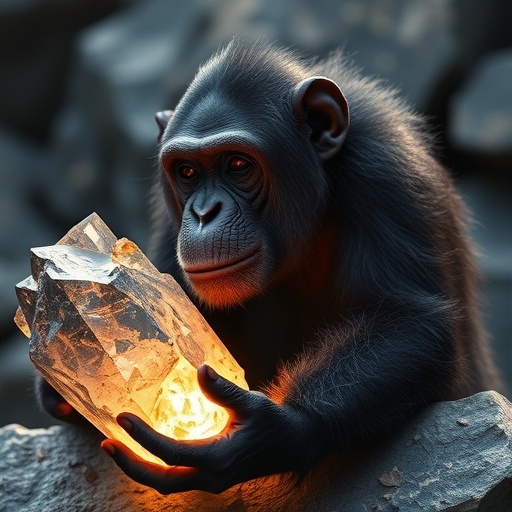
In the annals of human history, crystals have long been objects of intrigue and fascination, frequently discovered at archaeological sites alongside ancient human remains. These enigmatic stones, collected by hominins for at least 780,000 years, resisted utilitarian classification. Unlike weapons, tools, or decorative jewelry, these crystals seemingly held no obvious practical use. What then drove our ancestors to amass these geological marvels? A recent groundbreaking study published in Frontiers in Psychology seeks to elucidate the deep-rooted evolutionary underpinnings of our fascination with crystals by investigating the responses of one of our closest living relatives: the chimpanzee.
The research, led by crystallography expert Prof. Juan Manuel García-Ruiz from the Donostia International Physics Center, employed meticulously designed experimental protocols involving enculturated chimpanzees from the Rainfer Foundation in Spain. The central question was whether chimpanzees, sharing a common ancestor with modern humans dating back some six to seven million years, would exhibit a similar attraction to crystals. This could provide unprecedented insight into the ancient cognitive and perceptual mechanisms that might explain why early hominins collected these mineral specimens.
The experiment’s initial phase introduced two substantial objects—a sizeable quartz crystal, termed the ‘monolith,’ and a visually similar rock without crystalline structure—placed side by side on a platform. Initial reactions from the primates were impartial, with both stones eliciting curiosity. However, as the exposure progressed, a stark preference emerged, favoring the crystal. The chimps engaged in complex inspection behaviors, including rotating and tilting the crystal to observe its geometrical facets, an indication that their attraction was more than superficial. One chimp, Yvan, notably transported the crystal to the dormitories, signifying a possible valuation beyond mere investigatory interest.
This pronounced preference is reminiscent of human behavior patterns wherein the allure of a novel object wanes gradually, mirroring the decline in enthusiasm witnessed among the studied chimps over time. Such parallels reinforce the hypothesis that the intrigue elicited by crystalline structures possesses a phylogenetic basis reflective of deep evolutionary continuity. Caretakers observed that physical retrieval of the monolith from the animals required barter involving preferred foods such as bananas and yogurt, suggesting the chimps assigned intrinsic value to the crystals.
Subsequent experimental phases escalated the complexity by asking whether chimpanzees could differentiate smaller quartz crystals, closer in scale to those collected in prehistoric contexts, from a heterogeneous collection of 20 rounded pebbles. Remarkably, the chimpanzees repeatedly selected the quartz crystals within moments. Even when the assortment was diversified through the inclusion of pyrite and calcite crystals—mineralogically and morphologically distinct from quartz—the primates consistently isolated crystalline specimens. This demonstrated an ability to discern crystallinity beyond a singular mineral type, highlighting sophisticated perceptual discrimination faculties.
Behavioral observations unveiled nuanced interactions with the crystals. The chimpanzees exhibited prolonged periods of visual examination, often holding the stones up to eye level to scrutinize transparency and internal reflections. Sandy, one of the subjects, displayed a particularly sophisticated cognitive engagement by transporting crystals in her mouth to a wooden platform to segregate the stones by crystal type. This segregative sorting underscores an advanced appreciation for the polymorphic diversity of crystals, encompassing variations in transparency, symmetry, and luster. Intriguingly, since chimpanzees typically refrain from transporting objects orally, this behavior may allude to an effort to conceal or safeguard valuable items.
The study, while conclusive in many respects, recognizes its boundaries. It did not delve into individual differences in interest or possession among chimps, a topic ripe for future exploration considering known personality variabilities in primates. Some may be drawn to optical properties such as transparency; others could be motivated by olfactory cues or even edibility hypotheses. Additionally, the researchers acknowledged that the tested chimpanzees’ familiarity with human environments and artificial objects might have influenced their responses, recommending replication with less enculturated or wild apes to triangulate findings.
From a cognitive evolutionary viewpoint, the results have profound implications. They lend credence to the proposition that our poetic and aesthetic reverence for crystals is not purely cultural but may stem from inherent perceptual predispositions shared with our primate relatives. The natural world surrounding early humans was dominated by organic forms featuring curvature, branching, and irregularity. Crystals, uniquely characterized by polyhedral geometry—multiple flat, planar surfaces arranged symmetrically—stood in stark contrast. Such geometric anomaly in nature likely activated specialized neural mechanisms, attracting selective cognitive attention and possibly contributing to the symbolic significance attributed to crystals.
Prof. García-Ruiz articulates that the research enhances our understanding of the evolutionary roots of human aesthetics and the nascent formation of worldviews. The attraction to the geometric regularity and optical properties of crystals may have provided early humans with a foundational framework for distinguishing natural phenomena and facilitating abstract thought. In essence, the human mind’s fascination with these stones appears to be an ancient legacy, entwined intricately with the lineage shared by hominins and chimpanzees. This shared trait potentially dates back over six million years, indicating that the cognitive tapestry underpinning human appreciation of beauty is deeply embedded in primate evolution.
In sum, this pioneering research bridges the fields of crystallography, primatology, and cognitive psychology to shed light on a longstanding anthropological enigma. It moves beyond utilitarian interpretations of artifacts to embrace the symbolic and aesthetic dimensions that shaped human evolution. The findings invite a reevaluation of archaeological records and cultural narratives, emphasizing the profound influence of natural crystalline structures on the cognitive and cultural development of our species and our closest relatives in the animal kingdom.
Subject of Research: Animals
Article Title: On the origin of our fascination with crystals
News Publication Date: 4-Mar-2026
Web References: 10.3389/fpsyg.2026.1633599
Image Credits: García-Ruiz et al., 2026
Keywords
Crystals, chimpanzees, evolutionary psychology, hominins, aesthetic perception, crystallography, animal cognition, human evolution, prehistoric artifacts, transparency, polyhedral geometry, primate behavior


