

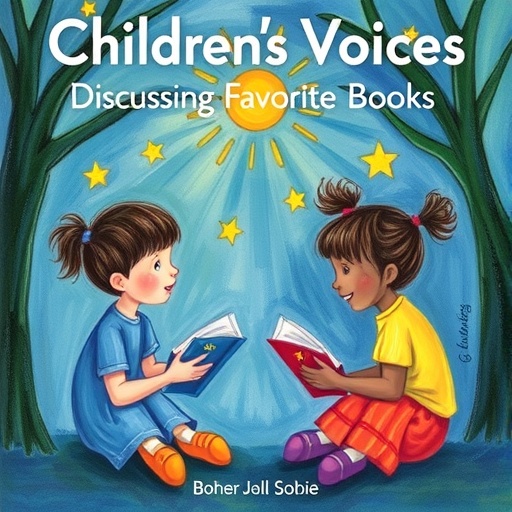
In an intriguing exploration of children’s literary interactions, the forthcoming study titled “Telling Through Pictures: Exploring Children’s Agency in Shared Talk About Favourite Books” by Z.J. Petrová and J. Vašíková delves into the dynamics of shared storytelling and the intrinsic agency children exhibit when engaging with their favorite books. Scheduled for publication in the International Journal of Early Childhood in 2025, this research seeks to unravel the layers of communication, interpretation, and emotional connection that arise in a shared reading context.
The study highlights how conversations about books, particularly when shared among peers or with caregivers, can illuminate a child’s ability to express thoughts, feelings, and ideas. The authors argue that children are not merely passive recipients of stories; rather, they actively negotiate meaning and create narratives of their own through dialogue. This representational act not only fosters deeper comprehension of the content but also encourages cognitive and social development.
Central to this investigation is the concept of agency, which refers to the capacity of children to act independently and make their own choices in the context of storytelling. The researchers employ a qualitative approach, supplemented by observational data collected through various shared reading sessions. This method allows them to capture authentic interactions as children articulate their responses to narratives visually and verbally.
As the researchers sift through the data, they reveal that children’s agency is significantly expressed through the use of illustrations. Illustrations provide a rich medium for young readers to connect with the text, facilitating a deeper understanding of characters and plots. The study articulates how children often reference both text and images during discussions, bridging verbal and visual comprehension as they convey their interpretations.
One essential finding underscores that children respond differently to various types of books, with genres like picture books enabling richer dialogues compared to traditional narrative texts. This is partly due to the interactivity that picture books promote, allowing children to engage actively with both the storyline and the illustrations. The visual elements in these books serve as prompt points for discussion, encouraging questions, comments, and imaginative speculation.
The researchers note a fascinating variance in how gender and cultural backgrounds influence the nature of these discussions. Girls and boys may focus on different aspects of a narrative or prefer different genres altogether, which highlights the need for diverse literary selections in early childhood education. Encouraging children to share their preferences not only bolsters their confidence but also enhances their ability to articulate thoughts based on personal experiences.
Furthermore, the study emphasizes the role of caregivers and educators in facilitating these discussions. The inputs and feedback from adults during conversations about books can shape children’s perceptions and interpretations significantly. Teachers can harness these interactions to promote critical thinking skills by asking open-ended questions and encouraging children to elaborate on their viewpoints.
Equally important is how children’s storytelling contributes to their identity formation. When they share their insights and favorite stories, they are not merely recounting plots; they are constructing a sense of self. The authors suggest that fostering a narrative-rich environment allows children to explore their own identities by relating to characters and situations in their favourite books. Through this lens, reading becomes a profound tool for personal development.
Moreover, the findings reveal that collaboration in storytelling enhances children’s cooperative skills. Working together to interpret a story cultivates a sense of community and mutual respect, vital traits for social interaction. Shared reading experiences can help create bonds, as children learn to listen, negotiate meaning, and appreciate differing perspectives.
In summation, Petrová and Vašíková’s research goes beyond mere literary analysis. It sheds light on a multifaceted process wherein storytelling becomes an interactive, creative adventure that nurtures children’s intellectual and emotional growth. This vital investigation into the realm of children’s literature offers insights that can enrich teaching practices and underscore the importance of relational learning in early childhood.
As the publication date approaches, the anticipation surrounding this research grows, potentially bridging academic discourse and practical application in educational settings. Through its focus on the complex interplay between agency, communication, and storytelling, this study paves the way for further exploration into children’s literature and its transformative potential.
The conversation around children’s interactions with books is broader and increasingly vital in an age where screens often dominate young lives. By championing the significance of shared reading experiences, Petrová and Vašíková’s work not only advocates for access to a diverse range of literature but also highlights the importance of nurturing an environment where children’s voices can flourish. As they continue their research, the impact of their work promises to resonate throughout educational communities, offering new strategies to engage young readers effectively.
Ultimately, this study serves as a clarion call for educators, parents, and scholars alike to recognize the importance of fostering children’s agency in literary discussions, as these practices may hold the key to nurturing the next generation of thoughtful, articulate individuals who can navigate the complexities of literature and, by extension, the world.
Subject of Research: Children’s literary interactions and agency in shared reading contexts.
Article Title: Telling Through Pictures: Exploring Children’s Agency in Shared Talk About Favourite Books
Article References:
Petrová, Z.J., Vašíková, J. Telling Through Pictures: Exploring Children’s Agency in Shared Talk About Favourite Books.
IJEC (2025). https://doi.org/10.1007/s13158-025-00475-9
Image Credits: AI Generated
DOI: https://doi.org/10.1007/s13158-025-00475-9
Keywords: Agency, children’s literature, shared reading, storytelling, education.


