

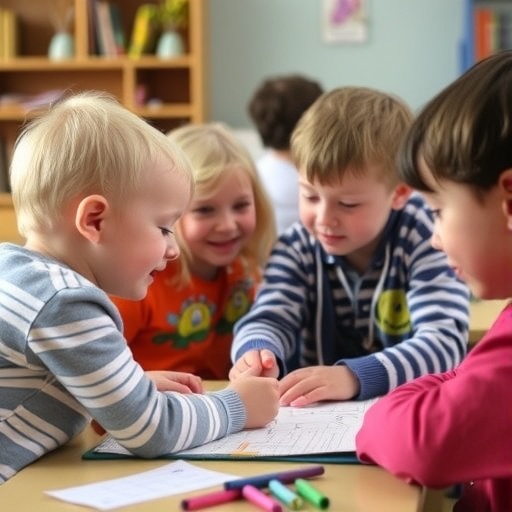
The transformation of early childhood care has become a focal point of educational research in recent years, particularly in contexts like the Czech Republic. A forthcoming study by Bartůsková and Milaniaková explores the efficacy of children’s groups as a pivotal model of early childhood care. This innovative approach is revealing how intentional structuring of children’s interactions can lead to developmental benefits. The research not only provides evidence of the practicality of children’s groups but also aims to challenge traditional paradigms of early childhood education by showcasing a community-based framework that empowers families and fosters collective child-rearing efforts.
The study’s core premise revolves around the notion that communal interactions among children facilitate a richer learning environment. In children’s groups, children engage with their peers in structured yet flexible settings, promoting socialization skills and emotional intelligence. Bartůsková and Milaniaková argue that these groups serve as essential platforms where children can practice social skills such as sharing, cooperation, and conflict resolution. This kind of environment can diminish social anxiety and foster a sense of belonging, all of which are crucial for a child’s holistic development.
Furthermore, the authors conducted an in-depth analysis involving various communities across the Czech Republic to investigate the diverse implementations of children’s groups. The results indicated that communities with active support and dedicated resources saw significantly better outcomes in children’s development. These groups, often led by trained educators, provide a safe and nurturing environment wherein children can explore, learn, and grow together in their formative years. By highlighting the difference in developmental milestones achieved in well-resourced settings compared to those lacking such support, the research emphasizes the need for a national framework that encourages the formation of children’s groups.
Building on the findings, the authors also delve into the psychological benefits that children’s groups offer to both children and parents. From the perspective of parents, these groups present an opportunity for reassurance, as they witness their children thrive in interactions with peers. Additionally, parents are provided with a support network, which can be instrumental in promoting healthy parenting practices. The fostering of community ties through these groups cultivates a shared responsibility for child-rearing, reinforcing the belief that it takes a village to raise a child—even beyond the family unit.
The implications of the research extend to policymakers and educators, urging them to reconsider investments in early childhood education. By confirming that children’s groups can effectively provide tailored learning experiences, the study calls for increased funding and resource allocation to community-based programs. This could potentially result in long-term improvements not just in individual child development but across the education system as a whole. Investing in these groups could lead to better educational outcomes, thus enabling future generations to become more resilient, socially competent adults.
Moreover, the study draws attention to the unique socio-cultural context of the Czech Republic and its implications on childhood education. The authors discuss how historical and cultural narratives have shaped the perception of communal child-rearing practices. In a society that values familial engagement, children’s groups resonate well with existing cultural traditions, thus promoting wider acceptance and participation. The study underscores the importance of aligning educational practices with cultural values to ensure the sustainability of such initiatives.
Through pragmatic case studies, Bartůsková and Milaniaková showcase success stories from various children’s groups, shedding light on innovative practices that have drawn families to participate actively. Testimonials from parents and educators reflect a growing recognition of the vital role these groups play in providing a balanced foundation for children’s growth. The findings suggest that when parents see tangible results in their children’s behavior and social skills, it fosters increased investment in both the process and the structure of early childhood programs.
In discussing the future of children’s groups, the study emphasizes the necessity of continuous evaluation and adaptive methodologies. Bartůsková and Milaniaková advocate for ongoing research to refine and iterate on the models, ensuring they remain relevant and effective. This position is bolstered by the dynamic nature of childhood development, which calls for flexible approaches that evolve alongside changing societal needs and norms.
Ultimately, the study by Bartůsková and Milaniaková enriches the discourse around early childhood care by intertwining research, cultural context, and community action. By framing children’s groups as not just alternatives but as essential components of early childhood education, this research invites stakeholders to visualize a collaborative future for young learners. The authors’ commitment to demonstrating the value of community in raising children is not only timely but essential in the broader discussion of educational equity.
As the findings circulate, they are likely to influence discussions worldwide about how best to structure early childhood education. The conversation initiated by this research could inspire similar investigations in other cultural contexts, compounding the understanding of how children’s groups might function in diverse societies. Furthermore, it challenges educators across the globe to reflect on their practices and consider how collaborative frameworks can lead to more inclusive, effective, and emotionally supportive learning environments for children. The potential ripple effects of this research could significantly alter the landscape of early childhood education, paving the way for models that genuinely reflect the complexities and joys of growing up.
In conclusion, the study conducted by Bartůsková and Milaniaková opens up new pathways for thinking about early childhood care. By spotlighting children’s groups, the research not only presents a compelling case for reform but also illustrates the profound impact of community-based practices on child development. As societies continue to grapple with the challenges posed by modern lifestyles, this innovative approach heralds a return to community-centered solutions, setting a precedent for future educational initiatives.
Subject of Research: Effective forms of early childhood care in the Czech Republic.
Article Title: Children’s Groups as an Effective Form of Early Childhood Care in the Czech Republic.
Article References:
Bartůsková, L., Milaniaková, L. Children’s Groups as an Effective Form of Early Childhood Care in the Czech Republic.
IJEC (2025). https://doi.org/10.1007/s13158-025-00468-8
Image Credits: AI Generated
DOI: https://doi.org/10.1007/s13158-025-00468-8
Keywords: Early Childhood Education, Children’s Groups, Czech Republic, Community-Based Learning, Social Development, Parental Involvement.


