

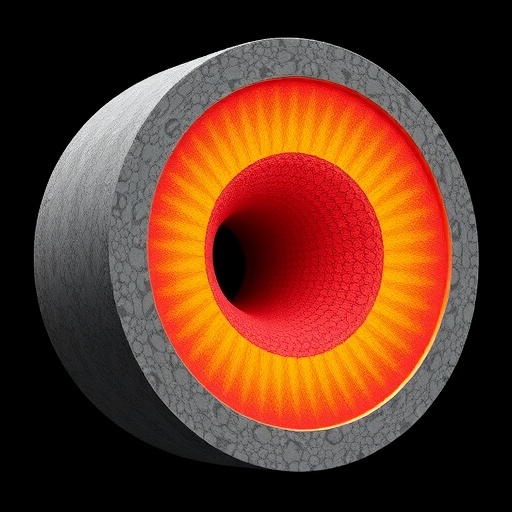
In a groundbreaking study published in Nature Communications, researchers have unveiled a complex and dynamic portrait of Earth’s inner core that challenges longstanding assumptions about its composition and behavior. The team, led by Evgeny Kolesnikov, Xiaoyan Li, and Stefan C. Müller, reveals that the anisotropic properties of the Earth’s inner core vary dramatically with depth and are intricately linked to chemical stratification. This revelation marks a significant leap forward in our understanding of deep Earth processes and the geodynamo—the mechanism generating Earth’s magnetic field.
For decades, Earth scientists have been puzzled by the varying directional dependence, or anisotropy, detected in seismic waves passing through the inner core. Conventional models often treated the inner core as largely homogeneous, but seismic observations suggested a far more nuanced structure. Until now, the underlying cause behind these variations remained elusive. The new research integrates seismic data, laboratory experiments on iron alloys under core-like pressures, and advanced computational modeling to disentangle the relationship between seismic anisotropy and the core’s chemical layering.
The inner core, composed primarily of solid iron alloyed with lighter elements, lies roughly 5,150 kilometers beneath the Earth’s surface. Despite its remoteness, it plays a pivotal role in sustaining the planet’s magnetic field and, by extension, life on Earth. However, studying this domain directly is impossible, so scientists rely on indirect methods like seismic wave analysis and material physics under extreme conditions. This study’s multidisciplinary approach harnesses these methods to decode the inner core’s hidden properties with unprecedented resolution.
One of the study’s most significant findings is the confirmation that the inner core’s anisotropy is not uniform but instead varies significantly from the outermost regions to the deepest interior. The researchers discovered a distinct transition zone, where seismic waves behave quite differently from what is observed near either the center or the periphery of the core. This stratified behavior implies chemical differentiation within the inner core itself, suggesting complex formation and evolution processes previously unaccounted for.
The variation in anisotropy was linked to changes in the crystalline alignment and the presence of light elements such as sulfur, silicon, and oxygen, which are known to affect iron’s physical properties under extreme pressures and temperatures. The study shows that in certain regions, layering leads to preferential alignment of iron crystals, enhancing directional seismic wave speeds. In contrast, other regions exhibit more isotropic behavior, indicative of chemical mixing or different solidification patterns.
This discovery challenges the conventional assumption that the inner core solidifies uniformly from the outer liquid core. Instead, the evidence points toward episodic or layered solidification, where chemical stratification impacts the core’s texture and seismic properties. These findings imply a more dynamic and chemically differentiated inner core evolution than previously modeled, with significant implications for the geodynamo’s stability and variability over geological timescales.
Moreover, the research tools employed represent a leap forward in simulating core conditions. The team used diamond anvil cells capable of generating pressures exceeding those at Earth’s center, combined with synchrotron X-ray diffraction to observe atomic-scale changes in iron alloys mimicking core compositions. Complementing these experiments were state-of-the-art computational models that track the anisotropic behavior of iron under varied chemical environments and thermal gradients, allowing a multi-scale understanding from atomic to planetary scales.
The insights from this research reshape the scientific narrative around Earth’s inner core as a chemically heterogeneous and structurally complex domain, rather than a simple, static iron sphere. Such complexity hints at residual geochemical signatures preserved within the inner core, potentially containing information about Earth’s early differentiation and thermal history. It adds a new dimension to evaluating how the planet has maintained its magnetic field over billions of years.
One intriguing implication relates to geomagnetic reversals and fluctuations. If the inner core’s structure influences the dynamics of fluid iron in the outer core, stratification patterns could affect magnetic field generation and stability. The layered anisotropy might contribute to asymmetric or directional biases in magnetic flux, helping explain some irregularities observed in paleomagnetic records. This connection opens fresh avenues for linking deep Earth processes with surface phenomena.
Furthermore, this improved understanding has ramifications beyond our planet. Many terrestrial planets and moons possess iron-rich cores, and similar principles of anisotropy and chemical stratification could govern their interior dynamics. Insights gained here provide a vital comparative framework for interpreting data from planetary missions exploring bodies like Mars, Mercury, or the Moon, where seismic measurements and magnetic analyses hint at complex core structures.
The study also underscores the indispensable role of interdisciplinary research in Earth sciences. By bridging mineral physics, seismology, geodynamics, and computational modeling, it advances a holistic understanding of inaccessible planetary interiors. Collaborative efforts like these exemplify how technological innovations and theoretical breakthroughs can unravel enigmas hidden beneath thousands of kilometers of solid rock.
While this research marks a significant milestone, it also lays the foundation for future explorations. Questions remain regarding the exact mechanisms driving chemical stratification and the temporal evolution of the inner core’s anisotropy. Upcoming seismological networks, combined with deeper experimental probes and enhanced supercomputing capabilities, will refine these models. As observational precision improves, the potential to decode Earth’s formative processes embedded in its core becomes ever more attainable.
In conclusion, this study by Kolesnikov and colleagues revolutionizes our conceptualization of Earth’s inner core. Moving away from simplistic homogeneous assumptions, it illuminates a dynamic, chemically stratified domain with depth-dependent anisotropic properties. This nuanced view enriches our understanding of core formation, evolution, and its critical role in sustaining Earth’s magnetic shield, ultimately enhancing our grasp of planetary interiors both on Earth and beyond.
The revelations presented here not only excite the scientific community but also capture the imagination of anyone intrigued by the mysteries residing at the center of our planet. As research progresses, the Earth’s inner core continues to emerge as a key to understanding Earth’s past, present, and future—a hidden engine driving processes essential to life’s endurance.
Subject of Research: Earth’s inner core anisotropy and chemical stratification
Article Title: Depth-dependent anisotropy in the Earth’s inner core linked to chemical stratification
Article References:
Kolesnikov, E., Li, X., Müller, S.C. et al. Depth-dependent anisotropy in the Earth’s inner core linked to chemical stratification. Nat Commun 16, 10986 (2025). https://doi.org/10.1038/s41467-025-67067-y
Image Credits: AI Generated


