

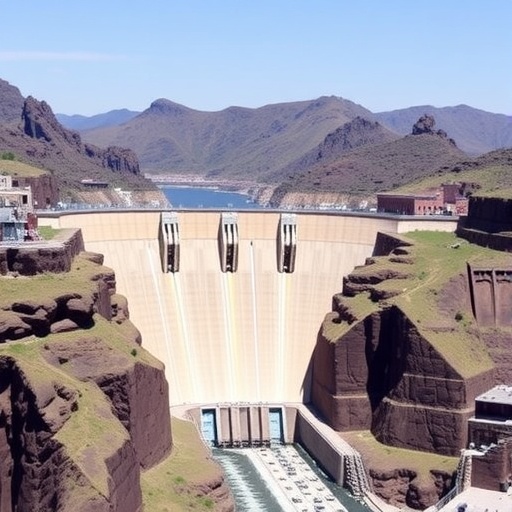
In a groundbreaking peer-reviewed study, Dr. Hesham El-Askary, a distinguished professor of computational and data science at Chapman University, has unveiled significant concerns regarding the structural stability of the saddle dam component of the Grand Ethiopian Renaissance Dam (GERD). This research highlights a series of vulnerabilities that, if left unaddressed, could pose severe risks to millions of people and vast infrastructure across multiple nations downstream. The study, published in the International Journal of Disaster Risk Reduction, signifies a critical call for enhanced transnational monitoring and risk mitigation frameworks.
The Grand Ethiopian Renaissance Dam, a massive hydroelectric project situated on Ethiopia’s Blue Nile River, has long stood as a symbol of energy advancement and regional contention. Despite its strategic importance and engineering achievements, the dam’s saddle structure—the auxiliary dam that integrates with the main body to manage reservoir levels—has come under intense scrutiny due to emerging geotechnical instabilities. El-Askary’s team employed an innovative combination of satellite observations, hydrological modeling, and geospatial analysis to critically evaluate these emerging threats.
Central to the analysis was the detection of extensive groundwater seepage from the reservoir into the surrounding substrata. Utilizing GRACE (Gravity Recovery and Climate Experiment) satellite data, combined with advanced hydrological models, the research estimates that approximately 41 ± 6.2 billion cubic meters of water have seeped into the adjacent groundwater during the reservoir filling phases. This seepage undermines the soil and rock integrity beneath the saddle dam, raising alarm about potential weakening and increased permeability pathways that could compromise dam safety.
Further compounding these concerns are newly identified leakage zones detected via high-resolution satellite imagery. These anomalous water bodies near the dam’s structural perimeter suggest discrete seepage or leakage conduits that were previously unmonitored. Such findings necessitate a rigorous on-site structural evaluation to assess the potential for steady erosion, internal weakening, or progressive failure mechanisms within the dam’s subsurface foundations.
The research team also utilized Persistent Scatterer Interferometry (PSI) techniques—a satellite-based radar approach capable of detecting ground deformation at millimeter scales. PSI analysis revealed differential settlement of up to 40 millimeters in critical segments of the saddle dam. These displacements are indicative of uneven subsurface compaction or deformation, factors often preludes to structural instability in earth dam systems. Sustained movements, even within the millimeter range, can herald future failures if not actively monitored and counteracted.
Associations between dam impoundment and seismic activity were investigated through sophisticated statistical modeling. The data illustrate an uptick in seismic events spatially coinciding with pre-existing fault lines beneath and near the saddle dam. Such reservoir-induced seismicity, while not uncommon in large impoundments, poses heightened risks when faults are actively loaded or lubricated—thus, increasing the chances of triggering more intense earthquake events locally. This interplay complicates the risk profile of the GERD saddle dam and requires further geomechanical analysis.
To quantify potential downstream impacts, the study includes dam-breach flood simulations under various failure scenarios. The models forecast catastrophic inundation depths reaching up to 34.7 meters in downstream floodplains, threatening major population centers and critical infrastructure in Sudan and Egypt. The projected flooding scales underscore the immense humanitarian and economic consequences of a breach, necessitating international cooperation for disaster preparedness and floodplain management.
While the study explicitly stops short of predicting imminent failure, the identification of multiple measurable early warning indicators urges immediate attention. Dr. El-Askary stresses the urgency of instituting transparent, science-based safety evaluations and continuous real-time monitoring systems. The potential for catastrophic loss of life and property, paired with destabilizing regional geopolitics, cannot be underestimated in the absence of these preemptive steps.
Of particular emphasis is the novel integration methodology deployed. By synthesizing satellite-derived datasets—including gravimetric, optical, radar interferometric measurements—and coupling these with hydrological and geophysical models, the research transcends traditional observational limits. This integrative approach provides a comprehensive, multi-disciplinary appraisal of dam health, subsurface water dynamics, and seismic risk profiles over the dam’s geographic extent and temporal evolution.
The broader implications of this research extend beyond the specific case of the GERD saddle dam. It highlights the indispensable need for rigorous monitoring infrastructures for mega-dams globally, particularly those situated in seismically active or hydrologically complex regions. Transparent data-sharing among upstream and downstream nations forming river basins could greatly enhance disaster risk management and reinforce diplomatic trust.
This study importantly shines light on the often-overlooked vulnerability of saddle dams in large hydroelectric projects. While main dams garner majority of technical and political focus, saddle dams frequently serve critical functions yet remain under-monitored. The findings advocate immediate institutional intensification of inspection protocols targeting these secondary but essential components.
In closing, Dr. El-Askary advocates for proactive strategies integrating science, engineering, and policy to mitigate risks associated with large infrastructure projects like the GERD. By embracing comprehensive monitoring and fostering international collaboration, the possibility of devastating dam failures and ensuing humanitarian crises can be substantially diminished, safeguarding millions of lives and securing regional stability in Northeast Africa.
Subject of Research: Structural stability and geohazard risk assessment of the saddle dam at the Grand Ethiopian Renaissance Dam
Article Title: The world’s largest saddle dam at risk: Multisensor geohazard analysis and downstream impacts
News Publication Date: February 24, 2026
Web References:
https://www.sciencedirect.com/science/article/pii/S2212420926000579?via%3Dihub
http://dx.doi.org/10.1016/j.ijdrr.2026.106045
Keywords: Earth systems science, dam stability, groundwater seepage, satellite geospatial analysis, hydrological modeling, reservoir-induced seismicity, dam deformation, flood risk modeling, transnational water infrastructure, geohazard monitoring


