

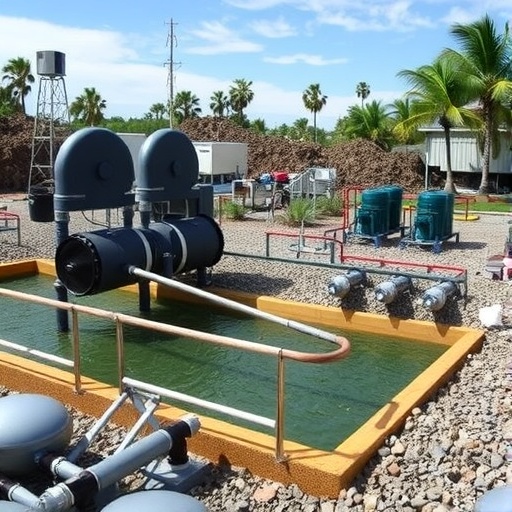
In a groundbreaking study published in “Environmental Science and Pollution Research,” researchers A. Atik Hamoud, F. Boumechhour, and R. de Almeida delve into the complex world of landfill leachate treatment, focusing specifically on the operational challenges associated with a full-scale reverse osmosis (RO) facility in Algeria. This study addresses a critical environmental concern, as landfill leachate, which is a toxic liquid produced when waste decomposes, presents serious challenges to public health and the ecosystem if not properly treated. The research team’s investigations reveal both the performance metrics and the operational hurdles faced in running such a facility, offering insights that could pave the way for advancements in waste management technology globally.
The reverse osmosis process, a vital technology for treating landfill leachate, works by applying pressure to force water through a semi-permeable membrane. This membrane effectively separates contaminants from the water, making it a promising solution for producing safe effluent. However, the authors emphasize that while RO systems are known for their efficacy, deploying them at a full scale brings forth various challenges that need meticulous attention. From feedwater quality fluctuations to membrane fouling, many factors can adversely affect the performance of such facilities.
One of the primary operational challenges discussed is the variability in the composition of landfill leachate. This liquid can contain a cocktail of organic and inorganic contaminants, with concentrations varying significantly over time. The unpredictability makes it difficult for the RO system to maintain stable performance. The researchers note that fluctuations in leachate characteristics can lead to periods of inefficient filtration, requiring continuous monitoring and adjustment of operational parameters to ensure consistent output quality.
Moreover, membrane fouling is frequently cited as a critical issue. The researchers explain that foulants from the leachate, including suspended solids and biological matter, can accumulate on the RO membranes, reducing their efficiency and lifespan. This necessitates regular cleaning and maintenance protocols, which, in turn, increases operational costs and complicates the treatment process. The study illustrates the balance that operators must strike between effective treatment and the economic feasibility of maintaining such facilities.
In addition to membrane fouling, the researchers highlight the role of scaling in jeopardizing the long-term viability of RO systems. Scaling occurs when dissolved minerals in the leachate precipitate and form deposits on the membrane surface, further impairing productivity. The authors propose solutions such as pretreatment processes—like coagulation and sedimentation—that can significantly reduce scaling potential. Implementing these methods can enhance not only the quality of treated effluent but also the overall operational efficiency of the facility.
The research also addresses the necessity of skilled personnel for managing such complex operations. With advanced technologies like RO systems, the requirement for expertise in both chemical processes and mechanical engineering becomes paramount. The authors argue that investing in training and development for operating staff can lead to substantial improvements in performance, highlighting that human factors often play as significant a role as technological ones in the success of such environmental initiatives.
Additionally, the study brings into focus the environmental implications of inefficient leachate management. Untreated or poorly treated leachate can lead to groundwater contamination, posing risks to surrounding ecosystems and human populations. The researchers passionately argue that effective treatment solutions are essential, and while RO is not a panacea, it represents one of the most viable avenues currently available for addressing the leachate problem effectively.
Another aspect explored is the financial challenges associated with operating a full-scale RO facility. The initial capital investment is often substantial, but the researchers point out that ongoing operational costs, including energy consumption and maintenance, can strain budgets. The need for innovative financial models or public-private partnerships is apparent, as such collaborations could enhance resource availability and reduce costs, making leachate treatment more sustainable in the long run.
The implications of the findings suggest that while reverse osmosis offers a path forward for treating landfill leachate, comprehensive planning and adapted technologies are critical for addressing the operational challenges that arise. The study illuminates potential pathways for enhancements, with recommendations for further research into alternative pretreatment methods and membrane technologies that could yield more robust solutions.
Moreover, international collaboration is encouraged, as knowledge sharing among experts in various regions can synergize efforts to improve leachate treatment processes globally. Learning from different operational experiences can lead to the formulation of best practices tailored to specific local conditions, ultimately benefiting both the environment and public health.
As the demand for sustainable waste management practices grows, this research not only sheds light on the complexities of current technologies but also opens avenues for future advancements. The commitment of researchers like Hamoud and his colleagues to push the boundaries of waste management technology underscores the importance of scientific exploration in tackling pressing environmental issues.
In conclusion, the study on the performance and operational challenges of reverse osmosis facilities for landfill leachate treatment presents crucial insights that resonate with current global environmental challenges. The evidence provided by the researchers emphasizes the need for continued innovation, collaboration, and investment in advanced technologies if we are to effectively manage the toxic byproducts of modern waste disposal practices.
Subject of Research: Landfill leachate treatment using reverse osmosis technology.
Article Title: Performance and operational challenges of a full-scale reverse osmosis facility for landfill leachate treatment in Algeria.
Article References:
Atik Hamoud, A., Boumechhour, F., de Almeida, R. et al. Performance and operational challenges of a full-scale reverse osmosis facility for landfill leachate treatment in Algeria.
Environ Sci Pollut Res (2025). https://doi.org/10.1007/s11356-025-37272-9
Image Credits: AI Generated
DOI: https://doi.org/10.1007/s11356-025-37272-9
Keywords: Reverse osmosis, landfill leachate, wastewater treatment, membrane fouling, scalability, environmental impact, innovative technology.


