

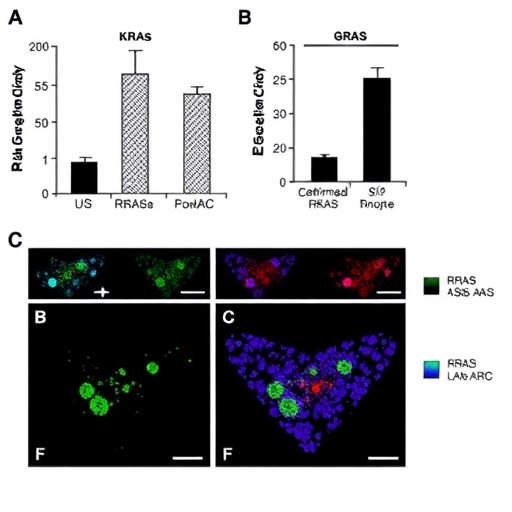
In a groundbreaking study published in 2026, researchers have unveiled a promising therapeutic strategy for combating one of the most aggressive forms of lung cancer. The study focuses on the synergistic effects of combining cetuximab with newly developed KRAS G12C inhibitors, specifically fulzerasib and sotorasib, in targeting non-small cell lung cancer (NSCLC) cells harboring the KRAS G12C mutation. This discovery offers renewed hope for patients suffering from this mutation-driven malignancy, historically regarded as difficult to treat with conventional therapies.
KRAS mutations represent a notorious challenge in oncology, often associated with poor prognosis due to their role in driving unchecked cellular proliferation. Among these, the G12C mutation is particularly prevalent in NSCLC, accounting for approximately 13% of cases. Until recently, direct targeting of mutant KRAS proteins was deemed nearly impossible, relegating patients to limited options such as chemotherapy and immune checkpoint inhibitors with varying degrees of success. The advent of KRAS G12C inhibitors marked a pivotal change, but monotherapies frequently encounter resistance mechanisms that limit their efficacy over time.
The current investigation explores the co-administration of cetuximab, an epidermal growth factor receptor (EGFR) inhibitor, alongside fulzerasib and sotorasib, both cutting-edge inhibitors designed to specifically and irreversibly target the KRAS G12C mutant protein. Cetuximab’s role in modulating EGFR signaling pathways complements the disruption of mutant KRAS activity, potentially overcoming traditional resistance pathways and amplifying antitumor responses. This dual blockade aims to dismantle the intricate signaling networks that facilitate tumor survival and proliferation.
Methodologically, the research team employed a variety of in vitro assays on human NSCLC cell lines known to express the KRAS G12C mutation. These experiments meticulously evaluated cell viability, apoptosis induction, and signaling cascade alterations in response to single-agent treatments versus combination therapy. Techniques including western blotting, flow cytometry, and real-time PCR were utilized to dissect molecular changes at the protein and transcript levels, offering mechanistic insights into the observed phenotypic effects.
Results indicated a striking enhancement in growth inhibition and apoptotic activity when cetuximab was combined with either fulzerasib or sotorasib, compared to monotherapy controls. Notably, the combination therapies suppressed downstream signaling effectors such as ERK and AKT more robustly than single-agent treatments. This finding suggests a more comprehensive shutdown of oncogenic pathways crucial for tumor cell survival. Furthermore, the data highlight how cetuximab-mediated blockade of EGFR limits compensatory feedback loops that typically re-activate KRAS signaling after inhibitor treatment.
Importantly, the dual treatment did not significantly increase cytotoxicity in non-cancerous control cells, indicating a degree of therapeutic selectivity. The preservation of healthy cell viability is critical for minimizing adverse side effects that often compromise patient quality of life during aggressive cancer regimens. This therapeutic window underscores the translational potential of the combination strategy for clinical applications.
The study further delves into the mechanisms underlying resistance to KRAS G12C inhibitors. It is well known that feedback activation of upstream receptors such as EGFR can accelerate bypass signaling, diminishing drug potency. The incorporation of cetuximab appears to preemptively inhibit these escape routes, thereby sustaining the inhibitory pressure on malignant cells and delaying resistance onset. This dual inhibition paradigm could reshape the standard of care for patients harboring KRAS mutations.
Beyond the molecular intricacies, the research holds substantial clinical implications. KRAS G12C inhibitors, though revolutionary, have had limited response durability. The innovative use of cetuximab could extend progression-free survival and overall survival rates, particularly in NSCLC patients with restricted therapeutic options. This study paves the way for upcoming clinical trials to validate safety, efficacy, and dosing schedules for combinational regimens in diverse patient populations.
The findings also open avenues for precision oncology, emphasizing the need to tailor treatments based on tumor genetic profiling. By integrating targeted therapies against multiple oncogenic nodes, clinicians may better navigate tumor heterogeneity and adaptive resistance. The study exemplifies how a molecularly informed therapeutic approach enhances content precision and response rates beyond the capabilities of monotherapy.
Challenges persist, including optimizing dose combinations to balance efficacious tumor suppression with manageable toxicities. Future investigations will need to assess long-term effects, potential immune modulation, and quality of life outcomes in clinical scenarios. Moreover, resistance mechanisms not addressed by EGFR blockade may emerge, necessitating continuous innovation and comprehensive biomarker discovery.
The implications extend to other KRAS-driven cancers, such as pancreatic and colorectal malignancies, where cetuximab and KRAS inhibitors could be adapted and tested. The universal challenge of targeting RAS oncogenes has plagued oncology for decades; this research marks a significant step toward conquering that barrier through strategic drug pairing.
In a broader sense, this study reflects the power of combining established monoclonal antibodies with next-generation small molecules to unlock new therapeutic vistas. It demonstrates that revisiting older drugs like cetuximab under new combinations and contexts can profoundly influence outcomes. Such reassessment is vital as oncology embraces the era of targeted precision medicine.
Ultimately, the scientific community eagerly anticipates extending these promising preclinical results into clinical development phases. Should subsequent studies confirm these effects in patients, the combination of cetuximab with fulzerasib and sotorasib may redefine the treatment landscape for KRAS G12C-mutant NSCLC, transforming therapeutic resistance into manageable disease control.
As oncology continues its rapid evolution, breakthroughs such as this fuel optimism that previously intractable genetic mutations will soon be met with equally sophisticated treatment strategies. This study’s contribution underlines the necessity of exploring innovative drug synergies to overcome cancer’s adaptability and secure lasting remission for patients worldwide.
Subject of Research: Combination therapy using cetuximab with KRAS G12C inhibitors (fulzerasib and sotorasib) in human KRAS G12C non-small cell lung cancer cells.
Article Title: Cetuximab co-treatment with KRAS G12C inhibitors fulzerasib and sotorasib in human KRAS G12C non-small cell lung cancer cells.
Article References:
Olmo-González, D., Zhou, M., Oliveira, N.G. et al. Cetuximab co-treatment with KRAS G12C inhibitors fulzerasib and sotorasib in human KRAS G12C non-small cell lung cancer cells. Cell Death Discov. (2026). https://doi.org/10.1038/s41420-026-02998-z
Image Credits: AI Generated


