

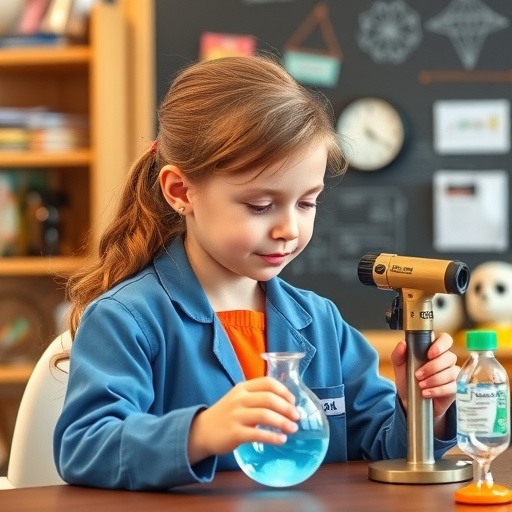
In a groundbreaking study set to be published in the esteemed Early Childhood Educator Journal, researchers Serrano, Gallego, and Alfaya explore a pivotal yet often overlooked aspect of early childhood education: the influence and talents of female scientists. As the world strives for gender equity in numerous sectors, including science, technology, engineering, and mathematics (STEM), the early developmental phase of children emerges as a crucial period for shaping interests and aspirations. This research intricately weaves together compelling narratives of female scientists to inspire the younger generation, a powerful strategy for igniting passion and curiosity in budding minds.
The study presents a richly detailed analysis of how children’s perceptions of science and scientists can be molded through stories and encounters with female role models. By emphasizing the lived experiences and achievements of female scientists, the researchers argue that children are more likely to envision themselves in these roles. This psychological and societal framing opens up new avenues for thinking about how we introduce scientific concepts to young children, aiming not just for educational attainment but also for representation and inspiration.
Significantly, the researchers delve into the methodology behind selecting the profiles of female scientists featured in the study. They employed qualitative methods, including interviews and observational studies, to gather rich narratives and experiences that reflect both personal and professional challenges. This serves to humanize female scientists, moving beyond mere statistical representation to foster relatable and achievable aspirations among young girls. The idea is to present a diverse array of scientific careers, challenging stereotypes that may deter young females from pursuing science.
Moreover, the findings revealed profound insights into children’s attitudes toward science when they are exposed to diverse role models. Discussions highlighted a notable difference in engagement levels between boys and girls when female scientists were presented as part of the curriculum. This implies that representation matters significantly, fostering an inclusive environment where every child feels capable of pursuing a career in science, irrespective of gender.
As the study further unfolds, it emphasizes the necessity for educators to integrate more stories of female scientists into their teaching practices. This integration is not merely a call for additional content but recommends a comprehensive re-evaluation of curricular frameworks. It encourages educators to adopt a narrative-based approach, transforming scientific discourse into a relatable and inspiring journey. By doing so, the research underlines that education should not just focus on facts and figures but should also cultivate an emotional connection to the subjects being taught.
The researchers discuss the implications of these findings for policy-makers and educational institutions. The urgency to implement gender-sensitive educational policies is accentuated, aiming at creating a balanced representation within teaching materials. This study potentially serves as a catalyst for rethinking how curricula can be more inclusive of diverse role models. By advocating for change at the institutional level, the researchers aim to create a ripple effect that benefits the next generation of aspiring scientists.
In examining existing educational resources, the researchers discovered a notable gap in representation. Textbooks and teaching materials predominantly feature male scientists, which may unconsciously instill a sense of inadequacy or unworthiness among young girls. This realization propels their argument for immediate curriculum reforms that include stories of female scientists from various backgrounds, sectors, and specialties, ensuring that every child can identify with the incredible possibilities a career in science offers.
Additionally, the emotional and psychological ramifications of representation are evaluated. The study posits that children need to see women succeeding in science not just as a statistical anomaly but as an everyday reality. When children see diverse role models, they are more likely to believe in their own potential and capability. This is crucial at the formative stages of a child’s education, where aspirations are born, cultivated, and either nurtured or stifled.
The multivariate nature of this research provides the foundation for future explorations on gender representation in educational settings. Subsequent studies may follow to quantitatively measure the direct impact of narrative-based learning on children’s aspirations towards STEM fields. As society inches closer to achieving gender equality in various sectors, the interplay between education, role models, and children’s aspirations cannot be understated; this research underscores that reality in striking detail.
Ultimately, the work by Serrano and colleagues serves as a wake-up call for educators and advocates alike. As we move further into a knowledge-based economy, the importance of understanding and promoting gender equity in all fields remains paramount. The contributions made through the lens of female scientists are not merely necessary but vital in building a future where every child can dream big, irrespective of gender stereotypes or societal barriers.
Collaboratively, this research advocates for a paradigm shift in early childhood education—where the narratives of female scientists are infused into the curriculum, inspiring the next generation. Drawing on storytelling, representation, and real-life achievements, this initiative encapsulates a comprehensive approach to fostering an inclusive science culture. By advocating for this shift, the researchers hope to empower children, particularly young girls, to envision and ultimately pursue careers in STEM, fulfilling the potential that even the youngest minds hold.
The collective stories of female scientists woven throughout this study shine a light on diverse pathways and accomplishments, making science more relatable. By harnessing the power of storytelling in science education, the implications of such research stretch beyond classroom walls, embedding within broader societal norms and attitudes towards women in STEM. As we look to the future, ensuring that children’s aspirations are informed by diverse and inspiring role models stands as a fundamental step toward achieving gender equity in the sciences.
In conclusion, the research conducted by Serrano and her colleagues promises to reshape the educational landscape by embracing a holistic understanding of how children learn about science. By intertwining personal stories and experiences with educational content, they are facilitating a revolutionary approach that can inspire the next generation of scientists and innovators. Greater visibility of female scientists in education not only enriches the learning experience but also builds a more hopeful, inclusive future where everyone can thrive in the scientific community.
Subject of Research: The Influence of Female Scientists on Early Childhood Education
Article Title: Learning From the Talents of Female Scientists in Early Childhood
Article References:
Serrano, R.M., Gallego, A.J., Alfaya, E.G. et al. Learning From the Talents of Female Scientists in Early Childhood.
Early Childhood Educ J (2026). https://doi.org/10.1007/s10643-025-02083-7
Image Credits: AI Generated
DOI: https://doi.org/10.1007/s10643-025-02083-7
Keywords: early childhood education, female scientists, representation, gender equity, STEM, educational policy


