

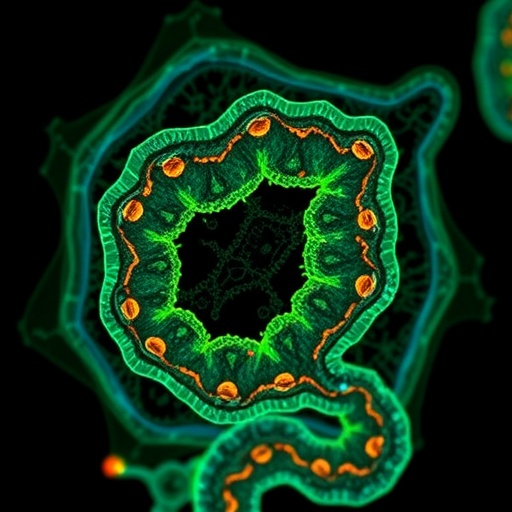
In a groundbreaking study published in Nature Communications in 2026, Lin, Liu, Hsu, and colleagues have unveiled novel insights into the molecular mechanisms governing intestinal homeostasis. Their work highlights the critical role of CBP phosphorylation in maintaining the stem cell niche, with particular emphasis on its interaction with versican, a pivotal extracellular matrix proteoglycan. This discovery not only advances our understanding of intestinal biology but also opens exciting new avenues for therapeutic interventions targeting gastrointestinal disorders.
The intestinal epithelium is a marvel of continual self-renewal, turning over every few days to maintain barrier function and facilitate nutrient absorption. This relentless regeneration hinges on the delicate balance and support of a specialized stem cell niche located at the crypt base. The niche not only nurtures stem cells but also orchestrates their proliferation and differentiation in response to physiological cues. Despite extensive research, the intricate molecular frameworks that stabilize this niche remain incompletely understood—until now.
Central to this study is the transcriptional coactivator CREB-binding protein (CBP), a multifunctional regulator implicated in chromatin remodeling and gene expression. Lin et al. have revealed that phosphorylation of CBP acts as a crucial molecular switch that maintains intestinal homeostasis. Phosphorylated CBP regulates the extracellular microenvironment of the stem cell niche by modulating the expression and deposition of versican, a large chondroitin sulfate proteoglycan. Versican’s role as a versatile matrix component is well-established; however, its direct linkage to stem cell niche integrity had remained elusive prior to this investigation.
Employing sophisticated genetic and biochemical approaches, the researchers identified that loss of CBP phosphorylation disrupted versican synthesis and assembly, resulting in compromised structural support within the stem cell niche. This defect precipitated aberrant stem cell function and impaired intestinal regeneration, underscoring the indispensability of this post-translational modification. The authors demonstrated that phosphorylated CBP interfaces with key transcriptional regulators to fine-tune versican gene expression, thereby modulating the niche environment in a manner conducive to stem cell maintenance.
This intricate interplay between phosphorylation-mediated CBP activity and extracellular matrix remodeling provides a paradigm shift in how we conceptualize stem cell niche regulation. The findings suggest that cellular signaling cascades impact not merely intracellular gene expression but also extracellular matrix composition to sustain tissue homeostasis. In the context of the intestinal stem cell niche, versican emerges as a crucial scaffold that sustains cellular dynamics and niche resilience.
Intriguingly, the study also reveals that the phosphorylation state of CBP integrates diverse environmental signals, including inflammatory stimuli and metabolic status, to adjust niche properties adaptively. Such plasticity of the stem cell niche ensures its capacity to respond appropriately to physiological stressors, injury, and microbial challenges. These insights deepen our grasp of the intestine’s remarkable regenerative capabilities and provide a molecular foothold for future manipulation of these processes.
The broader implications of this research extend beyond basic biology. Given the integral role of the intestinal barrier in human health and disease, therapeutic strategies that modulate CBP phosphorylation or versican expression may hold promise in treating inflammatory bowel disease, colorectal cancer, and other gastrointestinal pathologies. By restoring or enhancing niche homeostasis, it may be possible to promote mucosal healing and impede disease progression.
Methodologically, the team utilized a combination of in vivo mouse models with targeted mutations, organoid cultures, and advanced proteomics to delineate the CBP-versican axis. Phosphosite-specific antibodies and chromatin immunoprecipitation sequencing (ChIP-seq) revealed the downstream targets and transcriptional networks modulated by phosphorylated CBP. Versican’s distribution within the niche was visualized through high-resolution immunofluorescence microscopy, revealing how matrix architecture correlates with stem cell localization and function.
Their data also indicate that aberrant CBP phosphorylation dynamics may be an early hallmark of intestinal dysregulation, preceding overt pathological manifestations. This suggests potential utility for phosphorylation status as a biomarker in clinical diagnostics. Moreover, pharmacological agents capable of modulating CBP activity may represent a new class of regenerative medicine tools, enabling precision control of intestinal epithelial turnover.
The discovery challenges previous assumptions that transcriptional coactivators operate exclusively within the nucleus, unveiling a vital connection between nuclear signaling events and extracellular matrix maintenance. This multi-compartmental regulation introduces a new conceptual framework for understanding tissue homeostasis, highlighting the necessity of coordinated intracellular and extracellular mechanisms.
Importantly, the research contributes to the rapidly evolving field of stem cell niche biology by pinpointing versican not only as a structural molecule but also as a dynamic effector modulated by intracellular signaling pathways. This adds another layer of complexity to the niche microenvironment, integrating biochemical signals with mechanical and spatial factors that collectively govern stem cell fate decisions.
Lin and colleagues’ findings also resonate with emerging concepts in cancer biology, where alterations in the stem cell niche and extracellular matrix remodeling drive tumorigenesis and metastasis. Understanding how CBP phosphorylation influences versican distribution may illuminate novel targets for disrupting malignant niche remodeling and improving therapeutic outcomes.
Future research building on these findings will likely explore the temporal and spatial dynamics of CBP phosphorylation during physiological and pathological processes. Additionally, deciphering how interacting partners of CBP coordinate with other signaling modules to regulate extracellular matrix components will be pivotal. Such endeavors promise to enrich our molecular lexicon of stem cell niche regulation and tissue integrity.
In conclusion, this landmark study sets a new standard for dissecting the molecular crosstalk that sustains intestinal stem cell niches and preserves tissue equilibrium. By illuminating the central role of CBP phosphorylation in orchestrating extracellular matrix composition through versican, Lin et al. provide an essential blueprint for unraveling complex biological systems. Their work stands as a testament to the power of integrative molecular biology in solving fundamental questions with wide-ranging implications for health and disease.
Subject of Research: Intestinal stem cell niche regulation through post-translational modification of transcriptional coactivators affecting extracellular matrix composition.
Article Title: CBP phosphorylation maintains intestinal homeostasis by supporting the stem cell niche through versican.
Article References: Lin, YT., Liu, C., Hsu, YH. et al. CBP phosphorylation maintains intestinal homeostasis by supporting the stem cell niche through versican. Nat Commun (2026). https://doi.org/10.1038/s41467-026-71083-x
DOI: 10.1038/s41467-026-71083-x
Keywords: CBP phosphorylation, intestinal homeostasis, stem cell niche, versican, extracellular matrix, transcriptional regulation, intestinal regeneration, post-translational modification, epithelial biology, tissue remodeling
Image Credits: AI Generated


