


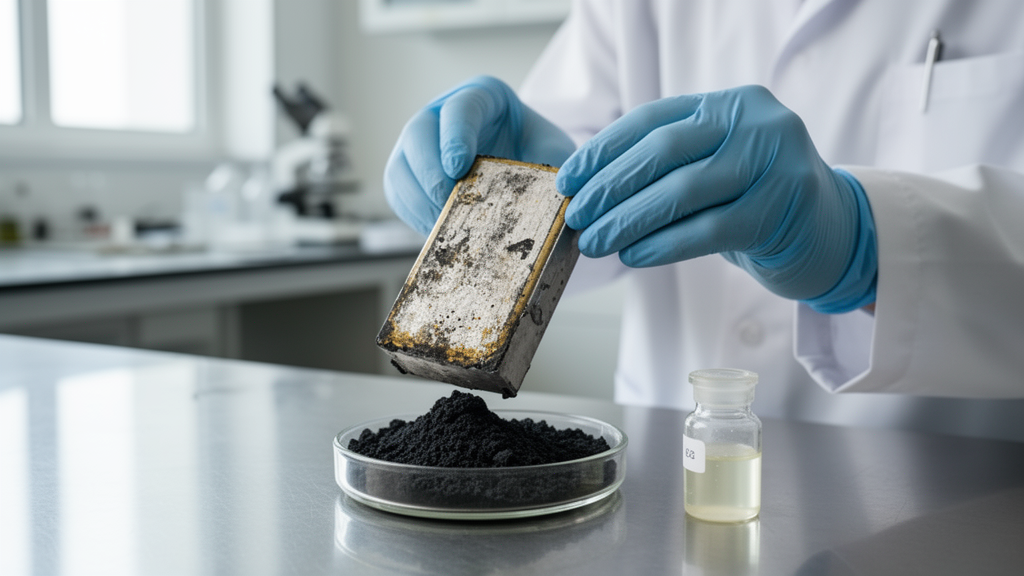
Every year, millions of lithium iron phosphate (LFP) batteries retire from electric vehicles and grid-scale energy storage installations, and their fate has become one of the most pressing questions in the battery world. Unlike cobalt- and nickel-rich chemistries, LFP contains only iron, phosphorus, and lithium, so the economic incentive to shred it and recover raw elements is thin. The real value lies in the carefully engineered cathode powder itself, which is why a growing community of researchers is trying to repair degraded LFP rather than dissolve it. A new study from Jilin Jianzhu University and Northeast Electric Power University in China, published in the journal Ionics, now reports a surprisingly simple repair recipe: a small dose of manganese dioxide, a hydrothermal bath, and a pinch of sugar are enough to bring spent LFP cathodes back to life.
The problem the team set out to solve is structural. During years of charging and discharging, LFP cathodes lose lithium ions, and the crystal lattice degrades toward iron phosphate, which is electrochemically inert in this context. Conventional recycling approaches, whether pyrometallurgical smelting or hydrometallurgical acid leaching, are energy-hungry and often fail to restore the degraded cathode structure; they break the material down and rebuild it from scratch, consuming large amounts of heat, chemicals, and water. Direct regeneration, by contrast, aims to replenish the missing lithium and heal the lattice while keeping the original particle morphology intact, which preserves much of the embodied energy and manufacturing value of the cathode powder.
The Chinese team’s strategy is a low-dose MnO₂-assisted hydrothermal process. They used lithium phosphate (Li₃PO₄) as the lithium source, glucose as the reductant, and a small amount of manganese dioxide as a catalytic promoter. The spent cathode material is immersed in this reaction medium and treated hydrothermally, allowing lithium to re-enter the degraded lattice under relatively mild conditions. A subsequent annealing step completes the reconstruction of the olivine LFP structure. The choice of MnO₂ is intriguing because manganese dioxide is a well-known heterogeneous catalyst in fields ranging from air cathodes to ozonation and organic oxidation reactions, but its role in battery relithiation chemistry had not been explored in this way before.
The results are impressive for such a simple process. Under optimized conditions, the regenerated LFP achieved a Li/Fe molar ratio of 0.98, very close to the stoichiometric ideal of 1.0, indicating that lithium replenishment was nearly complete. The recovered material delivered a discharge capacity of 142.3 mAh g⁻¹ at 0.2 C, which approaches the theoretical capacity of LFP, and maintained stable cycling performance over 200 cycles at 0.2 C. Electrochemical impedance spectroscopy revealed a charge-transfer resistance of 87.35 Ω, suggesting that the regenerated cathode surface and particle interfaces were restored to a state that supports efficient lithium-ion transport and electron transfer during battery operation.
What makes the MnO₂ addition so effective? The authors describe its role as catalytic-promoting, based on combined structural, surface-chemical, and electrochemical evidence, although they candidly acknowledge that the detailed reaction pathway requires further investigation. One plausible picture is that MnO₂ participates in the redox chemistry of the hydrothermal system, facilitating the transfer of lithium from the Li₃PO₄ source into the iron phosphate framework while glucose serves as the reductant that maintains favorable oxidation states. Manganese dioxide is known to mediate electron transfer and oxygen-related redox reactions in aqueous environments, and similar mediation chemistry has been shown to enable low-temperature hydrothermal relithiation in other cathode recycling studies. The exact mechanism in this LFP system, however, remains an open question that the team flags for future work.
The significance of this approach becomes clear when compared with the broader landscape of LFP recycling. Recent reviews describe a spectrum of direct regeneration technologies, including solid-state annealing, molten salt relithiation, electrochemical relithiation, ultrasonic methods, and redox-mediated hydrothermal processes. Each has advantages and limitations in terms of temperature, processing time, chemical consumption, and scalability. The hydrothermal route is attractive because it operates at moderate temperatures and in an aqueous medium, avoiding the extreme heat of solid-state methods and the aggressive acids of leaching routes. The use of Li₃PO₄ as the lithium source is notable because it is a relatively benign, phosphate-based compound that matches the anion chemistry of the cathode itself, and glucose is an inexpensive, renewable reductant.
The environmental case for direct regeneration of LFP is compelling. LFP batteries contain no cobalt or nickel, so the traditional economic drivers for recycling are weak, and yet the volume of retiring LFP packs is enormous and growing. If degraded cathode powder can be repaired rather than broken down, the energy and chemical inputs per kilogram of recovered cathode drop substantially, and the carbon footprint of new battery production falls accordingly. Direct regeneration also avoids the generation of mixed metal sulfate streams and wastewater that characterize hydrometallurgical routes, and it preserves the particle morphology and carbon coating that manufacturers spent considerable effort optimizing in the first place.
Challenges remain before this chemistry can leave the laboratory. The study was conducted on spent cathode materials under controlled conditions, and real-world recycling streams contain impurities, mixed chemistries, aluminum and copper foils, electrolyte residues, and binder contaminants that complicate any regeneration process. The authors themselves note that the catalytic role of MnO₂, while supported by evidence, is not yet fully understood at the mechanistic level, and understanding it could unlock further improvements in efficiency and dose reduction. Scaling hydrothermal reactors to industrial throughput, ensuring uniform treatment of ton-scale cathode powder, and integrating the process with upstream sorting and downstream electrode fabrication are all engineering hurdles that must be addressed.
Nevertheless, the work adds an important piece to the puzzle of sustainable LFP recycling. It demonstrates that a catalytic promoter, even at low dose, can meaningfully enhance a direct regeneration process, and it provides a feasible route for restoring spent LFP cathode materials with performance approaching that of virgin material. As the volume of retiring LFP batteries from electric vehicles and energy storage systems continues to climb, approaches like this one, which repair rather than destroy, will be essential to closing the loop on battery materials. The vision of a circular battery economy, in which end-of-life packs become feedstock for new ones with minimal energy loss and environmental burden, moves one step closer with each such advance in direct regeneration chemistry.
Subject of Research: MnO₂-assisted hydrothermal regeneration of spent LiFePO₄ cathode materials for sustainable lithium-ion battery recyclingAuthors:
Article Title: MnO₂-assisted hydrothermal regeneration of spent LiFePO₄ cathode materials for sustainable lithium-ion battery recyclingAuthors:
Article References: Wu, Y., Chi, M., Bai, L., Tuo, J., Li, S., Song, X., Zhang, C., Qiao, J., Li, J., & Wang, B. (2026). MnO₂-assisted hydrothermal regeneration of spent LiFePO₄ cathode materials for sustainable lithium-ion battery recyclingAuthors:. Ionics. https://doi.org/10.1007/s11581-026-07584-y
Image Credits: AI Generated
DOI: 10.1007/s11581-026-07584-y
Keywords: assisted, hydrothermal, regeneration, spent, LiFePO, cathode, materials, sustainable, lithium-ion, battery, recyclingAuthors, scientific research
Cite Scienmag News
Bethany Barker. (October 17, 2026). Catalyst Trick Repairs Worn LiFePO₄ Batteries at Low Cost. Scienmag. https://scienmag.com/catalyst-trick-repairs-worn-lifepo%e2%82%84-batteries-at-low-cost/
Bethany Barker. "Catalyst Trick Repairs Worn LiFePO₄ Batteries at Low Cost." Scienmag, 17 October 2026, https://scienmag.com/catalyst-trick-repairs-worn-lifepo%e2%82%84-batteries-at-low-cost/. Accessed 17 October 2026.
Bethany Barker. "Catalyst Trick Repairs Worn LiFePO₄ Batteries at Low Cost." Scienmag. October 17, 2026. https://scienmag.com/catalyst-trick-repairs-worn-lifepo%e2%82%84-batteries-at-low-cost/


