

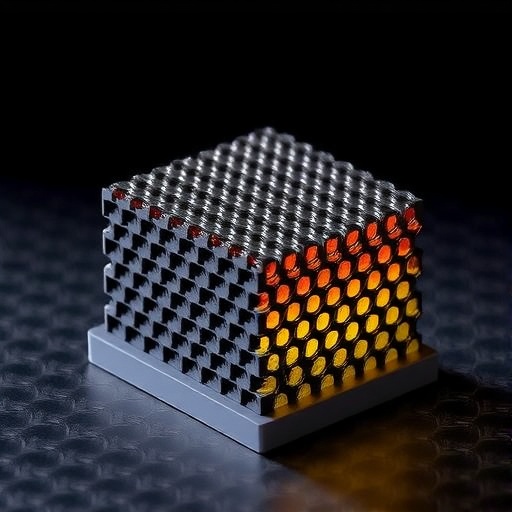
In the ever-evolving landscape of energy storage technologies, sodium-ion batteries have emerged as promising candidates to replace their lithium counterparts, primarily due to the abundance and low cost of sodium. A recent groundbreaking study published in the journal Ionics highlights significant advancements in the performance and longevity of sodium-ion battery cathodes. Researchers, including Song, Liu, and Liu, delve into the development of a multi-morphological carbon cross-linked composite that greatly enhances the high-rate performance and ultra-long cycling stability of the Na3Fe2(PO4)(P2O7) cathode.
At the core of this innovative research is the critical need for sustainable and efficient energy storage solutions. As the demand for renewable energy sources like solar and wind power increases, so does the necessity for robust battery systems capable of quick charging and long-lasting energy provision. The study sheds light on the Na3Fe2(PO4)(P2O7) cathode, which has garnered attention for its promising electrochemical properties, specifically when paired with advanced carbon composites. This novel composite provides a unique structure that effectively enhances electron and ion transport, crucial for maximizing battery performance.
Traditionally, lithium-ion batteries have dominated the market, although they are not without their limitations, such as high costs, resource scarcity, and environmental concerns. This new research elucidates how multi-morphological carbon cross-linked composites can leverage the benefits of sodium ions. The multi-morphological aspect of the composite refers to its capability of showcasing different structural forms, which play a pivotal role in optimizing the electrochemical performance of the Na3Fe2(PO4)(P2O7) cathode.
The researchers meticulously designed the carbon framework to provide an interconnected network that facilitates rapid movement of sodium ions during charge and discharge cycles. This interconnectedness ensures a reduction in the overall internal resistance of the battery, a critical factor for improving high-rate discharge capabilities. Notably, the research indicates that the enhanced conductivity achieved through this novel composite leads to superior rate performance, enabling the battery to operate effectively even under high load conditions.
Cycle stability is another paramount concern in the development of batteries. The team’s findings reveal that the carbon cross-linked composite significantly improves the cycling stability of the Na3Fe2(PO4)(P2O7) cathode, showing a remarkable retention rate over extended periods. Long cycling stability indicates that the transformation processes occurring within the cathode materials during repeated expansion and contraction are mitigated, thus prolonging the battery’s lifespan.
Furthermore, the researchers employed advanced characterization techniques to analyze the structural integrity and electrochemical properties of the developed composite. Techniques such as scanning electron microscopy (SEM) allowed for the visualization of the composite’s microstructure, thereby confirming the successful incorporation of multiple morphologies within the carbon framework. The insights gained from these analyses underscore the structural advantages that directly correlate to the observed high-rate performance and cycling stability.
Another significant benefit of using the multi-morphological carbon cross-linked composite is its environmental impact. Sodium resources are widely available, contrasting sharply with lithium, cobalt, and nickel, which are often tied to ethical and ecological concerns. Therefore, the innovations presented in this research represent a step toward more sustainable battery technology, meeting not only performance criteria but also addressing critical environmental challenges.
The research team emphasizes the potential scalability of their findings. As the desire for cleaner energy systems grows, the implications of this study could lead to large-scale production and deployment of sodium-ion batteries equipped with advanced cathodes. This scalability is crucial for utilizing the developed technologies in real-world applications, such as electric vehicles and renewable energy storage systems.
Moreover, the study draws attention to the growing landscape of energy storage solutions, where sodium-ion technology could play a pivotal role across various industries. With the ability to deliver high energy density, coupled with the affordability of raw materials, sodium-ion batteries stand to revolutionize how energy is stored and utilized, potentially rendering them as vital players in a sustainable energy future.
While the highlighted advancements are promising, further research is critical to understanding and addressing the challenges that remain. For instance, optimizing the anode material in conjunction with the Na3Fe2(PO4)(P2O7) cathode could create opportunities for even greater efficiency and capacity. Continuous advancements in materials science and chemistry will be vital to unlocking the full potential of sodium-ion batteries.
In conclusion, this innovative research marks a significant milestone in battery technology, showcasing the multi-morphological carbon cross-linked composite’s ability to enhance the performance characteristics of sodium-ion battery cathodes substantially. With unprecedented improvements in high-rate capabilities and ultra-long cycling stability, the research holds promise for paving the way toward a more sustainable, efficient, and reliable future for energy storage systems.
As the race for alternative battery technologies accelerates, this study is a beacon of hope for engineers and researchers alike, indicating that the journey toward sustainable and efficient sodium-ion batteries may be well within reach, thanks to the synergy of multi-morphological structures and innovative materials design.
Subject of Research: Enhancement of sodium-ion battery cathodes through multi-morphological carbon cross-linked composites.
Article Title: Multi-morphological carbon cross-linked composite enhances the high-rate performance and ultra-long cycling stability of Na3Fe2(PO4)(P2O7) cathode.
Article References: Song, H., Liu, K., Liu, Y. et al. Multi-morphological carbon cross-linked composite enhances the high-rate performance and ultra-long cycling stability of Na3Fe2(PO4)(P2O7) cathode. Ionics (2026). https://doi.org/10.1007/s11581-025-06938-2
Image Credits: AI Generated
DOI: 12 January 2026
Keywords: Sodium-ion battery, Na3Fe2(PO4)(P2O7), multi-morphological composite, high-rate performance, cycling stability, energy storage technology.


