

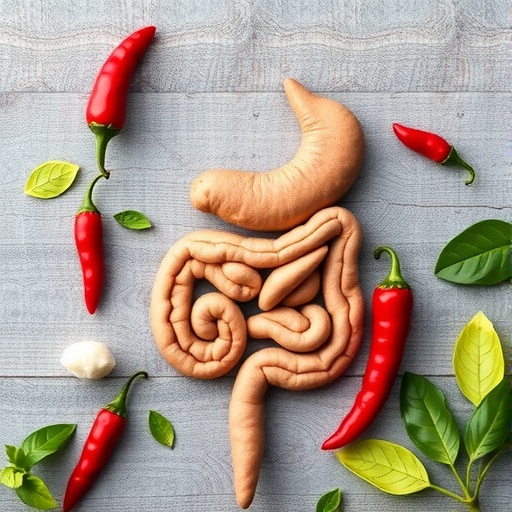
In an intriguing new study published in Nature Communications, researchers Wang, Wu, Yuan, and colleagues unveil a groundbreaking connection between dietary capsaicin and the pathophysiology underlying idiopathic short stature (ISS). This research elucidates the profound impact of capsaicin—a bioactive compound famously responsible for the heat in chili peppers—on gut inflammation and its downstream molecular mechanisms involving exosomal microRNA, notably miR-17-3p. Their findings not only open new avenues for understanding growth disorders but also pose significant implications for dietary guidance and therapeutic intervention strategies.
Idiopathic short stature has long puzzled clinicians and scientists alike due to its ambiguous etiology. It represents a condition characterized by significantly reduced height without identifiable systemic, endocrine, or nutritional causes. Despite advances in genomics and endocrinology, the molecular drivers of ISS remain poorly defined. This new study compellingly implicates dietary components—specifically capsaicin intake—as a pivotal environmental factor that modulates gastrointestinal inflammatory processes, potentially affecting growth trajectories.
The authors embarked on a meticulously designed series of experiments, integrating murine models and human clinical samples to explore the gut’s microenvironment under capsaicin-enriched diets. Their focal point was the inflammatory cascade triggered by capsaicin, quantifying biomarkers of inflammation alongside morphological changes across intestinal tissues. Notably, they observed a consistent upregulation of pro-inflammatory cytokines, signifying that capsaicin consumption induces a subclinical yet chronic inflammatory state within the gut mucosa.
Beyond localized inflammation, the study highlights a crucial mechanistic layer: the alteration of exosomal miRNA profiles secreted by intestinal epithelial cells. Exosomes—tiny vesicles facilitating intercellular communication—carry regulatory miRNAs that can influence distant tissues. Here, exosomal miR-17-3p levels were markedly elevated in the circulation of subjects consuming capsaicin-rich diets, linking dietary habits directly to molecular regulators potentially governing systemic growth signals.
MiR-17-3p, a member of the miR-17 family, is known for its involvement in cellular proliferation, differentiation, and immunomodulation. Elevated levels within exosomes hint at a systemic messenger role, possibly mediating the effect of localized gut inflammation on growth plate physiology. This axis of gut-to-systemic signaling represents a paradigm shift in our understanding of ISS, introducing the gut microbiome and exosomal miRNAs as influential environmental and molecular factors.
The gut inflammation induced by capsaicin does not operate in isolation; it perturbs the delicate balance of the intestinal microbiota. The dysbiosis observed in the study participants, including a depletion of beneficial bacterial taxa and an increase in inflammatory pathobionts, suggests a microbiome-mediated amplification loop that may exacerbate inflammatory signaling pathways. This microbial imbalance could synergize with exosomal miRNA alterations to compound growth impairment.
Importantly, the authors probed the downstream signaling pathways impacted by miR-17-3p in target tissues. They demonstrated that miR-17-3p modulates gene expression related to chondrocyte proliferation and hypertrophy in the growth plate cartilage, critical determinants of longitudinal bone growth. Dysregulation of these key genes could mechanistically explain the reduced stature phenotype in ISS patients consuming high-capsaicin diets.
The utilization of next-generation sequencing and advanced bioinformatics was pivotal in unearthing the complex regulatory networks affected by capsaicin. By integrating transcriptomic data from gut tissues, serum exosomes, and growth plate samples, the study delineated a multi-organ communication axis mediated by diet-induced inflammation and extracellular vesicle signaling. This multi-omic approach provided a holistic understanding never before achieved in ISS research.
Translating these laboratory findings into clinical relevance, the team analyzed serum samples from pediatric patients diagnosed with ISS, revealing elevated circulating miR-17-3p levels compared to healthy controls. Importantly, dietary histories correlated with capsaicin intake, reinforcing the environmental link. These clinical data underscore the potential of exosomal miR-17-3p as both a biomarker for ISS and a target for therapeutic modulation.
What sets this research apart is its translational potential. It paves the way for personalized nutrition strategies that consider capsaicin consumption as a modifiable risk factor in ISS. Additionally, pharmacological approaches aimed at modulating exosomal miRNA profiles or mitigating gut inflammation may become innovative treatments to restore normal growth patterns in affected children.
However, some questions remain unanswered. The dose-dependent effects of capsaicin, variability among human populations regarding sensitivity to dietary capsaicin, and the interplay with genetic predispositions call for further investigation. Moreover, exploring whether these mechanisms extend to other growth disorders could widen the impact of these findings substantially.
It is also worth noting the broader implications of this study on the understanding of gut-mediated systemic diseases. The intricate dance between diet, gut inflammation, microbiota dynamics, and exosomal communication challenges existing paradigms that compartmentalize these phenomena. As seen here, a seemingly innocuous component of daily diets can wield unexpected systemic consequences through molecular shuttling via exosomes.
In sum, Wang et al.’s study offers compelling evidence tying a common dietary molecule to complex biological cascades that ultimately influence human growth. By highlighting the role of exosomal miR-17-3p as a mediator of capsaicin-driven gut inflammation and impaired stature, this research charts a novel course in pediatric endocrinology and nutritional science. Its insights herald an era poised for innovation, where diet-based interventions and molecular therapeutics harmoniously address idiopathic growth disorders.
This research not only enriches our understanding of ISS but also beckons broader exploration of microRNA-containing exosomes as central players in the communication between the gut environment and distant organs. Future research inspired by these findings may well unlock new horizons in managing and preventing growth abnormalities worldwide, making capsaicin a molecule of interest well beyond its culinary allure.
Subject of Research: The effect of dietary capsaicin on gut inflammation and exosomal miR-17-3p levels contributing to idiopathic short stature.
Article Title: Capsaicin diet drives gut inflammation and exosomal miR-17-3p elevation in idiopathic short stature.
Article References:
Wang, Y., Wu, Z., Yuan, J. et al. Capsaicin diet drives gut inflammation and exosomal miR-17-3p elevation in idiopathic short stature. Nat Commun (2025). https://doi.org/10.1038/s41467-025-67883-2
Image Credits: AI Generated


