

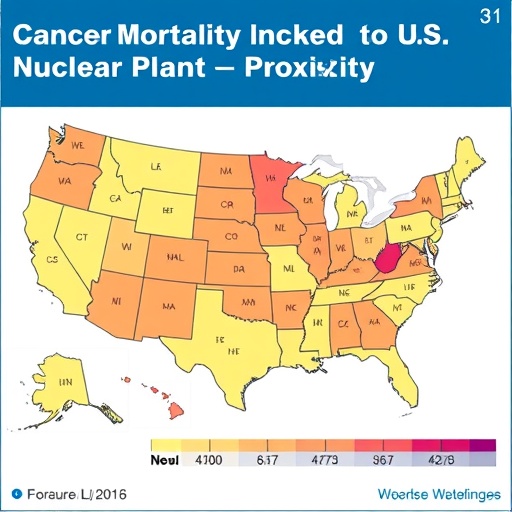
In a groundbreaking study that has sent ripples through the scientific community and the public alike, researchers have unveiled a comprehensive national analysis linking cancer mortality rates with residential proximity to nuclear power plants across the United States. Published in the prestigious journal Nature Communications in 2026, this research delivers an unprecedented, data-driven perspective on an issue that has long been a subject of public debate and environmental concern.
For decades, the presence of nuclear power plants has been a double-edged sword for many communities—offering a significant source of electricity while stirring fears about potential health risks. The new study, orchestrated by Alwadi, Alahmad, Vieira, and colleagues, transcends anecdotal evidence by systematically analyzing cancer death records nationwide in conjunction with geographic data on nuclear facility locations. This methodical approach allows for a clearer understanding of whether residing near these plants materially affects cancer mortality rates.
The research centers around a massive data aggregation effort, drawing upon cancer mortality records from the Centers for Disease Control and Prevention (CDC) spanning multiple decades. By overlaying this comprehensive epidemiological data with proximity maps of nuclear power plants—considering distances typically ranging from within 10 miles to beyond 50 miles—the study examined spatial correlations with remarkable granularity. This geographic approach is augmented by sophisticated statistical models that adjust for confounding factors such as socioeconomic status, age distribution, environmental pollutants, and urbanization levels.
One of the study’s key findings is the noticeable elevation in cancer mortality rates among populations living within close proximity to nuclear power plants. This correlation remains robust even after adjusting for numerous potential confounders, suggesting an environmental or occupational factor linked to the plants might contribute to increased cancer risk. Intriguingly, the analysis reveals specific cancer types, including leukemia and certain solid tumors, as disproportionately prevalent in these regions, raising questions about the mechanisms of radiation exposure, even at low environmental doses.
The research further delves into radiation pathways, proposing how both routine emissions and accidental releases might influence long-term cancer risks. Nuclear power plants, while highly regulated and designed to minimize radioactive discharges, nevertheless release minimal amounts of radioactive isotopes during normal operations. Over prolonged periods, the cumulative radiation doses, albeit low at individual levels, may have a collective public health impact. The study’s quantitative risk assessment models underscore the need for ongoing scrutiny of these exposure pathways.
Importantly, the article situates these findings within the broader context of energy policy and public health implications. The authors emphasize that the benefits of nuclear energy—carbon-neutral electricity generation and energy security—must be balanced against potential health risks. They advocate for enhanced monitoring and stricter emission controls to mitigate any identifiable adverse outcomes while not undermining the vital role of nuclear power in combating climate change.
The methodology showcases robust use of geographic information systems (GIS) technology and advanced epidemiological modeling, setting a new standard for environmental health research. By harnessing nationwide data and merging it with spatial analytics, the study pioneers an integrative framework capable of uncovering subtle, large-scale health patterns previously obscured by localized studies or smaller datasets.
Moreover, this study ignites an urgent call for more granular, longitudinal investigations. While the analysis provides compelling evidence of association, it stops short of establishing absolute causality, acknowledging the complex interplay of genetic, behavioral, and environmental factors in cancer etiology. Future research pathways should incorporate biological sampling, personal exposure tracking, and mechanistic studies to further elucidate causative pathways.
The research also reinvigorates the dialogue between scientists, policymakers, and community stakeholders. Transparent communication of these findings can empower affected populations, fostering collaborative approaches to risk mitigation, health monitoring, and community engagement. Public awareness campaigns, informed by solid scientific evidence, could be instrumental in addressing concerns and developing trust between nuclear facility operators and residents.
Critically, the study’s findings may influence regulatory agencies such as the Environmental Protection Agency (EPA) and the Nuclear Regulatory Commission (NRC) to revisit permissible emission levels and health surveillance protocols. The call for precautionary principle application underscores the ethical responsibility to protect vulnerable communities through proactive rather than reactive measures.
From a technical perspective, the study integrates complex dose-response models with demographic adjustments, emphasizing the nuanced nature of environmental risk assessments. The authors discuss the implications of low-dose ionizing radiation, referencing models such as the linear no-threshold (LNT) hypothesis, while acknowledging ongoing debates regarding radiation risk thresholds.
In tandem, the study contributes to the evolving understanding of environmental epidemiology by leveraging big data analytics, improving the precision of exposure assessment in epidemiologic studies. This paradigm shift promises to resolve longstanding ambiguities in environmental health research, delivering actionable insights based on robust scientific evidence.
The societal impact of this research cannot be overstated, particularly as the United States and other nations grapple with sustainable energy transitions. The balance between energy needs, environmental stewardship, and public health safety remains a delicate and high-stakes challenge. This study injects critical, evidence-based perspective into these discussions and may catalyze policy reforms and innovation in nuclear technology and safety measures.
In essence, the publication from Alwadi and colleagues marks a pivotal advancement in environmental health science. It highlights the significance of spatial epidemiology in uncovering environmental risk factors, contributes to an urgently needed reassessment of nuclear power’s health impacts, and sets a precedent for future research directions. As energy infrastructure continues to evolve, such integrative studies will be indispensable in ensuring that progress does not come at an unforeseen human cost.
Finally, this analysis underscores the importance of interdisciplinary research teams combining expertise in oncology, epidemiology, environmental science, geography, and data science. Only through such collaborations can the intricate connections between energy production and human health be comprehensively understood and responsibly managed.
Subject of Research:
Article Title:
Article References:
Alwadi, Y., Alahmad, B., Vieira, C.L.Z. et al. National analysis of cancer mortality and proximity to nuclear power plants in the United States. Nat Commun 17, 1560 (2026). https://doi.org/10.1038/s41467-026-69285-4
Image Credits: AI Generated
DOI: https://doi.org/10.1038/s41467-026-69285-4
Keywords:


