

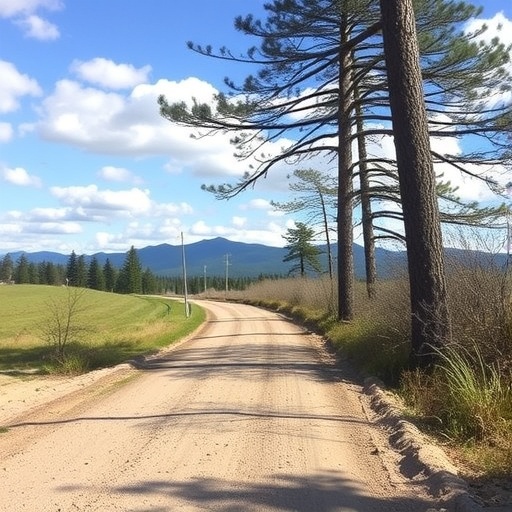
In the rugged terrain of northwest Arkansas, researchers have embarked on an ambitious study to unravel the complexities of sediment runoff from unpaved roads, a critical factor influencing the quality of water flowing into Beaver Lake, the region’s primary drinking water source. This investigation, led by assistant professor Shannon Speir and her team from the University of Arkansas System Division of Agriculture, provides an unprecedented glimpse into how sediment management requires a landscape-scale perspective rather than narrowly focusing on individual road crossings.
Northwest Arkansas presents a unique case study due to its juxtaposition of rapid urban expansion and deeply rural landscapes marked by Ozark hills, pastures, and agricultural activity. With 85 percent of county roads unpaved, these dirt roads intersect the landscape like veins, channeling water and sediment directly into tributaries such as Brush Creek. Traditionally, sediment loss studies have focused on forested watersheds in the Pacific Northwest, but Speir’s work pivots the conversation toward agricultural-dominated watersheds, where the dynamics of sediment movement differ significantly due to soil types, land use, and hydrology.
Central to the study were detailed water sampling efforts in Brush Creek to quantify total suspended solids—minute particles, including silt, clay, and organic matter—that travel within the stream during storm events. Remarkably, the researchers observed sediment loads equivalent to a massive 13 tons dropping into the creek during a single storm day, a volume analogous to an entire dump truck full of sediment being washed into the water system. This insight underscores the enormous sediment transport capacity of these watersheds during high-flow conditions.
The initial hypothesis posited that road crossings, specifically direct crossings where vehicles pass through flowing water, would be hotspots for sediment influx downstream, exacerbating sediment yields. However, data challenged this assumption. While local conditions at individual crossings showed some sediment influence, the predominant driver of sediment loss emerged at the watershed scale, dictated by the extent and density of unpaved roads, the proportion of pastureland, and prevailing hydrological flows across sub-watersheds.
This paradigm shift pivots sediment management strategies from isolated road repair toward comprehensive landscape planning. It suggests that addressing watershed-wide factors such as road network density and pasture management could yield more meaningful reductions in sediment transfer to water bodies. Speir emphasized this broader approach as essential for prioritizing conservation efforts where they will have the greatest environmental return.
The study melds seamlessly with ongoing projects like Project BEACON, where innovative agricultural practices—namely, the application of biochar-amended poultry litter—are being field-tested to reduce nutrient runoff. Biochar’s porous, carbon-rich nature enhances soil capacity to retain nutrients, effectively lowering their downstream flux. These synergistic efforts demonstrate a holistic approach to watershed management by concurrently tackling sediment and nutrient pollution.
Financial support from significant federal sources such as the U.S. Environmental Protection Agency and the Department of Energy bolstered these initiatives, enabling long-term water quality monitoring and innovative treatments. Such funding underscores the federal commitment to improving rural water systems, given their importance not only for local communities but also for the broader environmental health of critical water sources.
The study also highlights the crucial role of community collaboration. Access to private lands within the Brush Creek watershed and engaging local landowners provided invaluable insights into practical road management realities and potential conservation opportunities. This participatory science fosters trust and ensures that recommended practices are grounded in local social and ecological contexts.
Ultimately, the research at Brush Creek reiterates the pressing need for integrated watershed management, especially in regions facing dual pressures of rural land use and rapid urbanization. Sediment loading, as documented, remains significant under current land conditions, and further large storm events threaten to compound the sediment and nutrient pathways that degrade water quality.
Furthermore, the work has implications for policy and extension efforts. By disseminating these findings through Cooperative Extension Services and partnerships with organizations such as the Beaver Watershed Alliance, the research translates into actionable best management practices (BMPs). These targeted interventions promise substantial sediment reductions—over 800 tons annually in Beaver Lake, according to prior estimates—and underscore the tangible benefits of science-driven land stewardship.
As landscape-scale dynamics take center stage over localized crossing fixes, conservation priorities are becoming more scientifically nuanced. This reorientation is poised to enhance water quality across similar agricultural watersheds nationally, fostering sustainable land use patterns that protect vital freshwater resources while supporting rural livelihoods.
In the broader context of ecological research and environmental engineering, Speir’s study serves as a compelling example of how integrated approaches, combining detailed field measurements and landscape analysis, can illuminate complex watershed processes. This research will undoubtedly inform future studies and conservation policies aiming to balance human activity with the preservation of aquatic ecosystems.
Subject of Research: Sediment runoff from unpaved roads in a pasture-dominated rural watershed.
Article Title: Watershed-scale controls outweigh local crossing effects on sediment loss from unpaved roads.
News Publication Date: January 21, 2026.
Web References:
- Journal Article DOI: 10.1002/jeq2.70138
- Project BEACON: https://speirlab.weebly.com/project-beacon.html
- University of Arkansas Division of Agriculture Agricultural Experiment Station: https://aaes.uada.edu/
- Arkansas Extension Service: https://uaex.uada.edu/
References: Journal of Environmental Quality, University of Arkansas System Division of Agriculture Reports.
Image Credits: Courtesy Shannon Speir.
Keywords
Sediment runoff, unpaved roads, watershed management, water quality, Beaver Lake, sediment load, total suspended solids, biochar, poultry litter, agricultural watershed, conservation practices, stream monitoring, landscape-scale controls.


