

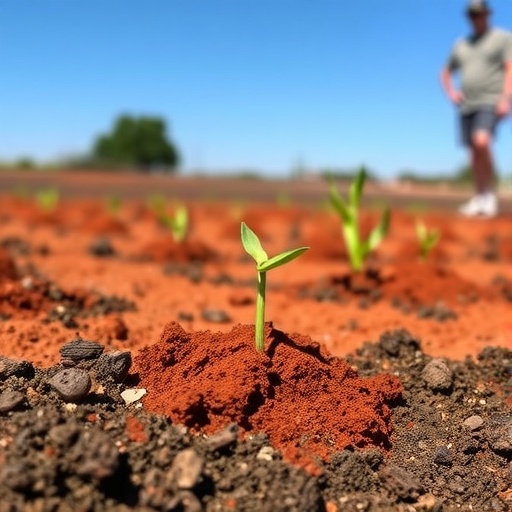
In an era where sustainable agriculture and environmental stewardship are more critical than ever, a pioneering study out of Morocco is set to transform how farmers and laboratories assess soil health. Traditional soil testing has long been a cumbersome, costly, and chemically intensive endeavor. However, the latest research published in Carbon Research unveils a revolutionary approach harnessing soil color indices as a proxy for Soil Organic Matter (SOM). This cutting-edge methodology not only promises exceptional accuracy but also heralds a paradigm shift toward green, affordable, and scalable soil monitoring solutions, particularly for semi-arid agricultural landscapes.
The research, led by Dr. Yassine Bouslihim at Morocco’s National Institute of Agricultural Research (INRA), emphasizes how the visible hues of soil can reveal intricate details about its carbon content—a critical metric linked to fertility, crop productivity, and carbon sequestration. What sets this study apart is its dual focus on science and economics. By integrating advanced machine learning techniques with colorimetric data, the team delivers a practical, financially viable alternative to legacy chemical assays that are not only expensive but generate hazardous waste.
Soil organic matter has always been a cornerstone of productive agriculture. It enhances soil structure, moisture retention, and nutrient availability. Historically, determining SOM involved methods like the Walkley-Black chemical oxidation technique, which, although effective, demands toxic reagents and intensive labor. The environmental footprint and operational costs of such approaches can be prohibitive for many testing facilities worldwide, especially in low-resource or semi-arid regions where sustainable management is urgently needed.
Dr. Bouslihim and his team embarked on an exhaustive experimental study performed at the Regional Center for Agronomic Research in Rabat. Their objective was to replace these traditional assays with an innovative model that employs soil color metrics captured via digital sensors. The study scrutinized soils in both dry and moist states to evaluate the robustness of color indices under varying field conditions. Leveraging machine learning, particularly the Random Forest algorithm, the researchers identified precise correlations between soil hues and organic matter content, establishing a novel predictive framework.
Among the key discoveries, the research highlighted the paramount importance of hue-related color parameters. In moist soils, these color attributes accounted for nearly half of the model’s predictive strength—an astounding figure suggesting that subtle color variations encode rich compositional information. This insight challenges long-held assumptions that soil color is too simplistic or variable a factor to reliably indicate complex chemical traits. Instead, the findings underscore the potential of digital colorimetry as a scientific mainstay in soil analysis.
Moreover, the research demonstrates that this approach can outperform more complicated prediction models while drastically lowering operational demands. Unlike chemical methods requiring hazardous reagents and sophisticated laboratory setups, the color-based technique requires only a digital imaging device and computational software. This minimalistic setup can be implemented widely, facilitating rapid soil analyses across vast tracts of agricultural land without compromising safety or data quality.
The economic implications of adopting colorimetric soil testing are equally striking. The team’s cost-benefit analysis estimates that for a medium-sized testing facility processing around 5,000 soil samples annually, expenses could plummet by an impressive 96%. This reduction arises from savings on labor, chemicals, equipment maintenance, and waste disposal. Even more compelling is the break-even point: initial technology investments recouped within a mere four months. Over five years, projected returns soar to an extraordinary 940%, positioning this method not only as environmentally sound but exceptionally lucrative.
This breakthrough arrives at a pivotal moment for agriculture in semi-arid regions, where fragile ecosystems are vulnerable to degradation yet serve as vital food production zones. Frequent soil organic matter monitoring—affordable and accessible—can empower farmers to make evidence-based land management decisions aligned with sustainable intensification and climate resilience goals. Furthermore, by facilitating improved soil carbon accounting, this method supports participation in emerging carbon credit and sequestration markets, unlocking new revenue streams for local communities.
The intersection of machine learning and soil science exemplified here also opens exciting avenues for broader applications. As algorithms advance and imaging technology becomes ever more sophisticated, the spectrum of detectable soil properties via color indices could expand to include moisture content, mineralogy, and contamination indicators. This digital soil profiling could revolutionize precision agriculture, enabling real-time field diagnostics that optimize inputs and boost yields while minimizing environmental footprints.
Crucially, the study’s integration of technical rigor with economic practicality sets a new standard for agricultural innovation. It responds to persistent calls within the scientific and farming communities for solutions that are not only scientifically valid but operationally feasible and economically sustainable. By validating a model that combines data science with accessible technology, Dr. Bouslihim’s work exemplifies how interdisciplinary research can deliver tangible benefits at scale.
As global policy shifts increasingly prioritize soil health for carbon management and food security, scalable testing methods like digital color analysis are poised to become indispensable. This research offers a tangible blueprint for laboratories, agronomists, and policymakers eager to modernize soil monitoring infrastructures. Beyond Morocco’s semi-arid zones, the implications reverberate across continents grappling with degraded lands, resource constraints, and the urgent imperative to mitigate climate change through effective land stewardship.
The potential for widespread adoption must be underscored by continued validation across diverse soil types and climatic conditions. However, with current evidence indicating superior accuracy and massive cost upside, the path forward is clear. Digital soil colorimetry is not merely a technical curiosity—it is an economic and ecological breakthrough that reframes how humanity interacts with the very foundation of agriculture.
In sum, this study heralds a transformative moment in soil science—where color, computation, and cost-efficiency converge to empower a new generation of sustainable farming. By translating complex soil chemistry into accessible visual and digital formats, it paves the way for greener testing that accelerates global efforts for sustainable crop production and carbon sequestration. As climate challenges mount, this innovative approach shows how simple changes in perspective—and perspective in color—can unlock profound environmental and economic benefits.
Subject of Research: Not applicable
Article Title: Predicting soil organic matter from color indices: economic and technical feasibility in semi-arid agricultural soils
News Publication Date: 24-Jan-2026
Web References:
- Journal website for Carbon Research: https://link.springer.com/journal/44246
- DOI Link: http://dx.doi.org/10.1007/s44246-025-00240-6
References:
Bouslihim, Y., Ennaji, W. & Hilali, A. Predicting soil organic matter from color indices: economic and technical feasibility in semi-arid agricultural soils. Carbon Res. 5, 9 (2026).
Image Credits: Yassine Bouslihim, Widad Ennaji & Abdessamad Hilali
Keywords: Economics; Soil chemistry; Organic farming; Soil science


