

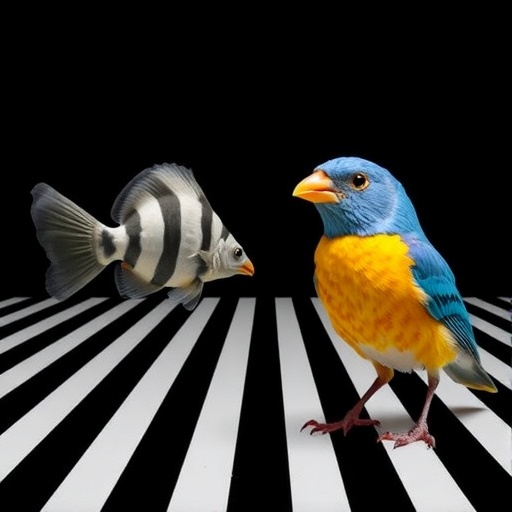
The Enigmatic Ebbinghaus Illusion: Insights into Perception from Fish to Birds
Perception is often taken for granted as a straightforward reflection of reality, yet it is an intricate construction by the brain that can be profoundly deceived. Among the most intriguing examples of visual deception is the Ebbinghaus illusion, where identical circles appear drastically different in size depending on their surrounding context. This phenomenon, discovered more than a century ago by German psychologist Hermann Ebbinghaus, captivates both scientists and the public alike by revealing how our visual system interprets size through relational cues rather than absolute measurements.
At the heart of this illusion lies a fundamental principle of human perception: size estimation is not an isolated process but is heavily influenced by comparative contexts. When a main orange circle is encircled by smaller shapes, it seems larger than when it is surrounded by larger circles, despite both central circles being physically identical. This illusion elegantly illustrates that our brain prioritizes relative size within a scene over direct measurement, adopting “global” strategies that integrate the entire visual field to interpret objects. Yet, fascinatingly, this cognitive shortcut is not universal and varies widely across species.
Recently, a groundbreaking study probed the extent to which the Ebbinghaus illusion manipulates perception in non-human animals, particularly focusing on guppies (Poecilia reticulata) and ring doves (Streptopelia risoria). These species were deliberately chosen because of their contrasting ecological niches and visual demands. Guppies inhabit complex aquatic environments where deciphering relative object size rapidly can mean the difference between life and death. By contrast, ring doves forage on the ground, often discerning minute seeds, prioritizing local, detail-oriented processing over a broad gestural scene.
The methodology utilized in this pioneering comparative study leveraged the animal’s feeding preferences to probe perceptual biases: food items were placed at the center of arrays of circles differing in relative size. Flakes served as the “central circles” for guppies, while millet seeds filled the analogous role for doves. The animals’ choices illuminated their underlying perceptual processes. Guppies repeatedly succumbed to the size illusion, showing a preference for food encircled by smaller shapes, indicative of global processing and context integration akin to human visual systems.
Conversely, ring doves presented a more complex picture. Unlike the guppies, ring doves did not show a consistent pattern of susceptibility nor immunity to the illusion. Some individuals appeared influenced by the illusion similarly to humans, others were indifferent, and a few even showed reversal effects. This interindividual variability suggests that, unlike guppies, doves may employ a mixture of perceptual strategies, potentially alternating between global and local processing modes depending on contextual cues or internal states, reflecting a more nuanced adaptation to their ecological demands.
Understanding these divergent perceptual strategies provides profound insights into the evolutionary pressures sculpting sensory processing. For guppies, rapid global processing may facilitate survival within visually cluttered, dynamic freshwater environments filled with predators and mates, where assessing relative size quickly aids decision-making. For ring doves, heightened local detail recognition optimizes foraging in terrestrial habitats rich with small, discrete food items, reducing reliance on context-dependent illusions that could mislead about actual object size.
Such findings also resonate beyond ecological considerations, offering a bridge to broader questions in neuroscience and comparative cognition. Perceptual illusions serve as experimental probes revealing the brain’s processing heuristics — the shortcuts and assumptions embedded in neural circuits that simplify complex sensory realities. Observing that some animals fall prey to illusions while others do not helps uncover the fundamental computations underlying perception across taxa, and identify species-specific adaptations that underpin diverse cognitive architectures.
Moreover, the variability observed among individual doves is particularly striking. It underscores that perception is not monolithic even within a species but rather shaped by a combination of genetic predisposition, experience, learning, and possibly personality traits. Such intra-species variation parallels human differences in illusion susceptibility, highlighting perception as a dynamic, flexible construct rather than a uniform function of the nervous system.
The implications extend further, challenging the common assumption that accurate perception equates to an objective snapshot of reality. Instead, perception is better framed as a pragmatic process evolved to optimize an organism’s interaction with its environment. What works best in one species’ niche may be maladaptive in another. By examining these cognitive divergences using illusions like Ebbinghaus, science gains a window into how evolutionary pressures have tailored sensory processing across millions of years and countless forms of life.
From a neuroscientific perspective, these results instigate new questions about the underlying neural substrates mediating global versus local processing. In humans, higher-order visual areas integrate contextual information to construct global scene understanding, but how analogous mechanisms operate in fish and birds remains largely unexplored. Future research combining behavioral experiments with neurophysiological recordings across taxa promises to unravel the comparative anatomy and functional pathways supporting these divergent perceptual strategies.
Ultimately, the study of the Ebbinghaus illusion across species invites a humbling reminder: perception is a creative act of the brain, rich with shortcuts that enhance survival yet open the door to misinterpretation. Beyond humans, animals navigate their worlds with sensory and cognitive tools shaped by environments unimaginable to us. This research not only enriches our understanding of vision and cognition but also deepens our appreciation for the diverse perceptual realities inhabited by Earth’s varied inhabitants.
As the boundary between human and animal cognition becomes increasingly porous, exploring illusions like the Ebbinghaus effect in other species illuminates how deeply intertwined are the threads of evolution, brain function, and environmental adaptation. Such comparative work elevates perceptual science from mere curiosity to a vital probe of life’s complexity—one circle at a time.
Subject of Research: Animals
Article Title: Circles of deception: the Ebbinghaus illusion from fish to birds
News Publication Date: 20-Oct-2025
Web References: http://dx.doi.org/10.3389/fpsyg.2025.1653695
Image Credits: Wikimedia Commons, public domain
Keywords: Ebbinghaus illusion, visual perception, guppy, ring dove, animal cognition, comparative psychology, sensory processing, global processing, local processing, evolutionary biology, illusion susceptibility, perception variability


