

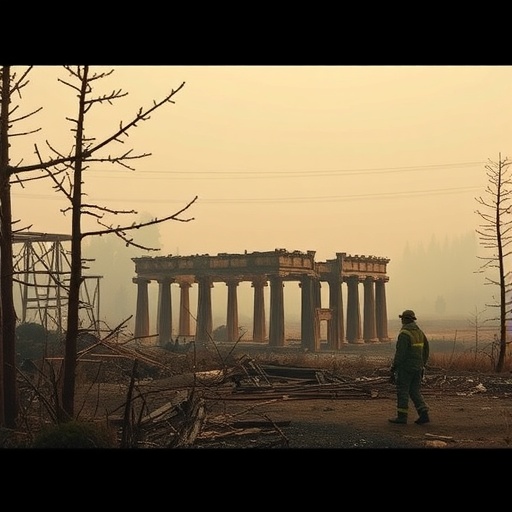
In recent years, the escalating frequency and intensity of wildfires across the United States have captured the attention of both the public and scientific communities. These disasters not only wreak havoc on ecosystems and human habitats but also contribute significantly to atmospheric pollution. A groundbreaking study led by Tang, Wiedinmyer, Emmons, and colleagues, soon to be published in Nature Communications (2025), has unveiled a critical yet overlooked source of air pollutants stemming from wildfires: emissions from burned structures. This research illuminates a profound gap in current air quality assessments and offers novel insights into the environmental impact of structural combustion during wildfire events.
Traditionally, wildfire pollution studies have concentrated on organic matter, such as trees, grasses, and other vegetation that serve as the primary fuel for wildfires. However, Tang and co-authors argue that the combustion of human-made structures — homes, commercial buildings, and infrastructure — generates an array of hazardous emissions not adequately accounted for in national air quality models. The inclusion of burned structural materials introduces a new dimension to understanding the composition and volume of pollutants released during wildfire episodes, potentially redefining the scale and scope of air pollution attributed to wildfires in the US.
The team’s investigation employed a meticulous approach combining satellite data, ground-based measurements, and advanced atmospheric modeling to quantify emissions from fires that consumed built environments. Key pollutants identified include volatile organic compounds (VOCs), polycyclic aromatic hydrocarbons (PAHs), heavy metals, and fine particulate matter (PM2.5). These substances are known contributors to respiratory and cardiovascular conditions and have broader implications for public health. The study’s findings emphasize that emissions from structural fires exacerbate the toxic burden on air quality beyond what is currently estimated from vegetation fires alone.
One of the study’s most striking revelations is the differential chemical signature of pollutants emitted by burned structures compared to natural biomass. Structural combustion releases synthetic compounds derived from plastics, treated wood, insulation materials, and electronics—all of which generate complex and highly reactive chemical species upon burning. These substances can interact in the atmosphere to form secondary aerosols and ozone, amplifying their environmental persistence and health risks. The research underscores that overlooking these emissions has resulted in systematic underestimations of wildfire-induced air pollution impacts in urban-adjacent regions.
To elucidate the broader consequences of their findings, the researchers integrated their emissions data into comprehensive air quality models spanning multiple wildfire seasons. Simulations revealed that when structural fire emissions are included, modeled concentrations of PM2.5 and toxic gases rose significantly in affected regions, particularly in California, Oregon, and Washington – states frequently affected by fires where urban-wildland interfaces are extensive. The refinement in modeling accurately mirrored observed spikes in hospital admissions for respiratory illnesses during wildfire events, strengthening the link between structural fire emissions and public health outcomes.
The implications of these results extend into the domains of environmental justice and disaster preparedness. Communities with higher densities of aging or vulnerable buildings, often socioeconomically disadvantaged, may disproportionately bear the burden of hazardous emissions during fires. The study advocates for policymakers to incorporate structural fire emissions into wildfire response planning, air quality monitoring strategies, and public health advisories. This approach enables more precise risk communication and resource allocation to mitigate health impacts among susceptible populations during wildfire crises.
In addition to their core findings, Tang et al. highlight the urgent necessity for improved data collection on the composition and burn rates of various structural materials. Currently, emission factors for synthetic materials are poorly characterized at large scales. The researchers suggest deploying in situ sampling during fires and controlled laboratory combustion experiments to refine emission inventories. Enhanced understanding in this area will foster the development of predictive models capable of capturing the heterogeneous nature of wildfire emissions across different environments and building types.
While their study primarily focused on the US context, the authors acknowledge the global pertinence of their findings. Wildfires in many regions worldwide increasingly involve the incineration of urban and suburban settings, especially where rapid development meets fire-prone landscapes. Consequently, accurately quantifying structural fire emissions stands as a critical challenge and opportunity to improve global assessments of wildfire air pollution and its health effects, as climate change continues to drive fire season severity.
Moreover, this research prompts reconsideration of mitigation strategies for wildfire air pollution. Traditional approaches emphasize forest management and fuel reduction but may overlook the importance of building materials and urban planning in reducing emissions during structural fires. The team suggests that adopting fire-resilient construction technologies and materials could not only preserve property but also curtail pollutant release in fire-prone communities. This dual benefit offers a forward-thinking pathway to enhance population resilience against wildfire impacts.
The integration of structural fire emissions into air quality models also provides a framework to reassess regulatory standards and emission inventories maintained by agencies such as the Environmental Protection Agency (EPA). Current inventories may need revision to integrate these newly characterized sources, potentially altering compliance targets and informing environmental policy adjustments. The study’s comprehensive approach could thereby influence regulatory paradigms, harmonizing air quality management with emerging wildfire realities.
Importantly, the research presents a call to action for interdisciplinary collaboration. Understanding and addressing the complexity of wildfire-related pollution requires expertise across atmospheric chemistry, environmental engineering, public health, urban planning, and disaster management. This holistic perspective ensures that strategies to tackle wildfire emissions are robust, effective, and equitable.
Tang and colleagues’ contribution represents a pivotal evolution in wildfire science, moving beyond vegetation-centric paradigms to embrace the full spectrum of combustion sources that affect air quality. As wildfires surge in frequency and destructiveness under changing climatic conditions, the need to rethink emission inventories and health risk assessments becomes increasingly urgent. This study lays a foundational cornerstone for that necessary paradigm shift.
The integration of satellite imagery, ground sensors, and cutting-edge modeling techniques in this research exemplifies the power of modern scientific tools to uncover hidden environmental challenges. It also stresses the value of proactive research that anticipates emerging threats before they manifest wholly in public health crises. By spotlighting the overlooked emissions from burned structures, the study enriches our understanding of wildfire impacts and equips society with better knowledge to adapt and respond.
In the face of escalating wildfire risks globally, the insights provided by this research are a crucial step toward more effective air quality protection measures. As communities and policymakers digest these findings, the hope is that innovative solutions will emerge, mitigating the toxic legacies of wildfires on human and ecosystem health. The study by Tang, Wiedinmyer, Emmons, and their team stands as a landmark investigation that reshapes the narrative of wildfire pollution and charts a path for future inquiry and action.
Subject of Research: Emissions from burned structures in wildfires as significant and previously unaccounted sources of air pollution in the United States.
Article Title: Emissions from burned structures in wildfires as significant yet unaccounted sources of US air pollution.
Article References:
Tang, W., Wiedinmyer, C., Emmons, L.K. et al. Emissions from burned structures in wildfires as significant yet unaccounted sources of US air pollution. Nat Commun (2025). https://doi.org/10.1038/s41467-025-66292-9
Image Credits: AI Generated


