

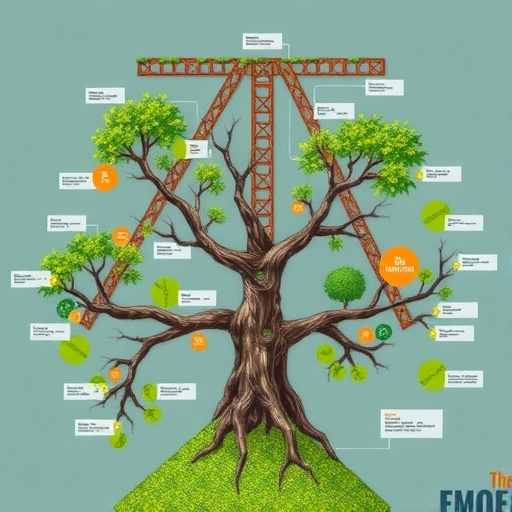
In a rapidly industrializing world burdened by mounting waste and environmental degradation, the quest for sustainable solutions has never been more urgent. Addressing this pressing issue, a pioneering team of researchers, led by Zhao, Sun, Ren, and colleagues, has unveiled a groundbreaking approach that leverages state-of-the-art large language models (LLMs) to construct an intricate waste-to-resource knowledge graph. Published in the esteemed journal Nature Communications, this innovative work promises to revolutionize how industries identify and implement symbiotic collaborations, transforming waste streams into valuable resources with unprecedented efficiency.
The essence of this research lies in the concept of industrial symbiosis—a sustainable paradigm where waste produced by one industrial process inadvertently serves as the raw material for another. Industrial symbiosis holds immense potential for reducing environmental footprints, conserving raw materials, and fostering circular economies. Nonetheless, identifying viable synergistic partnerships among disparate industries remains a complex, data-intensive challenge. Traditional approaches often rely on manual data collection, fragmented databases, and limited analytical tools, impeding scalability and timeliness.
To overcome these limitations, Zhao and colleagues harnessed the power of large language models, the same advanced artificial intelligence systems behind the recent leaps in natural language understanding and generation. By training LLMs on vast corpora of industrial reports, waste management literature, material safety datasheets, and scientific publications, the researchers enabled these models to extract nuanced, domain-specific knowledge about waste characteristics, material compatibilities, and industrial processes. This foundation set the stage for constructing a comprehensive, dynamic knowledge graph that encapsulates complex relationships among waste types, processing methods, and potential industrial applications.
The knowledge graph functions as a sophisticated digital ecosystem where nodes represent various waste materials, resource categories, industrial entities, and treatment technologies, while edges denote interactions and compatibility metrics. Through this structure, the research team could computationally model multifaceted industrial networks, illuminating opportunities for symbiotic exchanges that might have otherwise remained concealed. Unlike static databases, the graph can evolve dynamically, integrating newly published data or industry insights to reflect the rapidly changing industrial landscape.
Central to their methodology is the intelligent parsing and semantic understanding that large language models lend to disparate data sources. This semantic intelligence significantly improves the accuracy of mapping waste materials to feasible resource recovery pathways. For instance, the system can distinguish subtle compositional differences between waste streams, assess potential contamination risks, and recommend optimal treatment steps to convert waste into usable inputs tailored to specific industries’ requirements. Such granularity marks a substantial leap beyond conventional keyword search or heuristic matching strategies prevalent in current industrial symbiosis identification efforts.
Moreover, the approach leverages advanced graph analytics and embedding techniques to prioritize symbiotic opportunities based on environmental impact reduction, economic viability, and logistic feasibility. The researchers integrated lifecycle assessment data and cost models, enabling decision-makers to visualize trade-offs and select optimal symbiotic partners. This multidimensional evaluation framework promotes actionable insights while facilitating strategic planning for industry stakeholders and policymakers striving to foster sustainable industrial ecosystems.
An additional remarkable aspect of this research is its scalability and adaptability. The team demonstrated that by continuously feeding updated textual data from scientific literature, policy documents, and real-time industrial reports into the LLM-powered pipeline, the knowledge graph remains perpetually current. This ensures continual identification of novel industrial symbiosis opportunities reflective of innovations in waste treatment technologies, shifts in regulatory environments, and evolving market demands. Such dynamism is crucial for maintaining the relevance and impact of the system across diverse sectors and geographic regions.
The implications of implementing this technology are profound. By transforming vast, heterogeneous text datasets into an actionable, interconnected knowledge framework, industries can drastically reduce waste generation, minimize reliance on virgin raw materials, and curtail greenhouse gas emissions. Simultaneously, they unlock economic value embedded in waste streams and catalyze innovation cycles conducive to circular economy principles. These benefits collectively advance environmental sustainability goals while bolstering industrial competitiveness in a resource-constrained global economy.
Critically, the researchers underscore the role of human expertise in augmenting AI-driven analyses. They envision collaborative workflows where industrial ecologists, environmental engineers, and policymakers interact with the knowledge graph outputs to validate findings, contextualize recommendations, and customize solutions to localized conditions. This synergy between human insight and artificial intelligence ensures robust, ethically grounded deployment and amplifies societal acceptance of AI-enabled sustainable development tools.
The experimental evaluations presented in the publication showcase numerous successful identifications of previously unrecognized symbiotic connections across industries ranging from chemical manufacturing and metallurgy to agriculture and construction materials. These case studies highlight the model’s potential to uncover high-impact circular resource flows, often involving complex multi-industry chains rarely captured by existing frameworks. Such empirical validation cements confidence in the technology’s practicality and transformative capacity.
In summary, Zhao and colleagues have charted an exciting new frontier at the intersection of natural language processing, knowledge representation, and environmental engineering. Their construction of a waste-to-resource knowledge graph powered by large language models not only enhances the discovery of industrial symbiosis but also lays a versatile foundation for future AI-augmented sustainability solutions. As industries strive to harmonize economic growth with ecological stewardship, this research embodies a critical step toward intelligent, integrated waste management systems of tomorrow.
In the broader context of global climate action and circular economy advocacy, this work exemplifies how frontier AI technologies can be harnessed responsibly to address complex environmental challenges. By embedding sophisticated semantic understanding and graph-based reasoning into industrial symbiosis identification, Zhao et al. provide a scalable, adaptive tool for catalyzing systemic industrial transformations. The path forward will involve continued refinement, cross-sector collaboration, and real-world implementation efforts, but the groundwork laid promises substantial dividends for sustainable development agendas worldwide.
As society navigates an era defined by resource scarcity, environmental urgency, and digital innovation, the marriage of AI and industrial ecology showcased here signals a paradigm shift. Large language models, traditionally associated with language tasks, now demonstrate immense potential to decode, organize, and operationalize specialized domain knowledge critical for planetary health. This synthesis of computational prowess and environmental insight epitomizes next-generation sustainability science and opens numerous avenues for investigational and practical advancements.
Ending with an optimistic perspective, the authors anticipate that widespread adoption of such AI-enhanced knowledge graphs could democratize access to industrial symbiosis strategies, enabling small and medium enterprises alongside multinational corporations to identify cost-effective, environmentally sound resource recovery opportunities. Consequently, this work not only advances academic frontiers but also equips diverse industrial actors with actionable intelligence central to achieving sustainable, resilient economies in the 21st century.
The study by Zhao, Sun, Ren, and collaborators sets a compelling precedent for integrating advanced AI with environmental management domains, highlighting how data-driven, intelligent knowledge representations can facilitate large-scale industrial sustainability transitions. As researchers and practitioners build upon this foundation, the vision of a global industrial ecosystem where wastes are seamlessly transformed into resources draws ever closer to reality.
Subject of Research: Development of a waste-to-resource knowledge graph using large language models to identify and facilitate industrial symbiosis for sustainable resource management.
Article Title: Construction of waste-to-resource knowledge graph for industrial symbiosis identification using large language models.
Article References:
Zhao, L., Sun, Y., Ren, J. et al. Construction of waste-to-resource knowledge graph for industrial symbiosis identification using large language models. Nat Commun (2025). https://doi.org/10.1038/s41467-025-66599-7
Image Credits: AI Generated


