

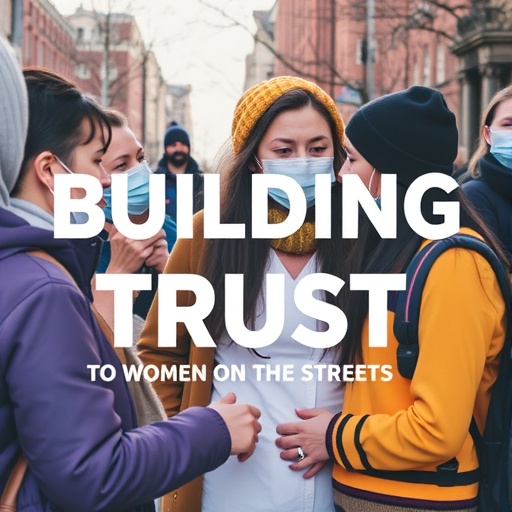
In the heart of British Columbia, a significant shift is emerging in the way healthcare professionals engage with women who experience street involvement. Recent research, encapsulated in a qualitative study, sheds light on the dynamics of relational trust between these healthcare workers and the vulnerable women they serve. The study by Gagnon, Jiao, and Kassam, published in the BMC Health Services Research journal, reveals intricate layers of interaction, empathy, and systemic barriers that challenge effective outreach.
Street-involved women often find themselves at the intersection of societal neglect and health service deficiencies. Understanding the nuances of trust can unlock advanced methods of outreach that not only connect these women to essential health services but also empower them to reclaim their narratives. The research highlights that relational trust serves as a fundamental building block for effective engagement. It is not merely about the delivery of services but about fostering connections that validate the lived experiences of these women.
Central to the analysis is the recognition that traditional outreach methods often fall short. Many healthcare providers approach street involvement through a clinical lens, which can inadvertently alienate potential patients. The emphasis on relational trust invites a paradigm shift that favors understanding and respect over mere transactional interactions. The study illustrates how healthcare providers can better support these women by cultivating environments that treasure personal stories and recognize the individuality of each woman.
Throughout the research, participants shared their experiences of healthcare interactions. Many women conveyed feelings of skepticism toward health services, often rooted in past negative experiences. This skepticism impedes their willingness to seek help, particularly for sensitive issues like mental health or substance use. The implications are stark; without trust, the bridge to care remains uncrossed. Hence, the research illuminates the necessity of building rapport: a soft approach that values listening and compassion over authority and judgment.
The qualitative methods employed in this study provided a rich tapestry of insights. Through in-depth interviews and focus groups, Gagnon and colleagues captured personal stories that reflect systemic barriers. Women described instances where healthcare providers inadvertently overlooked their needs or dismissed their experiences. These narratives reveal a crucial gap in healthcare service design—where voices from the margins are often drowned out, leading to disconnection between service providers and their intended beneficiaries.
Moreover, the research delves into the strategies healthcare workers can employ to cultivate relational trust. For instance, providers who engage in active listening and demonstrate cultural competence can effectively bridge the gaps. By recognizing the stigma and challenges faced by street-involved women, healthcare providers can create a more inclusive dialogue that encourages empowerment and participation.
Importantly, the study also outlines the impact of external factors on the dynamics of trust. Social determinants of health, such as housing instability, financial insecurity, and historical trauma, are intertwined with healthcare experiences. Addressing these determinants is vital to not only improve individual health outcomes but also to foster collective resilience within community settings. This holistic approach challenges the narrower focus often seen in public health strategies, demanding instead a comprehensive understanding of the causes behind marginalized health experiences.
The research asserts that successful outreach does not solely depend on healthcare policies but also on the relationships formed at the grassroots level. Recognizing that these relationships take time to develop is crucial. Misconceptions about the immediacy of healthcare engagement can undermine the long-term commitment needed to nurture trust. Hence, patience and persistence emerge as vital attitudes for healthcare providers working with vulnerable populations.
Gagnon and her collaborators emphasize the importance of collaborative care. When healthcare providers work closely with social workers and community organizations that have established trust with street-involved women, the potential for effective outreach increases exponentially. A multidisciplinary approach not only bolsters the trust factor but also enriches the care spectrum that these women receive, making it more tailored and responsive to their complex needs.
Critically, the findings of this study also suggest a reevaluation of academic training for healthcare providers. Incorporating training on relational trust and the lived experiences of marginalized populations into medical and nursing curricula can fundamentally reshape healthcare delivery. Training programs that emphasize empathy, cultural sensitivity, and communication skills will likely produce professionals better equipped to meet the intricate needs of their patients.
As the research gains traction, it beckons a call to action well beyond British Columbia. The principles of relational trust articulated by Gagnon and her colleagues can resonate across various healthcare settings worldwide. Different communities grappling with similar issues can adapt these insights to forge their own pathways toward building trust and improving healthcare accessibility.
Ultimately, this complex interplay between relational trust, systemic barriers, and effective outreach identifies a crucial area for investment in the global healthcare landscape. The voices of street-involved women, often underrepresented in health discourse, form a vital part of this narrative. Amplifying these voices can enhance policy frameworks, ensuring that the systems designed to serve them are genuinely inclusive and compassionate.
As this study illustrates, the journey of improving outreach to women experiencing street involvement is fundamentally linked to relationship-building. A commitment to understanding, validating, and supporting these women as individuals rather than statistics can revolutionize healthcare outcomes in this vulnerable population. Bridging the gap between health services and the experiences of marginalized voices in society remains a shared responsibility that promises both healing and empowerment.
Through this research, Gagnon, Jiao, and Kassam contribute substantially to the discourse on relational trust in health care. Their findings not only challenge existing methodologies but also pave the way for innovative, person-centered approaches that prioritize empathy and connection. For both practitioners and policymakers, the call is clear: to elevate those hardest to reach, we must first deepen our commitment to genuinely understanding and nurturing trust.
Engaging with the voices and experiences of women facing street involvement serves as a powerful reminder of the resilience of human connection. As the study unfolds, it serves as both a foundation and a beacon—urging healthcare providers, researchers, and advocates to remember the profound impact that trust can have in transforming lives and improving health at the community level.
Subject of Research: Relational trust in outreach with women experiencing street involvement
Article Title: Relational trust in outreach with women experiencing street-involvement in British Columbia, Canada: a qualitative study.
Article References:
Gagnon, M., Jiao, S., Kassam, S. et al. Relational trust in outreach with women experiencing street-involvement in British Columbia, Canada: a qualitative study.
BMC Health Serv Res (2025). https://doi.org/10.1186/s12913-025-13875-3
Image Credits: AI Generated
DOI:
Keywords: Trust, Outreach, Healthcare, Street-Involvement, Qualitative Study, British Columbia, Vulnerable Populations, Social Determinants, Relational Dynamics.


