

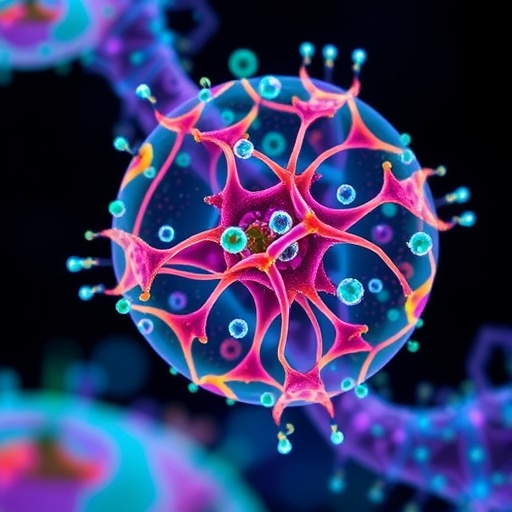
A groundbreaking advancement in microscopy has emerged from Stanford University, where researchers have developed interferometric Image Scanning Microscopy (iISM), a label-free imaging technique that revolutionizes the way live cellular structures are visualized. This innovative approach addresses the long-standing challenges in cellular imaging, particularly the limitations imposed by fluorescence microscopy, such as photobleaching, phototoxicity, and perturbation of biological processes. iISM presents a paradigm shift by enabling high-resolution, high-contrast imaging inside living cells, all while minimizing light exposure to preserve cell viability during long-term observation.
Traditional fluorescence microscopy relies heavily on fluorescent markers to visualize cellular components, but these labels have well-documented drawbacks. Photobleaching rapidly depletes fluorescent signals, while phototoxicity can damage delicate live cells, altering or halting vital biological processes under investigation. Moreover, fluorescence tagging is sometimes incompatible with certain cellular environments or conditions. Label-free imaging methods circumvent these issues by detecting intrinsic optical signals generated naturally within cells. However, such methods often suffer from poor sensitivity and low contrast, especially when imaging the densely populated and light-scattering interiors of live cells, where signal differentiation becomes arduous.
The newly reported iISM technique builds upon interferometric scattering microscopy (iSCAT), a method already renowned for its exceptional sensitivity. iSCAT amplifies signals by measuring interference patterns between scattered light from sub-cellular nanostructures and a strong reference beam, thereby detecting even minuscule scatterers with impressive precision. Nonetheless, applying iSCAT directly within the crowded intracellular milieu is fraught with challenges. Background scattering from myriad organelles and macromolecules generates noise that can easily mask the subtle signals of interest. Conventional confocal iSCAT uses a pinhole to reject out-of-focus light, enhancing signal specificity. Yet, this comes at a cost: the pinhole discards a substantial fraction of photons, necessitating higher illumination powers or slower scan speeds to compensate, both detrimental to living samples.
The conceptual leap introduced by the Stanford team involves replacing the traditional single confocal pinhole detector with an array detector—effectively a camera system capable of capturing multiple spatial points simultaneously. This design innovation allows the collection of the entire interferometric point-spread function (iPSF) at each scanned location, capturing numerous “off-axis pinholes” concurrently. Such multiplexed detection harnesses a wealth of previously inaccessible spatial information in parallel, dramatically improving photon efficiency. By doing so, the system unlocks new potential to resolve fine cellular details without subjecting samples to intense illumination.
Complementing this hardware breakthrough is a sophisticated computational technique known as adaptive pixel reassignment (APR). Standard pixel reassignment algorithms enhance image resolution by combining signals from different detector elements. However, the intricate nature of interferometric signals, which carry both amplitude and phase information, demands a tailored approach. The APR algorithm developed here accounts for the interferometric phase explicitly, enabling the fusion of multiple measurements into reconstructed images exhibiting improved resolution and markedly enhanced contrast-to-noise ratios. This integrated hardware-software solution represents a significant departure from conventional microscopy paradigms.
To draw an analogy, ordinary imaging with a single detector resembles viewing a complex scene with one eye, where depth and background separation are difficult. Using a second eye introduces parallax, helping to differentiate foreground from background effortlessly. iISM takes this analogy further by deploying tens to hundreds of “eyes”—detections at different spatial offsets—simultaneously. This multiplicity of viewpoints significantly enhances the system’s ability to disentangle genuine scattering signals from confounding background noise within live cells, facilitating cleaner and more informative images.
Experimental validations of iISM reveal its impressive capabilities. The technique achieves a lateral resolution of approximately 120 nanometers in a label-free modality, surpassing conventional diffraction limits associated with light microscopy. Most strikingly, this improved resolution comes without increasing illumination intensity. The researchers report that imaging speed can be enhanced by an order of magnitude, or conversely, the light dose reduced by a similar factor while maintaining acquisition rates. Such a balance is critical in live-cell imaging where photodamage directly limits observation periods and the integrity of biological findings.
iISM’s prowess extends to the visualization of dynamic intracellular phenomena. The researchers successfully imaged intricate organelles such as the endoplasmic reticulum, mitochondria, lysosomes, and vesicles, capturing their movements and interactions in real time without relying on fluorescent labels. These label-free movies provide unprecedented insight into the cellular interior’s dynamic landscape, revealing organelle trafficking and network remodeling with exquisite clarity. This capacity underscores iISM’s potential as a powerful tool for live biological investigations, especially where labeling options are constrained.
Significantly, iISM integrates seamlessly with traditional confocal fluorescence microscopy, allowing simultaneous acquisition of label-free structural maps alongside fluorescently tagged molecular signals. This fusion offers a holistic view whereby molecular specificity provided by fluorescence complements the high-contrast structural detail from iISM. Such correlative imaging capabilities hold promise for dissecting complex biological interactions with unmatched detail and contextual understanding.
The broader implications of iISM are profound. By facilitating nanoscale visualization of live cell dynamics under near-native conditions and significantly lowering phototoxic stress, iISM is poised to transform studies of intracellular trafficking, cytoskeletal rearrangement, host-pathogen interfaces, and organelle network dynamics. It offers a versatile, sensitive alternative to fluorescence-dependent methods and broadens the accessibility of live-cell super-resolution microscopy for a wide range of research settings.
Looking ahead, the developers of iISM aim to enhance the technique’s temporal resolution further, pushing into realms where rapid biological processes can be captured in unprecedented detail. Efforts to democratize the technology focus on streamlining acquisition speeds and simplifying instrumentation to facilitate widespread adoption. Dr. W. E. Moerner, a pioneer in single-molecule spectroscopy and Nobel laureate, underscores the vision for iISM as a next-generation tool combining ultrasensitive label-free detection with molecular fluorescence specificity to unravel cellular complexity.
In conclusion, interferometric Image Scanning Microscopy stands at the forefront of optical microscopy innovation, offering a unique blend of sensitivity, resolution, and cellular compatibility. By overcoming critical limitations of existing methods, it opens a new window into the living cell, enabling researchers to observe the intricate dance of life at the nanoscale without the compromises of phototoxicity and labeling. This technique is set to usher in a new era of cellular imaging, fostering discoveries that deepen our understanding of cellular mechanisms and disease processes in their unperturbed states.
Subject of Research: Development and application of interferometric Image Scanning Microscopy (iISM) for label-free, high-resolution imaging inside live cells.
Article Title: Interferometric Image Scanning Microscopy for label-free imaging at 120 nm lateral resolution inside live cells.
Web References: DOI: 10.1038/s41377-026-02210-y
Image Credits: Michelle Kueppers et al.
Keywords
Interferometric Image Scanning Microscopy, iISM, label-free imaging, live-cell microscopy, nanoscale resolution, interferometric scattering microscopy (iSCAT), adaptive pixel reassignment, super-resolution microscopy, cellular dynamics, phototoxicity reduction, organelle imaging, correlative fluorescence microscopy


