

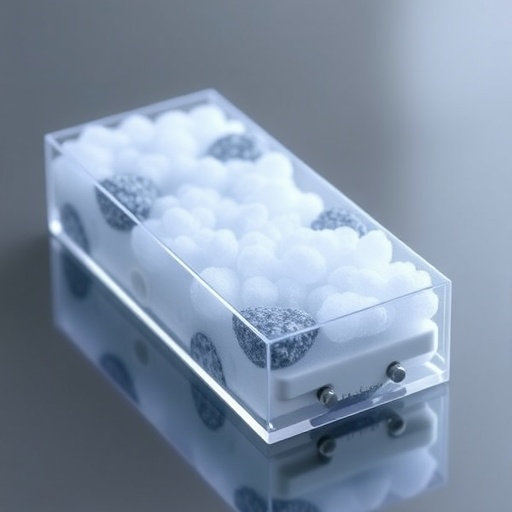
In the global pursuit of sustainable and efficient energy storage solutions, the development of large-capacity rechargeable batteries remains a critical technological frontier. These batteries must support countless charge-discharge cycles without significant degradation, a demand propelled by the growing reliance on electric vehicles and renewable energy systems. Although lithium-ion technologies currently dominate the market, their dependence on expensive and scarce metals, notably lithium and platinum, raises concerns about long-term economic feasibility and material supply security. This situation has intensified scientific efforts to discover and engineer alternative battery chemistries that are both cost-effective and environmentally benign.
Emerging prominently within this context are magnesium-air (Mg-air) rechargeable batteries, which combine the advantages of earth-abundant materials with theoretically promising energy densities. These batteries incorporate a magnesium metal anode, a carbon-based cathode, and an electrolyte solution containing magnesium chloride. A pivotal feature of Mg-air batteries lies in their cathode’s ability to utilize atmospheric oxygen as the reactive species, enabling a lightweight and high-capacity design. The theoretical performance metrics of Mg-air systems closely rival those of lithium-air batteries, positing them as strong contenders in the landscape of next-generation energy storage. However, practical deployment is hindered primarily by internal chlorination processes, catalyzed by chloride ions in the electrolyte, which accelerate cathode degradation and diminish battery lifespan.
Addressing these challenges, a groundbreaking study out of the University of Tsukuba introduces a novel nitrogen-doped porous graphene cathode tailored to resist chloride-induced degradation effectively. By integrating nitrogen functionalities into a three-dimensional nanoporous graphene matrix, researchers have created a cathode material exhibiting exceptional stability and catalytic activity in the harsh electrochemical environment of Mg-air batteries. The porous architecture of this cathode not only enhances oxygen reduction reactions but also efficiently accommodates discharge products, facilitating better mass transport and sustaining electrochemical performance across prolonged cycling.
The research team has successfully constructed an all-solid-state magnesium-air rechargeable battery that leverages commercially available magnesium metal as the anode and employs a polymer gel containing magnesium chloride as the solid-state electrolyte. This design strategy circumvents the common issues associated with liquid electrolytes, such as leakage and flammability, while maintaining ionic conductivity necessary for battery operation. The all-solid-state configuration delivers outstanding performance superiority over conventional Mg-air batteries utilizing platinum-based cathodes, underscoring the functional benefits of the nitrogen-doped nanoporous graphene electrode.
Key performance achievements include a remarkable tolerance to electrolyte bending and mechanical deformation, with the battery retaining its initial electrochemical properties even when subjected to a 120° bend. This mechanical flexibility addresses critical challenges in developing wearable or flexible electronic devices powered by rechargeable batteries. Furthermore, the solid polymer electrolyte significantly enhances the safety profile of the battery by eliminating risks inherent in liquid electrolytes, thereby expanding the possible application scenarios for Mg-air batteries across diverse technological fields.
This research signifies a major leap forward in sustainable battery technology by demonstrating an effective pathway to mitigate material supply risks, reduce costs, and improve battery safety without compromising performance. The flexibility and resilience of the solid-state Mg-air battery open avenues for integration into electric vehicles, portable electronics, and grid storage systems, where high capacity and long cycle life are prerequisites. The combination of nitrogen-doped graphene’s catalytic properties with the robust solid electrolyte represents a key innovation poised to redefine battery architecture paradigms.
The implications of this developed Mg-air system extend into broader electrification efforts, presenting a credible alternative to the incumbent lithium-ion battery technology. As electric mobility scales globally, materials that are abundant and cost-effective will be fundamentally crucial to sustainable production chains and environmental conservation. Mg-air batteries, empowered by the novel cathode design and solid-state electrolyte, align strongly with these sustainability goals while providing competitive energy density and cycle stability.
The research also highlights the vital role of nanostructured materials in energy storage advancements. The engineered nanoporous graphene cathode exemplifies how atomic-level doping and controlled porosity design can finely tune catalytic activity and resistance to detrimental electrochemical reactions. This approach enhances the discharge product management and elevates mass transport mechanisms essential for prolonging battery life and sustaining high power outputs.
Industrial adoption of this technology, enabled by commercially accessible Mg metal and scalable polymer electrolyte manufacturing, could significantly reduce production costs relative to lithium and platinum dependencies. This economic advantage, coupled with enhanced battery performance, may accelerate the transition toward widespread use of Mg-air rechargeable batteries in consumer electronics and automotive sectors.
Beyond performance and cost, the solid-state configuration fosters improved battery safety by eliminating electrolyte leakage—a notorious failure mode in conventional liquid electrolyte batteries. The demonstrated resilience against mechanical stress addresses critical practical concerns, establishing the suitability of this Mg-air system for flexible, portable, and wearable device markets, where battery integrity under dynamic conditions is pivotal.
Future research directions include optimizing the nitrogen doping levels, exploring alternative polymer gel compositions for improved ionic conductivity, and scaling the battery design to commercial sizes. These investigations will be instrumental in transitioning from laboratory prototypes to market-ready energy storage solutions.
In conclusion, the innovative Mg-air rechargeable battery developed with a nitrogen-doped 3D nanoporous graphene cathode and solid polymer electrolyte exemplifies a transformative advance in sustainable energy storage technology. It harmonizes high capacity, cost-efficiency, safety, and mechanical flexibility, setting a new benchmark for rechargeable battery design. As electrification demands expand globally, such breakthroughs will be pivotal in shaping a cleaner, more resilient energy future.
Subject of Research: Development of an all-solid-state rechargeable magnesium-air battery using nitrogen-doped 3D nanoporous graphene cathode.
Article Title: Empowered rechargeable solid-state Mg-O₂ battery using free-standing N-doped 3D nanoporous graphene
News Publication Date: 11-Feb-2026
Web References:
DOI Link to Original Paper
Image Credits: Yoshikazu Ito, University of Tsukuba
Keywords
Magnesium-air battery, solid-state electrolyte, nitrogen-doped graphene, nanoporous cathode, rechargeable battery, energy storage, battery safety, flexible battery, catalytic activity, chloride resistance, electric vehicles, sustainable materials


