

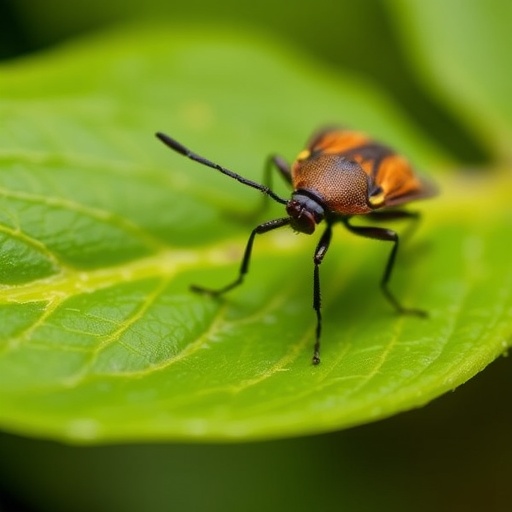
In a groundbreaking study poised to redefine pest management strategies, researchers have unveiled the potent insecticidal and repellent properties of certain botanicals against Tribolium castaneum, commonly known as the red flour beetle. This elusive pest, infamous for its destructive impact on stored grains worldwide, has long presented challenges due to its resilience and rapid adaptation to conventional pesticides. The research, conducted by Kumar, Devee, Thokchom, and colleagues, delves deep into the biochemical dynamics underpinning these botanicals’ effects, opening a promising frontier in eco-friendly pest control.
The red flour beetle, a cosmopolitan pest, is notorious for contaminating and destroying stored food products, significantly undermining food security and causing economic distress within the agricultural sector. Traditional synthetic insecticides, while effective to some extent, have encountered hurdles related to environmental toxicity, human health concerns, and the rapid development of insect resistance. This study’s focus on naturally derived compounds offers a refreshing and sustainable alternative, potentially minimizing the ecological footprints of pest control.
At the heart of this research lies the investigation into how specific botanicals exert insecticidal and repellent effects on T. castaneum. Researchers meticulously selected a range of plant extracts, analyzing their efficacy not only in reducing beetle populations through mortality but also in deterring infestation through behavioral repellency. These dual actions are crucial because they not only eliminate existing pests but also prevent further colonization, offering a comprehensive pest suppression mechanism.
What sets this study apart is its exploration of the molecular mechanisms by which these botanicals affect the beetles. Specifically, the researchers examined the impact on detoxifying enzymes—key players in the insect’s metabolic pathways that enable it to neutralize and resist chemical exposure. By targeting these enzymes, the botanicals can effectively weaken the beetle’s defense system, rendering it more susceptible to insecticidal action. This insight is vital as it shifts the paradigm from mere pest eradication to understanding and disrupting the biological resilience of pests.
The methodology embraced by the research team was robust and multifaceted, incorporating bioassays to quantify mortality rates and repellency tests to assess behavioral responses. Additionally, enzyme activity assays were conducted to measure alterations in the levels of detoxifying enzymes post-exposure to the botanical treatments. This comprehensive approach allowed the researchers to draw correlations between biochemical disruptions and observable pest control outcomes, thereby strengthening the validity of their conclusions.
Among the botanicals evaluated, several exhibited remarkable efficacy, with significant reductions in beetle survival and substantial repellent activity. These findings not only support the potential of plant-based extracts as viable pest control agents but also underscore the importance of exploring biodiversity as a treasure trove for novel insecticidal compounds. The identification of such natural products may bolster integrated pest management programs, marrying eco-consciousness with practical effectiveness.
Importantly, the study sheds light on the mode of enzymatic interference by these botanical extracts. Detoxifying enzymes such as esterases, glutathione S-transferases, and cytochrome P450 monooxygenases were found to be inhibited in treated beetles. This enzymatic inhibition compromises the insect’s ability to metabolize toxic substances, which is often the root cause of pesticide resistance. Hence, the botanicals not only act as direct insecticides or repellents but also as modulators of insect detoxification pathways, a novel and strategic angle in pest control research.
The implications of this research extend beyond the immediate context of stored grain pest management. By advancing our understanding of how botanical compounds can manipulate insect physiology at the enzymatic level, the study paves the way for the development of a new class of bio-insecticides. These bio-insecticides could be employed with reduced risk of resistance development, environmental contamination, and non-target impact, aligning pest control objectives with sustainable agricultural practices.
Moreover, the incorporation of repellent properties within these botanical agents offers an innovative two-pronged assault on pest populations. Repellency ensures that pests are deterred from infestation zones, thereby reducing crop exposure and contamination risks. When combined with insecticidal action, this synergistic effect presents an optimized defense strategy that is both preventive and curative, an ideal scenario in integrated pest management frameworks.
The study also highlights the broader trend of rediscovering botanical insecticides amid growing global demands for environmentally benign pest control solutions. As public awareness about pesticide hazards intensifies and regulatory landscapes tighten, there is an urgent need for alternatives that balance efficacy with safety. This research responds to this critical demand by validating the scientific underpinnings and practical applications of botanicals within agricultural ecosystems.
In terms of practical application, the research hints at the feasibility of developing formulations enriched with the identified plant extracts. Such formulations could be tailored for use in storage facilities, grain handling equipment, and processing environments, where T. castaneum infestation is most prevalent. The adaptability and ease of integration of botanical-based products in existing pest management regimes could accelerate their uptake among farmers, storage operators, and industry stakeholders.
Furthermore, the study’s focus on detoxifying enzymes as a target provides a strategic advantage in managing insecticide resistance. By disrupting these enzymes, the botanical compounds may restore susceptibility in resistant beetle populations or prevent the onset of resistance altogether. This biochemically informed approach challenges the status quo of pest control and invites a rethinking of how resistance management can be innovatively addressed.
It is also essential to consider the environmental and health benefits inherent to botanical insecticides. Unlike synthetic chemicals, many plant-derived compounds degrade rapidly in the environment, minimizing residual toxicity. They pose lower risks to non-target organisms, including beneficial insects, mammals, and humans. By championing such natural alternatives, this research supports a future where pest control aligns harmoniously with ecological stewardship and public health safeguarding.
The study by Kumar et al. emerges as a beacon for future research directions, encouraging deeper exploration into the complex interactions between botanicals and insect physiology. The precise identification of active compounds, dosage optimization, formulation improvements, and field trials constitute crucial next steps to translate laboratory findings into real-world applications. Collaboration across disciplines, including entomology, chemistry, and agronomy, will be indispensable to harness the full potential of botanical insecticides.
In conclusion, this pioneering work unravels critical insights into the insecticidal and repellent efficacy of selected botanicals against the challenging pest T. castaneum. By elucidating their impact on detoxifying enzymes, the researchers have opened a novel pathway to enhancing pest management strategies that are sustainable, effective, and environmentally sound. As the world grapples with pesticide resistance and ecological degradation, such innovative botanical solutions offer a timely and transformative approach to safeguarding global food security.
This research not only advances scientific knowledge but has the potential to influence policy frameworks and agricultural practices worldwide. It underscores the viability of integrating natural products into pest management while highlighting the necessity for ongoing innovation in the face of evolving pest threats. The study by Kumar and colleagues stands as a testament to the power of interdisciplinary research in forging sustainable pathways towards resilient agriculture and healthier ecosystems.
Subject of Research: Insecticidal and repellent effects of selected botanicals against Tribolium castaneum and their influence on detoxifying enzymes.
Article Title: Insecticidal and Repellent Effects of Selected Botanicals against Tribolium Castaneum (Herbst) (Coleoptera: Tenebrionidae) with Reference To their Effect on Detoxifying Enzymes.
Article References: Kumar, A., Devee, A., Thokchom, S. et al. Insecticidal and Repellent Effects of Selected Botanicals against Tribolium Castaneum (Herbst) (Coleoptera: Tenebrionidae) with Reference To their Effect on Detoxifying Enzymes. Acta Parasit. 71, 27 (2026). https://doi.org/10.1007/s11686-025-01202-z
Image Credits: AI Generated
DOI: https://doi.org/10.1007/s11686-025-01202-z


