

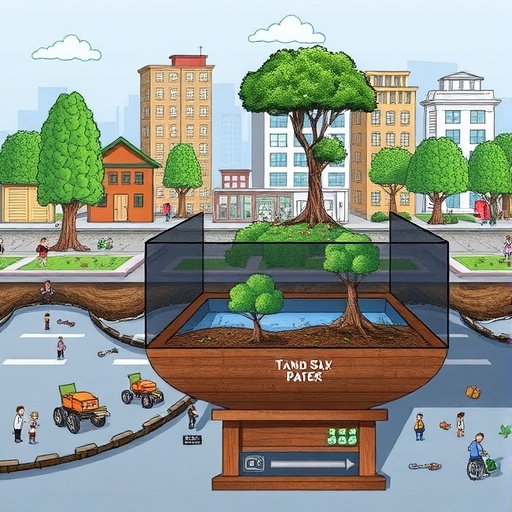
In the heart of some of the world’s most embattled urban centers, a silent crisis unfolds—one that jeopardizes not only lives but the very fabric of post-conflict recovery and sustainability. The challenge of nurturing resilient urban food systems within areas under siege has long been overshadowed by immediate humanitarian concerns. However, recent advancements underscore the vital importance of enhancing seed, land, and water management to revolutionize how aid is delivered and absorbed in these complex environments. This approach not only promises to sustain life during protracted conflicts but also lays the groundwork for enduring urban recovery.
Urban areas facing siege present a unique and often overlooked nexus of vulnerabilities. Unlike rural regions, where agriculture can depend on expansive lands and relatively stable access to natural resources, cities under duress are constrained by limited space, fractured infrastructure, and disrupted supply chains. These limitations complicate traditional food production techniques and demand innovative solutions tailored to dense urban landscapes. The integration of specialized seed varieties, optimized land use strategies, and innovative water management promises a paradigm shift in humanitarian intervention.
Central to this transformation is the refinement of seed technology specific to siege conditions. Seeds are not merely carriers of genetic material; they embody resilience against environmental stresses such as soil salinity, erratic water availability, and elevated pollutant levels often present in war-torn urban soils. The development and deployment of seed variants capable of thriving in compact, damaged plots with minimal resource input enable local populations to produce food where conventional agriculture would be unfeasible. These seeds incorporate traits such as drought tolerance, rapid maturation cycles, and resistance to urban contaminants—elements crucial for survival under siege.
Land management in urban conflict zones requires a nuanced understanding of landscape fragmentation and soil degradation processes exacerbated by warfare. Bombardments, construction ruin, and mass displacement disrupt the soil’s physical and chemical properties, reducing fertility and water retention capabilities. Advanced soil remediation techniques, including biochar application, phytoremediation, and micro-mulching, are essential to restore productivity in these degraded soils. Furthermore, strategic land allocation plans focus on maximizing micro-farming plots, rooftop gardens, and reclaimed vacant lots to optimize food production without exacerbating overcrowding or triggering additional conflict.
Water management represents perhaps the most formidable challenge in besieged urban contexts. Traditional irrigation infrastructures often fall victim to destruction or neglect, leaving urban farmers reliant on scarce and unpredictable water sources. Innovative interventions, therefore, emphasize water harvesting, recycling, and conservation technologies that integrate with limited urban spaces. For instance, greywater recycling systems recycle household wastewater for irrigation, reducing dependence on municipal supplies. Meanwhile, rainwater harvesting installations capitalize on sporadic precipitation, storing vital water reserves during dry spells. Collectively, these strategies address water scarcity and quality issues, thereby sustaining agricultural productivity.
The convergence of seed, land, and water management technologies further extends into integrated urban food production systems. Hydroponics and aquaponics have emerged as viable alternatives that circumvent traditional soil dependence, leveraging nutrient-rich water solutions to grow crops vertically in confined spaces. Coupled with seed varieties bred for hydroponic systems, these methods offer scalable, resource-efficient options for food production in areas where soil contamination or space limitations preclude conventional agriculture. Such systems have an added benefit of being less visible targets during conflict, thus maintaining a measure of protection for food sources.
Equally critical to these technical advancements is the socio-political framework supporting humanitarian interventions. Effective deployment hinges on coordination among local communities, NGOs, and international agencies to ensure that innovations align with cultural practices, security considerations, and logistical realities. Empowering local populations through training and participatory planning enhances resilience and fosters a sense of ownership, which is vital in sustaining food production when external aid becomes intermittent or ceases. This bottom-up approach helps bridge the gap between cutting-edge science and on-the-ground practicality.
Digital technologies bolster these efforts by providing real-time data analytics and geospatial mapping to optimize resource allocation and monitor environmental conditions. Satellite imagery, combined with ground-level sensors, enables precise assessment of land degradation, water availability, and crop health, informing adaptive management strategies. These tools also facilitate transparency and accountability, allowing humanitarian agencies to evaluate intervention efficacy dynamically and adjust tactics swiftly as conflict conditions evolve.
The environmental implications of urban siege extend beyond immediate human concerns, touching on broader ecosystem dynamics. The pollution arising from urban conflict—chemical residues, heavy metals, and particulate matter—compounds risks to soil, water, and human health. Addressing these toxic legacies through integrated remediation techniques contributes to long-term sustainability, ensuring that urban agriculture post-conflict can thrive rather than perpetuate cycles of contamination and disease. This acknowledgment repositions humanitarian interventions not just as emergency responses but as crucial contributors to urban ecological restoration.
Interdisciplinary research plays a pivotal role in synthesizing knowledge across agronomy, urban planning, hydrology, and social sciences to shape holistic solutions. Recent studies employ scenario modeling to forecast how various seed, land, and water management combinations can perform under different siege intensities and durations. These predictive models guide decision-makers in prioritizing interventions with the highest likelihood of success and identifying potential unintended consequences. By embedding scientific rigor into humanitarian planning, interventions become more strategic, efficient, and resilient.
Challenges persist, notably around access constraints in siege zones where active hostilities impede movement and resource transport. Innovative logistical frameworks leveraging drones, local networks, and decentralized supply chains are under exploration to circumvent blockades and maintain the flow of essential agricultural inputs. The imperative to navigate these complex terrains underscores the need for flexible, context-specific solutions over one-size-fits-all models, embracing adaptive management as a core principle.
The holistic approach to food security in besieged urban environments, centered on enhancing seed, land, and water management, aligns closely with global imperatives such as the United Nations Sustainable Development Goals. It advances targets around zero hunger, clean water and sanitation, sustainable cities, and climate action. In this sense, the endeavor transcends immediate crisis response, contributing to resilient urban futures capable of withstanding conflict shocks and environmental uncertainties.
Ethical considerations also arise regarding the prioritization of urban agriculture under siege. Allocating limited resources to seed and water management must balance immediate humanitarian relief—such as medical aid and shelter—and long-term sustainability efforts. Integrating ethical frameworks into planning processes ensures that interventions respect human rights and equitable access, mitigating the risk of exacerbating inequalities within already vulnerable populations.
Testimonials from field operations reveal that communities engaging in enhanced seed, land, and water management report not only improved food availability but also positive psychosocial outcomes. The ability to cultivate crops amidst adversity rekindles hope, autonomy, and social cohesion. These intangible benefits serve as powerful incentives for sustaining agricultural initiatives beyond conflict phases, reinforcing the transformative potential of these scientific and technical advancements.
Looking ahead, advancing research on seed genetics tailored to urban conflict zones continues to evolve, with emerging gene-editing technologies offering prospects for even greater adaptability and yield. Coupling these innovations with smart irrigation systems powered by renewable energy can create localized, self-sufficient urban farms resilient to siege-induced disruptions. Cross-sector partnerships between academia, governments, and private sectors will be essential to accelerate these developments from laboratory to field implementation.
In conclusion, the integration of enhanced seed, land, and water management within humanitarian interventions embodies a revolutionary stride toward addressing urban food insecurity under siege. By tackling the multifaceted challenges imposed by conflict and urban density, these approaches provide scalable, sustainable pathways for survival and regeneration. This paradigm shift not only redefines humanitarian aid but also charts a hopeful trajectory for cities caught in the crossfire, transforming them from barren battlegrounds into bastions of resilience and life.
Subject of Research: Enhancing seed, land, and water management techniques to improve humanitarian food security interventions in urban areas under siege.
Article Title: Enhancing seed, land and water management in humanitarian interventions for urban areas under siege.
Article References:
Adam-Bradford, A. Enhancing seed, land and water management in humanitarian interventions for urban areas under siege. Nat Water (2025). https://doi.org/10.1038/s44221-025-00556-y
Image Credits: AI Generated


