

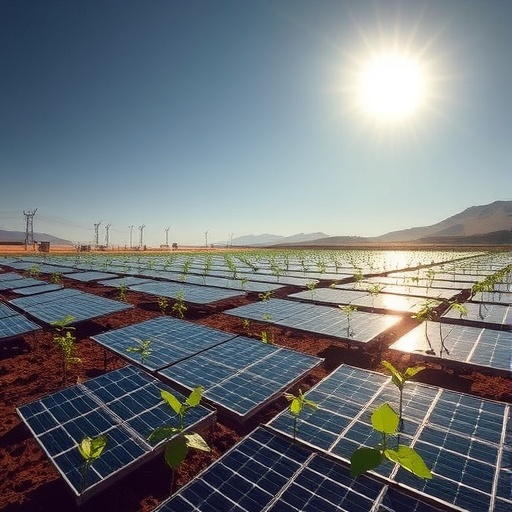
Solar evaporation technology has long been hailed as a promising solution to address water scarcity and provide sustainable desalination. However, a persistent challenge has been the stark performance gap between carefully controlled laboratory experiments and variable, often harsh, real-world environmental conditions. A recent groundbreaking study by Wang, Ct., Lin, C., Xu, K., and colleagues, published in Nature Communications in 2026, provides a transformative perspective on this issue, engineering solar evaporation systems with unprecedented environmental robustness. Their work not only elucidates the mechanisms behind performance degradation in field applications but also offers innovative engineering principles to bridge the long-standing lab-to-field gap.
In laboratory settings, solar evaporators typically achieve high efficiency due to optimized materials and stable environmental parameters such as temperature, humidity, and solar irradiance. However, when deployed in field conditions, these devices often suffer dramatic drops in performance. Variations in atmospheric humidity, fluctuating solar intensity, temperature swings, wind, and contaminants significantly affect evaporation rates and energy conversion efficiency. Previous research has largely overlooked the integrated influence of these environmental parameters, focusing more on individual material performance rather than robustness. This new study directly confronts this oversight.
The research team began by performing an extensive diagnostic analysis of commercial and experimental solar evaporators under diverse real-world conditions. Utilizing a combination of high-fidelity climatological data sets and in-situ measurements, they quantified the performance deviations as a function of specific environmental stressors. Their findings revealed that parameters such as humidity and temperature variability contributed disproportionately to performance losses, explaining up to 40% efficiency reductions in some cases. Such quantitative insights were instrumental in guiding the design of more resilient evaporation architectures.
To address these challenges, the team engineered a novel multilayered solar evaporation platform incorporating materials with adaptive properties to dynamically respond to environmental changes. At the core is a selectively porous membrane capable of modulating vapor flux in response to ambient humidity levels, maintaining optimal evaporation rates even under high moisture conditions. Surrounding this core are superhydrophobic coatings that prevent fouling and salt accumulation, which historically compromise long-term device sustainability and efficiency.
Another key innovation lies in the photothermal conversion layer. Traditional materials degrade or lose efficiency under high solar irradiance and thermal cycling. By employing nanocomposite materials that exhibit both high solar absorbance and superior thermal stability, the researchers achieved a system that not only maximizes heat capture but also withstands temperature fluctuations without structural degradation. These materials were synthesized via an eco-friendly, scalable method suitable for mass production, addressing industry concerns over practical deployment.
The integration of these components was complemented by a bio-inspired ventilation strategy. Drawing inspiration from desert beetles’ water harvesting mechanisms, the team designed micro-scale surface textures that promote efficient vapor diffusion while reducing convective heat loss. This biomimicry approach enabled the platform to maintain high evaporation rates across varying wind conditions, effectively mitigating environmental disturbance impacts.
One of the most compelling aspects of the study was the rigorous field testing conducted across multiple geographically and climatically distinct test sites. From arid deserts with extreme diurnal temperature swings to tropical coastal regions with high humidity and saline aerosols, the engineered solar evaporator consistently outperformed conventional designs. On average, the new system demonstrated a 25-30% higher evaporation rate under fluctuating environmental conditions compared to leading commercial devices, confirming the effectiveness of the environmental robustness engineering.
Furthermore, the durability of the system was subjected to accelerated aging tests simulating prolonged exposure to ultraviolet radiation, saltwater corrosion, and mechanical abrasion. The multilayered platform retained over 90% of its initial efficiency after 12 months equivalent of outdoor operation, a remarkable achievement signaling the potential for long-term sustainable deployment. This robustness addresses one of the main barriers to commercialization — the trade-off between performance and lifespan — thus enhancing the economic feasibility of solar evaporation technologies.
Beyond empirical testing, the researchers employed advanced computational modeling to predict system performance under future climate scenarios. The models demonstrated that the environmental adaptability of the engineered system would sustain high efficiency even amid climate variability, such as increased temperature extremes and shifting humidity patterns. This predictive capability offers stakeholders critical insights for planning resilient water purification infrastructure in the face of global climate change.
The implications of this research extend far beyond solar evaporation. By establishing a framework to systematically quantify and engineer environmental robustness, it paves the way for advancements in other solar-driven technologies such as photovoltaics, solar thermal power, and photocatalytic systems. The multidisciplinary approach combining materials science, bio-inspired design, climatology, and systems engineering exemplifies the future of sustainable technology development.
Importantly, the study also addresses socioeconomic factors by demonstrating that the materials and fabrication processes used are compatible with low-cost manufacturing. This makes the technology accessible to underserved regions where water scarcity is most acute. The authors highlight ongoing collaborations with non-governmental organizations and local communities to co-develop scalable deployment strategies that ensure equitable access to clean water, emphasizing the humanitarian impact of their work.
In conclusion, the work by Wang, Ct., Lin, C., Xu, K., and their team redefines the solar evaporation landscape by offering a robust, high-performance solution tailored for real-world environmental complexity. Their systematic approach to bridging the gap between laboratory potential and field reality stands as a testament to innovation grounded in practical challenges. As global water demand intensifies, such pioneering efforts in environmental engineering will be crucial to securing sustainable water resources for future generations.
This pioneering research sheds light on how deliberate design and engineering can overcome natural variability and environmental extremes that have historically limited the practical impact of solar evaporation. It underscores the necessity of adopting holistic perspectives in renewable technology development, extending beyond mere efficiency metrics to encompass durability, adaptability, and socio-economic factors. With this advancement, solar evaporation may soon transition from a promising experimental concept to a reliable, scalable solution addressing one of humanity’s most pressing challenges — access to clean water.
The research community and industry stakeholders alike are poised to benefit from these insights, sparking new waves of innovation dedicated to closing the divide between laboratory breakthroughs and real-world applications. As global challenges grow more complex, such integrative approaches will play an indispensable role in translating scientific discovery into impactful, resilient technologies that serve diverse environments and populations.
In the broader context of sustainability and climate adaptation, this study embodies the principles of resilience engineering—designing systems not just to perform optimally under ideal conditions but to thrive amid uncertainty and change. Such resilient technologies will be pivotal as societies strive for harmony with nature while meeting escalating resource demands.
With more extensive field deployments planned over the coming years, the refined solar evaporation platform developed by Wang and colleagues holds promise to revolutionize water harvesting, desalination, and purification worldwide. It is a shining example of how cutting-edge science can address the urgent need for robust, sustainable water solutions in an increasingly unpredictable world.
Article References:
Wang, Ct., Lin, C., Xu, K. et al. Engineering high environmental robustness in solar evaporation to bridge the lab-to-field performance gap. Nat Commun (2026). https://doi.org/10.1038/s41467-026-71004-y
Image Credits: AI Generated


