

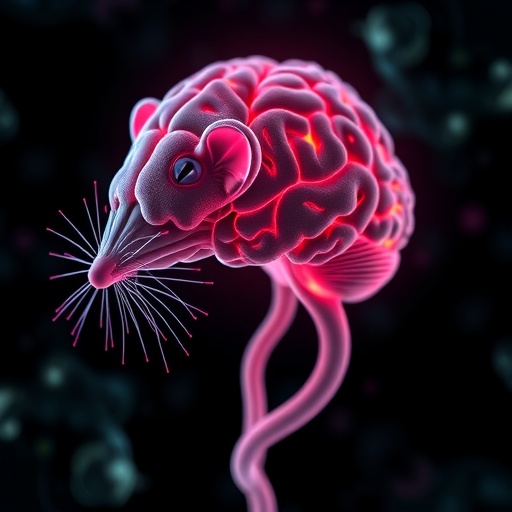
The tantalizing aroma of lasagna or the sight of a glistening holiday ham can no doubt awaken a deep hunger, igniting the senses in anticipation of a meal. Yet, beyond these familiar sensations lies a far less understood communication network: the vagus nerve, an information superhighway connecting the gut directly to the brain. While we typically appreciate how sensory cues from the environment influence our appetite, a groundbreaking study has now illuminated how signals originating in the gastrointestinal tract profoundly shape brain function, particularly cognitive aging.
Researchers from Stanford Medicine and the Arc Institute in Palo Alto have unveiled a remarkable biological pathway linking the gut microbiome—the vast ecosystem of bacteria residing in our intestines—to age-related cognitive decline in mice. The study reveals that as the gut microbial community shifts with advancing age, it triggers inflammatory responses that disrupt communication along the vagus nerve. This disruption in gut-brain signaling impairs hippocampal function, the region of the brain indispensable for memory formation and spatial navigation—functions notoriously vulnerable during aging.
Dr. Christoph Thaiss, assistant professor of pathology and a senior author on the study, emphasizes the dynamic nature of memory decline. “Memory loss is often regarded as an inevitable, brain-intrinsic feature of aging,” Thaiss notes. “Our findings challenge this assumption by demonstrating that the timing and extent of cognitive decline are modulated by peripheral factors within the gastrointestinal tract.” This paradigm shift opens new avenues for understanding how the aging body influences brain health far beyond neurons alone.
In experiments designed to probe the gut-brain relationship, young and aged mice were co-housed, facilitating microbial transfer via close contact and shared environments. After a month, young mice exposed to the microbiome profile of older animals exhibited cognitive impairments mirroring those seen in naturally aged mice. These deficits manifested in diminished exploration of new objects and compromised maze navigation—tasks that depend heavily on hippocampal integrity.
Additional layers of investigation employed germ-free mice, raised in sterile conditions devoid of gut bacteria. Remarkably, old germ-free mice maintained youthful cognitive performance, implicating microbial presence as a critical factor in memory decline. Introducing aged microbiomes into these germ-free young mice replicated cognitive impairments, directly implicating microbial composition as a modulator of brain aging.
Delving into microbial taxonomy, the team identified an age-associated bloom of Parabacteroides goldsteinii in the guts of older mice, correlating with cognitive deficits. When this bacterial species was introduced into young mice, their memory and spatial abilities declined, coinciding with decreased hippocampal neuronal activity. This key discovery links specific microbial populations with functional brain outcomes, highlighting a microbial driver of cognitive aging.
Mechanistically, the study delineates a three-step cascade: as mice age, their gut microbiome alters, producing elevated levels of medium-chain fatty acids, metabolites known to activate myeloid immune cells within the gastrointestinal tract. These immune responses then initiate inflammation, which subsequently inhibits vagus nerve signaling. The interruption of vagal communication blunts hippocampal activation necessary for forming robust memories.
What is truly remarkable is the reversibility observed in these processes. Stimulating the vagus nerve in aged mice restored their cognitive function to levels indistinguishable from youthful counterparts, underscoring that cognitive decline driven by gut-brain axis dysfunction is not an irreversible fate. This insight positions the vagus nerve as a powerful therapeutic target to counteract memory loss, leveraging peripheral nervous pathways rather than solely focusing on the brain itself.
The research further contextualizes gut-brain interactions within the larger concept of interoception—the brain’s ability to perceive internal physiological states. While extensive knowledge exists regarding exteroception, the sensing of external stimuli through traditional senses, less is understood about interoception and its age-dependent alterations. This study highlights that age impairs interoceptive signals from the gastrointestinal tract, diminishing the brain’s capacity to monitor and adapt to internal bodily states, which in turn degrades cognitive functions.
Importantly, the gut’s evolutionary primacy as one of the earliest developed organ systems suggests that brain processes have long been shaped by gut-derived signals. Dr. Maayan Levy, co-senior author, reflects on this evolutionary perspective: “The gastrointestinal tract likely provides essential contextual cues for cognitive processes such as memory formation. Understanding this symbiotic interaction reshapes how we conceptualize the intertwined nature of body and brain in aging.”
From a translational standpoint, these findings open promising therapeutic possibilities. Since vagus nerve stimulation is already FDA-approved for conditions like depression, epilepsy, and stroke recovery, repurposing this modality to treat age-related cognitive decline has pragmatic clinical appeal. Furthermore, the gastrointestinal tract’s accessibility offers avenues for non-invasive monitoring and modulation of gut microbiota and neuronal activity, potentially enabling personalized interventions aimed at preserving memory.
The team is expanding their inquiry to human studies, probing whether similar gut-brain signaling pathways drive cognitive aging in people. Success in this endeavor could revolutionize approaches to combat dementia and other memory disorders, redirecting focus from the brain alone to systemic, microbiome-informed strategies.
This pioneering work not only challenges existing dogmas about neurodegeneration but also spotlights the profound role of a once-overlooked organ system in shaping the brain’s aging trajectory. With continued research, harnessing the gut microbiome and vagus nerve may yield powerful strategies to extend cognitive healthspan, providing hope for millions facing age-associated memory challenges worldwide.
Subject of Research: Gut microbiome influence on age-associated cognitive decline via vagus nerve signaling
Article Title: Intestinal interoceptive dysfunction drives age-associated cognitive decline
News Publication Date: 11-Mar-2026
Web References: https://doi.org/10.1038/s41586-026-10191-6
Keywords: Gut microbiome, vagus nerve, cognitive decline, aging, hippocampus, interoception, Parabacteroides goldsteinii, inflammation, memory, neurogastroenterology, gut-brain axis, vagus nerve stimulation


