

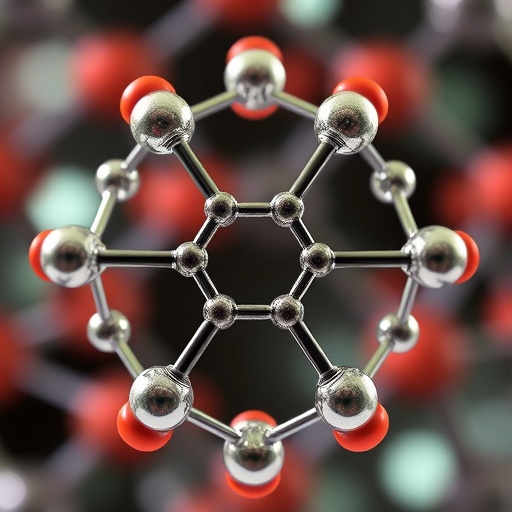
In a groundbreaking study published recently in Nature Communications, a team of researchers led by Wang, F., Li, YH., and Wang, FX. have unveiled a novel approach to significantly enhance Fenton-like reactions through the innovative use of a homointerpenetrated metal-organic framework (MOF). Their work, titled “Dynamic stretching beyond electron transfer in a homointerpenetrated metal‒organic framework for enhanced Fenton-like reactions,” opens new avenues in the field of catalysis, environmental remediation, and chemical synthesis by transcending traditional electron transfer mechanisms. This breakthrough could have sweeping implications for industrial applications and pollutant degradation technologies.
Metal-organic frameworks are crystalline materials composed of metal ions or clusters coordinated to organic ligands, forming porous architectures with immense surface areas. These characteristics make MOFs ideal candidates for catalysis, gas storage, and molecular separation. The novelty in this recent work lies in the exploitation of a dynamic stretching mechanism within a homointerpenetrated MOF structure that surpasses conventional electron transfer pathways typically employed in Fenton-like catalytic systems. By engineering the framework’s flexibility and electron transport properties, the team managed to achieve unprecedented catalytic efficiency.
Traditionally, Fenton reactions utilize iron-based catalysts to generate hydroxyl radicals through the reaction of hydrogen peroxide, leading to the breakdown of organic pollutants and contaminants. However, the efficiency of these reactions is often limited by factors such as the electron transfer rate, catalyst stability, and surface availability. The homointerpenetrated MOF introduced by Wang and colleagues circumvents these limitations through dynamic structural modulation, which actively participates in the catalytic cycle and enhances the production of reactive oxygen species.
Central to the study is the concept of dynamic stretching—an effect that involves the periodic expansion and contraction of the MOF’s lattice in response to catalytic cycles. This flexibility enables more efficient electron delocalization and facilitates charge transfer across the framework. Unlike static MOFs, the stretching mechanism optimizes the spatial arrangement of active sites and the accessibility of reactants, thus drastically improving reaction kinetics. In other words, the MOF framework itself behaves almost like a molecular “breathing” entity, adjusting in real-time to the demands of the catalytic process.
To probe these complex phenomena, the research team employed a suite of sophisticated characterization techniques. Spectroscopic methods such as electron paramagnetic resonance (EPR) and X-ray absorption spectroscopy (XAS) were pivotal in illustrating the changes in electronic states and local coordination environments during catalysis. Moreover, in situ measurements allowed for observation of dynamic structural variations, confirming that the MOF undergoes controlled deformation while maintaining crystalline integrity—an essential aspect contributing to its catalytic prowess.
The fine-tuning of the homointerpenetrated architecture was achieved through careful synthetic control. By modulating ligand connectivity and metal node composition, the researchers created a framework with optimal interpenetration density. This balancing act between rigidity and flexibility enabled the precise dynamic stretching behavior observed. Computer simulations and density functional theory (DFT) calculations supported experimental findings by mapping electron density distribution and predicting the impact of mechanical deformation on electron transfer rates and catalytic activity.
One of the most exciting outcomes reported is the MOF’s enhanced ability to catalyze the generation of hydroxyl radicals in Fenton-like reactions under mild conditions. This enhancement not only accelerates reaction rates but also extends the catalyst’s operational lifespan, overcoming typical issues related to metal leaching and structural degradation. The sustainability aspect is significant, especially considering the environmental benefits of using such catalysts for wastewater treatment, pollutant mineralization, and organic compound degradation.
Furthermore, the study delves into how the dynamic stretching mechanism transcends electron transfer to influence other crucial catalytic parameters. For instance, the stretching modulates the pore environment, affecting reactant adsorption and product desorption kinetics. This nuanced control over molecular traffic within the pores signifies a paradigm shift in designing responsive catalytic materials that adapt to varying reaction conditions, a feature previously elusive in rigid catalysis platforms.
From an application standpoint, the findings hold promise beyond Fenton reactions. The design principles established here could be extended to other catalytic systems requiring fine control over electron flow and molecular interactions. This includes photocatalysis, electrocatalysis, and enzymatic biomimetic processes, where dynamic structural responses could similarly enhance performance. The homointerpenetrated MOF framework, therefore, represents a versatile platform for the next generation of smart catalysts.
Another compelling aspect of this research is the insight it provides into the interplay between mechanical properties and catalytic functions in porous materials. By bridging materials science, physical chemistry, and catalysis, the study paves the way for multi-disciplinary innovations. It elucidates how minute mechanical motions at the molecular level have outsized effects on electronic behavior and reaction pathways, offering a new dimension to catalyst design that marries structural dynamics with chemical reactivity.
Looking ahead, the research team highlights the importance of exploring other types of MOFs with varying topologies and compositions to tailor the dynamic stretching effect for specific catalytic processes. Integrating external stimuli, such as light, electric fields, or mechanical stress, could further amplify the adaptive capabilities of these materials. This vision positions MOFs not merely as passive scaffolds but as active, tunable devices in chemical engineering.
Moreover, scalability and practical implementation of such dynamic MOFs in industrial settings remain a crucial frontier. The team underscores the need for developing cost-effective synthetic routes and ensuring material stability under prolonged operational and environmental stress. Addressing these challenges will be key to translating laboratory successes into real-world applications that benefit water purification, chemical manufacturing, and environmental sustainability efforts on a global scale.
In summary, the discovery of dynamic stretching beyond electron transfer in a homointerpenetrated metal-organic framework constitutes a significant leap in catalysis research. By fundamentally rethinking how material frameworks can participate actively and dynamically in chemical reactions, this work not only enhances Fenton-like catalysis but also charts a course toward multifunctional, adaptive catalytic materials. It exemplifies the transformative potential of combining structural innovation with electronic precision to forge the catalysts of the future.
This pioneering study amplifies the role of MOFs as frontiers in material science, particularly emphasizing the importance of dynamic and responsive behavior in catalysis—traits that conventional catalysts often lack. The reverberations of this research will likely be felt across multiple sectors, inspiring further exploration into the rich intersection of physical dynamics, electron transfer, and catalytic efficiency. It is a vivid reminder that the microscopic dance within molecular frameworks can orchestrate macroscopic environmental and technological advancements.
As research continues to unfold based on these findings, much anticipation surrounds potential synergies with renewable energy harnessing and sustainable chemical conversion processes. The interactive nature of dynamic MOFs might also encourage novel sensor designs, molecular machines, and next-generation energy storage systems, highlighting the versatility born from a single design principle—dynamic stretching.
Ultimately, the study by Wang, Li, Wang, and colleagues stands as a landmark in the quest to harness the full potential of metal-organic frameworks, underpinning a new era where dynamic structural tuning translates directly into superior catalytic performance. This innovation not only addresses long-standing challenges in Fenton chemistry but also unlocks a broader vision for intelligent materials that can adapt, respond, and excel in demanding chemical environments.
Subject of Research: Enhanced Fenton-like catalysis using homointerpenetrated metal-organic frameworks with dynamic structural modulation.
Article Title: Dynamic stretching beyond electron transfer in a homointerpenetrated metal‒organic framework for enhanced Fenton-like reactions.
Article References:
Wang, F., Li, YH., Wang, FX. et al. Dynamic stretching beyond electron transfer in a homointerpenetrated metal‒organic framework for enhanced Fenton-like reactions. Nat Commun (2026). https://doi.org/10.1038/s41467-026-68917-z
Image Credits: AI Generated


