

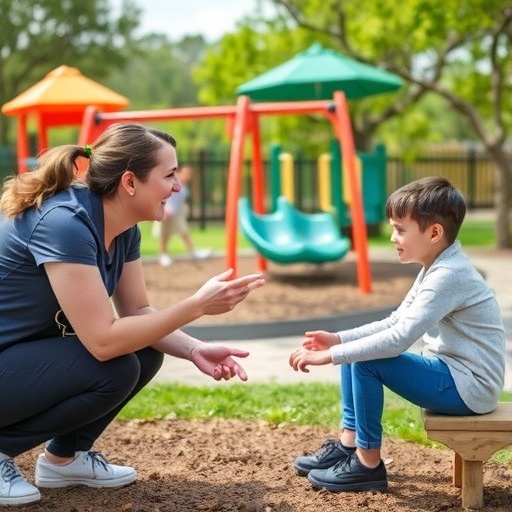
Public playgrounds have long been celebrated as vital social spaces designed primarily for children’s recreation and development. However, a groundbreaking new study challenges the traditionally child-centric model by spotlighting the overlooked yet crucial role caregivers play in shaping the playground experience. By examining not only how caregivers interact with children but also their behavioral patterns, spatial presence, and emotional engagement, researchers have uncovered a complex dynamic that calls for a radical rethinking of playground design. This investigation repositions playgrounds as intergenerational environments where play, care, and social interaction coexist symbiotically, inviting designers and policymakers to embrace a more inclusive approach.
Until now, playgrounds have been predominantly perceived as child-focused arenas where children’s autonomous play is prioritized, while caregiver involvement was largely relegated to a passive backdrop. This study disrupts that paradigm by showing that caregiving should not be dismissed as a mere peripheral activity but recognized as a set of observable, active behaviors that directly influence the rhythm, duration, and affective tone of children’s play. Caregivers’ proximity to play structures, verbal encouragement, and interactive involvement enhance children’s engagement levels, whereas feelings of discomfort or social isolation among caregivers can dampen such involvement. These findings highlight the profound impact caregiver emotions and behaviors exert on the playground atmosphere.
Employing a rigorous mixed-methods approach, the research integrates on-site questionnaire surveys, an adapted version of the System for Observing Play and Recreation in Communities (SOPARC), and detailed spatial activity mapping to systematically record how caregivers engage in playground settings. Through this multifaceted lens, four distinct caregiving roles emerged: active player, guided play partner, passive supervisor, and leisure parent. Each role is defined by unique postural and spatial characteristics, ranging from immersive participation to distant observation. Importantly, these roles are fluid rather than fixed, evolving dynamically with context, time, and individual disposition, thus challenging the conventional fixed-user typology that has historically dominated playground design discourse.
This nuanced understanding led researchers to propose five innovative design strategies aimed at fostering inclusive, intergenerational play environments. Firstly, the introduction of shared-use play equipment encourages interaction between generations, facilitating joint participation and collaborative play. Secondly, the creation of adaptive zones responds to the embedded presence of caregivers by offering flexible spaces tailored to varied engagement levels and social needs. Thirdly, diversified rest environments provide comfortable and appealing areas for caregivers and children to sustain co-presence and social bonding. Fourthly, enhancing spatial connectivity within playgrounds supports smooth transitions between caregiving roles, enabling fluid movement from active engagement to supervisory states. Finally, incorporating multisensory stimuli extends engagement beyond children to caregivers, enriching overall experience.
Collectively, these strategies signify a paradigm shift from perceiving playgrounds solely as child-exclusive domains to recognizing them as intergenerational infrastructures of care. Such environments support negotiated autonomy—allowing children freedom to explore while caregivers maintain relational presence—and foster relational inclusion, where social connections transcend age boundaries. This broadened conceptualization presents playgrounds as vibrant public arenas where everyday co-presence and interdependence are not only possible but actively encouraged and celebrated.
Despite the promising advances offered by this research, its scope and methodology come with inherent limitations that temper broad generalizations. Conducted exclusively within the urban context of Hong Kong, cultural norms, population density, and spatial configurations unique to this metropolitan landscape may influence observed behaviors, limiting applicability to different geographic or socio-cultural settings. The sample size of 95 caregivers across 40 playgrounds, while robust, constrains in-depth subgroup analyses that might reveal more granular variations in caregiver-child interaction driven by demographic factors or playground characteristics.
Moreover, the study’s focus on playgrounds officially designated for children aged 2–12, as per local guidelines, was not supplemented with precise individual age or developmental data for children. Observer-estimated caregiver attributes such as gender and age were deliberately excluded to reduce classification bias, yet these variables likely play a significant role in caregiving styles and engagement. Another methodological limitation arises from the snapshot observation technique employed, which recorded caregiver roles once per session. This approach, although illuminating persistent behavioral patterns, does not capture the dynamic, moment-to-moment role switching caregivers frequently undertake during play sessions.
Nonetheless, the aggregation of numerous temporal and spatial observations across diverse playgrounds yielded consistent distributional patterns and demonstrated robust environment–behaviour interdependencies. These findings reinforce the validity of the identified caregiving roles and their spatial manifestations, offering a reliable foundation for design innovation. Future studies might expand this empirical base through longitudinal tracking and incorporate qualitative tools such as interviews or time-use diaries to deepen insights into caregivers’ intentions and experiences, further bridging observed behavior with motivational context.
A critical direction for subsequent research lies in the cross-cultural exploration of caregiving engagement in playgrounds. Given the global diversity in social norms regarding child-rearing, public space use, and intergenerational interaction, comparative studies could elucidate how cultural narratives and values shape caregiving roles and expectations. Longitudinal methodologies would also illuminate how caregiving behaviors evolve over time, not only within individual development cycles but also in response to changing societal conditions, technological influences, and urban design trends.
In relation to analytical frameworks, this study utilized a five-group age classification model but suggests that future research might employ dichotomized variables—such as distinguishing caregivers above and below age 50—to enhance statistical power and clarity. Expanding sample sizes and incorporating more nuanced demographic data would allow for detailed subgroup analyses, revealing intersections of age, gender, cultural background, and socio-economic status in shaping caregiving engagement. Such granularity is crucial to developing targeted, context-sensitive playground designs that resonate with diverse user populations.
From a policy perspective, the implications of this research call for a reorientation of inclusive playground standards to explicitly incorporate caregiver perspectives and spatial requirements. Municipal authorities and design professionals are encouraged to adopt evaluation metrics that move beyond mere physical accessibility and safety, toward assessing how playground environments foster intergenerational presence, support varying caregiving roles, and facilitate seamless transitions between those roles. This holistic vision aligns with principles of universal design, advocating for public spaces that enable shared social life and community building across age groups.
In practical terms, incorporating caregiver-inclusive design features could transform urban playgrounds into vital social infrastructure that transcends utilitarian recreation. By supporting extended co-presence and meaningful interaction, playgrounds can nurture stronger bonds between generations, reduce caregiver social isolation, and promote child development through enriched relational contexts. Sensors, seating arrangements, multi-use play installations, and spatial layouts that anticipate caregiver mobility and rest needs exemplify this progressive approach.
These insights underscore the importance of moving beyond traditional metrics of playground success, which often prioritize physical accessibility and child safety alone. Instead, recognizing playgrounds as complex social ecosystems invites a recalibration of design priorities to encompass emotional well-being, social cohesion, and interdependence. By embedding caregiver behavioral and spatial analysis into design processes, environments become far more responsive and inclusive, catalyzing a social ecology that supports everyday care and play.
In summary, this pioneering study advances a transformative vision of public playgrounds as relationally inclusive spaces deeply attuned to the intertwined needs and roles of children and caregivers. Through rigorous empirical observation and spatial analysis, it challenges static user typologies and foregrounds the dynamic, context-sensitive nature of caregiver engagement. The proposed inclusive design strategies pave the way for future urban landscapes shaped by mutual presence, negotiated autonomy, and shared public life, elevating playgrounds from mere play zones to intergenerational arenas of care and connection.
As urban areas worldwide grapple with rising population density and shifting social fabrics, the need for public spaces that promote social inclusivity and intergenerational solidarity has never been greater. This study offers timely, evidence-based guidance for architects, urban planners, policymakers, and community advocates seeking to create public playgrounds that are not only physically accessible but socially vibrant and relationally inclusive. By casting caregivers as active participants rather than passive bystanders, playground design can evolve to reflect the rich social realities of everyday life.
In embracing this evolved perspective, future playgrounds will not only nurture children’s growth but also honor the caregiving practices that underpin their experiences. They will serve as foundational spaces where play and care intertwine seamlessly—spaces where generations connect, relationships grow, and communities flourish. This represents a bold step toward realizing truly inclusive public realms, grounded in empathy, diversity, and shared humanity at their very core.
Subject of Research:
Caregiver engagement and intergenerational dynamics in public playgrounds; environment-behaviour analysis and inclusive design strategies for enhancing co-presence and relational inclusion.
Article Title:
Enhancing caregiver engagement in public playgrounds: inclusive design strategies for intergenerational play.
Article References:
YANG, Z., ZHOU, R., ZHAO, X. et al. Enhancing caregiver engagement in public playgrounds: inclusive design strategies for intergenerational play. Humanit Soc Sci Commun 12, 1927 (2025). https://doi.org/10.1057/s41599-025-06200-0
Image Credits: AI Generated


