

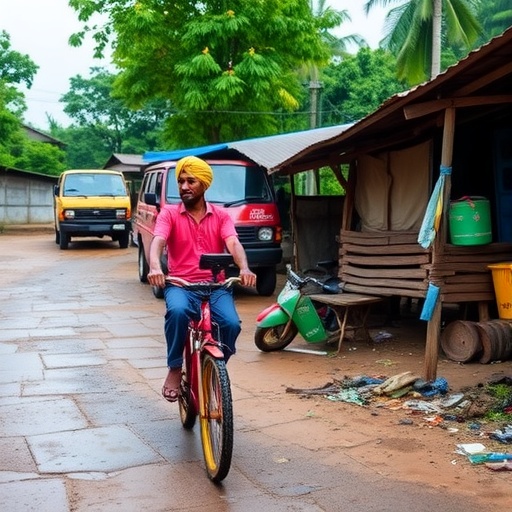
In the context of escalating climate change and persistent socio-political unrest, the interplay between violent conflict and natural hazards poses significant challenges for vulnerable populations worldwide. A groundbreaking study conducted by researchers Markus Leis and Katerina Petrova sheds light on how combined models of violent conflict and natural hazards can improve predictions of household mobility in Bangladesh, a country often at the forefront of these dual threats. This research, published in the journal Commun Earth Environ in 2025, offers critical insights that could reshape policy-making and humanitarian aid strategies in regions most affected by instability and environmental risks.
Bangladesh, with its low-lying geography and inadequate infrastructure, is highly vulnerable to natural disasters such as cyclones, floods, and rising sea levels. Concurrently, the nation grapples with internal conflicts and sociopolitical strife exacerbated by resource scarcity and ethnic tensions. Leis and Petrova’s study tackles the complex relationship between these two factors, asserting that traditional predictive models have often overlooked their interconnections. By employing a dual approach, the researchers reveal a fuller picture of how households are likely to respond to these intertwined challenges, particularly in terms of migration and displacement.
Through extensive field research and analysis of historical data, Leis and Petrova demonstrate that areas adversely impacted by violent conflicts tend to experience greater displacement during natural disasters. The researchers argue that this correlation is not merely coincidental; rather, it suggests that those already facing social instability are less equipped to deal with the additional stressors posed by climate-related hazards. This finding has profound implications for disaster preparedness and response strategies, emphasizing the urgent need for integrating conflict analyses into environmental planning.
Moreover, their models employed sophisticated statistical techniques and machine learning algorithms to analyze the multifaceted layers at play in household mobility. By synthesizing data from various sources—including socio-economic indicators, demographic information, and environmental assessments—the researchers managed to construct a predictive framework that offers policymakers a valuable tool. Notably, rather than treating violent conflict and natural hazards as separate entities, this research illustrates the necessity of understanding their interactions to effectively address the resulting humanitarian crises.
The implications of the study extend beyond academic interest; they are particularly relevant for organizations involved in disaster relief and conflict resolution. Acknowledging the intertwined nature of conflict and natural hazards can lead to more cohesive strategies that prioritize the needs of displaced households. Leis and Petrova argue for a paradigm shift wherein humanitarian organizations adopt a more integrated approach that considers the socio-political and environmental vulnerabilities simultaneously.
One of the standout aspects of this research lies in its potential to influence policy formulation. Policymakers could leverage the insights gained from this dual modeling to allocate resources more effectively and develop targeted interventions. For instance, areas identified as high-risk for both conflict and climatic events could benefit from enhanced infrastructure and community resilience programs aimed at mitigating displacement.
Furthermore, the researchers underscore the importance of community engagement in these strategies. Involving local populations in planning and decision-making processes can not only improve the efficacy of interventions but also empower communities to adapt to changing circumstances. This bottom-up approach is critical, especially in a country like Bangladesh, where local knowledge and context-specific solutions can make all the difference in disaster readiness and recovery.
Technological advancements contribute significantly to the efficacy of the predictive models developed by Leis and Petrova. The integration of satellite imagery, real-time data collection from various social media platforms, and traditional demographic surveys enriches the datasets, offering a more granular understanding of the situation. Machine learning algorithms facilitate the analysis of this complex data, allowing for dynamic modeling that can be updated as new information emerges.
Despite the promising findings, the researchers caution that the path forward is fraught with challenges. For one, the situation in Bangladesh is not isolated; it reflects broader global trends where climate change and conflict intersect, particularly in countries that are already prone to instability. The dual model developed by Leis and Petrova could serve as a prototype for similar studies in other regions, offering a framework for understanding the complexities of modern displacement crises around the globe.
In conclusion, this innovative research by Leis and Petrova marks a significant contribution to the fields of environmental studies and conflict resolution. By illustrating the symbiotic relationship between violent conflict and natural hazards, their study not only enhances predictive modeling for household mobility in Bangladesh but also sets the stage for transformative change in disaster management and humanitarian assistance. The call for an integrated response to these multifaceted challenges is clear and urgent, as the world grapples with an increasing number of crises that demand holistic solutions.
As the findings resonate across various domains, they invite reflection on how societies can better prepare for the inevitable challenges posed by a volatile climate and complex sociopolitical dynamics. Whether through policy, community engagement, or technological innovation, the research provides a guiding light for weaving resilient and adaptive strategies that prioritize human dignity and survival in the face of adversity.
Subject of Research: The interplay between violent conflict and natural hazards in predicting household mobility in Bangladesh.
Article Title: Combined models of violent conflict and natural hazards improve predictions of household mobility in Bangladesh.
Article References:
Leis, M., Petrova, K. Combined models of violent conflict and natural hazards improve predictions of household mobility in Bangladesh. Commun Earth Environ (2025). https://doi.org/10.1038/s43247-025-03086-3
Image Credits: AI Generated
DOI:
Keywords: Climate change, human mobility, violent conflict, natural hazards, predictive modeling, Bangladesh, resilience, humanitarian response, community engagement, data analysis.


