

Unraveling the Quantum Secrets of Regular Black Holes: A Revolutionary Leap in Our Understanding of Spacetime
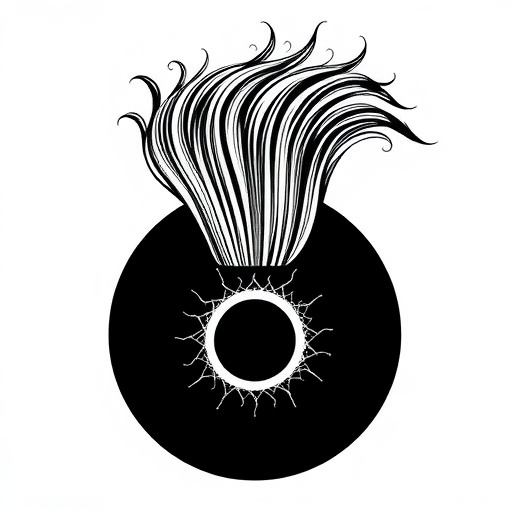
The universe, in its infinite complexity, continues to present us with phenomena that push the boundaries of our comprehension, none more enigmatic than black holes. For decades, these cosmic behemoths have been the subject of intense scientific scrutiny, primarily through the lens of Einstein’s theory of general relativity which predicts singularities at their core. However, recent theoretical breakthroughs, spearheaded by the groundbreaking work of S.M. Amirfakhrian, published in the European Physical Journal C, are challenging these long-held notions by proposing a revolutionary concept: regular black holes imbued with fermionic quantum hair, undergoing topological phase transitions. This ambitious research ventures into the quantum realm, suggesting that the heart of a black hole might not be a point of infinite density but rather a region governed by principles of quantum mechanics, leading to potentially observable and profound implications for cosmology and particle physics. The image accompanying this revolutionary paper, an intricate visualization of theoretical spacetime structures, hints at the complexity and beauty of these newly proposed cosmic entities, igniting imaginations within the scientific community and beyond.
At the heart of this paradigm shift lies the concept of “regular black holes.” Unlike their classical counterparts, which are defined by an inescapable singularity, regular black holes are theorized to possess a smooth, non-singular structure at their core. This theoretical departure from the singularity is crucial, as singularities represent a breakdown of our current physical laws, a cosmic “no-go zone” where our mathematical models fail. By proposing a regular structure, Amirfakhrian’s work opens a pathway for applying quantum mechanics to the very fabric of these extreme gravitational objects, allowing for a more complete and consistent description that avoids the infinities that plague classical black hole theory. This theoretical framework allows for a richer understanding of the internal dynamics of these objects, promising to resolve some of the most persistent paradoxes in astrophysics.
The introduction of “fermionic quantum hair” is perhaps the most intriguing aspect of this research. In physics, hair refers to properties of a black hole beyond its mass, charge, and angular momentum, which are the only characteristics observable from the outside in classical general relativity. The concept of quantum hair suggests that quantum mechanical properties can manifest as external features of a black hole, effectively imprinting information onto the spacetime geometry that could, in principle, be detected. Amirfakhrian’s specific focus on fermionic quantum hair implies that the fundamental particles obeying Fermi-Dirac statistics, such as electrons and quarks, play a pivotal role in shaping these quantum characteristics, offering a direct link between fundamental particle physics and the macroscopic behavior of black holes. This novel idea suggests that the “no-hair theorem” of classical black holes might be incomplete when quantum effects are considered.
The research further posits that these regular black holes with fermionic quantum hair are susceptible to “topological phase transitions.” This concept draws an analogy from condensed matter physics, where materials can undergo dramatic changes in their fundamental properties – their topology – when subjected to varying conditions like temperature or pressure. In the context of black holes, these transitions could be triggered by changes in the quantum environment, leading to alterations in the very geometry and topology of spacetime around the black hole. Imagine a smooth manifold suddenly developing a “twist” or a “hole” due to quantum fluctuations or interactions, fundamentally changing the nature of the region. This implies that black holes might not be static objects but rather dynamic entities capable of undergoing profound transformations in their structure.
The implications of these topological phase transitions are far-reaching. They could offer a new mechanism for understanding phenomena such as Hawking radiation, the gradual evaporation of black holes, or even provide insights into the early universe and the formation of cosmic structures. If black holes can transition between different topological states, it suggests a new form of evolution for these objects, opening up possibilities for understanding their lifecycle and their interactions with the surrounding cosmic environment. The very definition of a black hole might need to be re-evaluated if it can fundamentally alter its geometric and topological characteristics.
One of the most tantalizing aspects of this research is the potential for observational verification, however challenging it may be. While directly probing the interior of a black hole remains an insurmountable task with current technology, the concept of quantum hair, especially if it influences observable phenomena like gravitational waves or the cosmic microwave background, could offer indirect evidence. Theoretical predictions of subtle distortions in these cosmic signals, attributable to the presence of this quantum hair, could provide smoking guns for the existence of regular black holes and their unique quantum properties. Such discoveries would undoubtedly revolutionize our understanding of gravity and the universe at its most extreme scales.
The mathematical framework employed in this study is sophisticated, weaving together principles from quantum field theory in curved spacetime with advanced differential geometry. Amirfakhrian tackles the complexities of fermionic fields interacting with a dynamic gravitational background, employing techniques that allow for the description of quantum effects within a relativistic context. The derivation of conditions under which these topological transitions occur requires precise calculations involving stress-energy tensors and the behavior of quantum fields near the gravitational horizon, a testament to the rigor of the theoretical investigation. The intricate interplay between quantum fluctuations and spacetime curvature is at the forefront of this complex analysis, pushing the boundaries of theoretical physics.
The very existence of fermionic quantum hair suggests a departure from the classical “no-hair theorem.” This theorem, a cornerstone of black hole physics, states that a black hole is completely characterized by only three external properties: mass, electric charge, and angular momentum. The idea of quantum hair implies that quantum mechanics might be adding additional, subtle “hair” to black holes. This “hair” would be a manifestation of quantum fields that settle into specific configurations around the black hole, imprinting their quantum nature onto the external gravitational field in a way that is not captured by classical descriptions. This could mean that two black holes with the same mass, charge, and angular momentum might still have subtle differences due to their quantum hair.
The implications for the information paradox, one of the most persistent puzzles in theoretical physics, are also profound. The information paradox arises from the apparent loss of information when matter falls into a black hole, a violation of the fundamental principle of quantum mechanics that information cannot be destroyed. If black holes are regular and possess quantum hair, it is conceivable that this “hair” could encode the information that fell into the black hole, providing a mechanism for its eventual retrieval or preservation, thereby resolving the paradox. The quantum hair could act as a cosmic hard drive, storing the details of everything that has ever crossed the event horizon, preventing the ultimate obliteration of information.
Understanding these topological phase transitions could also provide new avenues for exploring the nature of dark matter and dark energy. If black holes can undergo quantum transformations, these events might release energy or particles that could be related to these mysterious components of the universe. The dynamic nature of regular black holes could be a missing piece of the puzzle in our quest to comprehend the dominant forces shaping the cosmos. The subtle effects of these transitions might be imprinted on the large-scale structure of the universe, offering clues about the enigmatic dark sector.
The research is not merely theoretical; it is a beacon of inspiration for future experimental endeavors. While direct observation of quantum hair or topological transitions is currently beyond our reach, the theoretical predictions that emerge from this work can guide the development of new observational strategies. Future generations of gravitational wave detectors, advanced radio telescopes, and perhaps even novel quantum sensing technologies could be specifically designed to search for the subtle fingerprints of these quantum phenomena. The quest for direct evidence will undoubtedly fuel innovation in scientific instrumentation.
In essence, Amirfakhrian’s work presents a unified vision where the immensely large (black holes) and the infinitesimally small (quantum particles) are intricately linked. It suggests that the quantum world is not merely an abstract realm but has tangible, observable consequences even in the most extreme gravitational environments. This research bridges the gap between general relativity and quantum mechanics, offering a tantalizing glimpse into a more complete and unified theory of everything, a quest that has eluded physicists for generations. The elegant mathematical descriptions paint a picture of a cosmos far stranger and more interconnected than previously imagined.
The potential for this research to be viral stems from its profound implications for humanity’s understanding of the universe. The idea that black holes are not just cosmic vacuum cleaners but complex quantum objects capable of undergoing phase transitions is inherently captivating. It sparks curiosity about the fundamental nature of reality, the origins of the universe, and our place within it. This is not just science; it is a philosophical exploration of existence itself, communicated through the rigorous language of physics, which has the power to resonate with a broad audience hungry for knowledge and wonder. The sheer audacity of the claims, while grounded in solid theory, is enough to capture the public imagination.
The theoretical framework developed in this paper could also have unforeseen applications in other fields of physics. The understanding gained from studying quantum fields in curved spacetime and topological transitions in black holes might find parallels in areas like quantum computing, materials science, or even the study of fundamental forces. The cross-pollination of ideas between seemingly disparate fields is a hallmark of scientific progress, and this research offers fertile ground for such unexpected discoveries. The elegance of the underlying principles may unlock solutions in areas we haven’t even considered yet, representing a truly fundamental advance.
Finally, this research represents a significant step forward in our journey to unravel the deepest mysteries of the cosmos. By daring to reimagine the internal structure of black holes and imbue them with quantum properties, S.M. Amirfakhrian has opened up a new frontier of scientific inquiry. The regular black holes with fermionic quantum hair and their potential for topological phase transitions are not just theoretical curiosities; they are potential keys to unlocking a more profound understanding of gravity, quantum mechanics, and the very fabric of spacetime, ushering in a new era of cosmological exploration and discovery that will inspire generations of scientists.
Subject of Research: The exploration of regular black holes, their internal quantum structure, and the phenomenon of topological phase transitions.
Article Title: Fermionic quantum hair and topological phase transitions in regular black holes.
Article References:
Amirfakhrian, S.M. Fermionic quantum hair and topological phase transitions in regular black holes.
Eur. Phys. J. C 85, 1453 (2025). https://doi.org/10.1140/epjc/s10052-025-15198-3
Image Credits: AI Generated
DOI: https://doi.org/10.1140/epjc/s10052-025-15198-3
Keywords: Regular black holes, quantum hair, topological phase transitions, quantum gravity, spacetime topology, fermionic fields, physics of black holes.


