

Cosmic Heartbeats: Unraveling the Fractal Secrets of Black Hole Accretion
Prepare to have your understanding of the universe’s most enigmatic objects, black holes, and their feeding frenzies fundamentally reshaped. A groundbreaking study published in the European Physical Journal C is pulling back the cosmic curtain on the intricate and surprisingly ordered chaos of black hole accretion disks, revealing a hidden fractal dimension within their temporal dynamics. This research, spearheaded by a trio of intrepid astrophysicists, suggests that the seemingly random fluctuations observed in the material spiraling into these gravitational behemoths are not merely noise, but rather echoes of a deeper, self-similar pattern that governs their behavior across vast scales of time and space. The implications are profound, hinting at universal principles that govern even the most extreme astrophysical phenomena and offering a tantalizing new lens through which to view the universe’s most powerful engines.
For decades, astronomers have been captivated by the mesmerizing dance of matter around black holes. As gas, dust, and even stars plunge towards these cosmic abysses, they form vast, swirling disks. Within these accretion disks, intense gravitational forces and magnetic fields collide, generating a symphony of electromagnetic radiation that we can detect across the cosmos. However, the precise mechanisms driving the variability in this emitted light, particularly the phenomenon known as Quasi-Periodic Oscillations (QPOs), have remained elusive. These QPOs, which manifest as rhythmic pulses in the black hole’s emissions, have long been a puzzle, their origins debated and their relationship to the underlying physics of accretion still not fully understood; this new research offers a revolutionary perspective on these pulsatile cosmic signals.
The breakthrough lies in the application of fractal geometry, a mathematical framework that describes complex, irregular shapes and patterns that exhibit self-similarity – meaning they look the same at different scales. Think of a snowflake, where each branch is a miniature replica of the whole. The researchers, through meticulous analysis of observational data and sophisticated theoretical modeling, have discovered that the temporal fluctuations in black hole accretion disks, and specifically the patterns of QPOs, exhibit precisely this kind of fractal characteristic. This implies that the processes at play within these extreme environments are not localized to specific regions or moments but are intricately interconnected, with patterns repeating in a predictable, albeit complex, fashion across varying timescales.
This discovery challenges conventional models of accretion disks, which often treat them as simplified, homogeneous structures. Instead, the fractal nature suggests a far more intricate and dynamic system, where small-scale turbulence and instabilities might be amplified and mirrored in larger-scale phenomena, and vice versa. Imagine a vast cosmic ocean where ripples on the surface, generated by tiny disturbances, are mirrored in colossal waves, all governed by the same underlying fluid dynamics. The fractal temporal dynamics imply that the chaotic-looking light curves from accreting black holes are, in fact, deeply ordered, containing information about the system’s history and its future evolution encoded within their complex structures.
The team’s findings specifically highlight the scaling properties of Quasi-Periodic Oscillations within these fractal patterns. QPOs are not random outbursts but appear to follow specific scaling relationships as the black hole’s mass or accretion rate changes. This means that as a black hole grows or feeds more furiously, the characteristics of its QPOs change in a predictable, scale-invariant manner, akin to how the size of a fractal element relates to its overall structure. This newfound scaling law represents a significant leap forward in our ability to interpret and predict QPO behavior, transforming them from enigmatic signals into powerful diagnostic tools for probing the engines of black holes.
The implications of this fractal temporal dynamics extend far beyond the immediate study of black holes. Fractal geometry has found applications in a wide array of natural phenomena, from the branching of rivers and the structure of lungs to the patterns of earthquakes and the diffusion of particles. The emergence of fractal patterns in the highly energetic and gravitationally extreme environment of a black hole accretion disk suggests that these mathematical principles might be more universally applicable to complex dynamical systems than previously thought, potentially unifying our understanding of processes from the subatomic to the cosmic. It paints a picture of the universe as a tapestry woven with threads of self-similarity, even in its most violent and chaotic corners.
Furthermore, this research opens up exciting avenues for predicting the behavior of black holes and potentially even for distinguishing between different types of black hole systems based on their fractal signatures. By understanding the fractal dimensions and scaling laws, astronomers might be able to determine the mass, spin, and magnetic field configurations of black holes with unprecedented accuracy, even for those too distant to observe directly. This could revolutionize our ability to map the distribution of black holes in the universe and to study their evolution over cosmic timescales. It’s like having a unique fingerprint for each black hole, allowing us to categorize and understand them with incredible specificity.
The complexity of astrophysical systems, often characterized by seemingly random fluctuations, has long been a stumbling block for theoretical physicists. However, the discovery of fractal temporal dynamics in black hole accretion provides a powerful new framework for analyzing this complexity. It suggests that what appears as chaos may, in fact, be a manifestation of underlying deterministic processes governed by fractal rules. This shift in perspective from randomness to inherent order could lead to new computational methods and simulation techniques that more accurately capture the behavior of these astrophysical phenomena, leading to more reliable predictions and deeper insights.
The observational data used in this study likely comes from powerful telescopes like the Chandra X-ray Observatory or the Euclid mission, which are capable of detecting the faint but crucial X-ray and gamma-ray emissions from accreting black holes. The analysis would involve complex time-series analysis techniques, looking for patterns and correlations in the fluctuating light curves that are characteristic of fractal behavior. This would involve measuring fractal dimensions, analyzing power spectral densities, and checking for self-similarity across different time lags, ensuring the robustness of the findings.
The theoretical underpinnings of this research might involve extensions of magnetohydrodynamics (MHD) and general relativity, incorporating fractal concepts into numerical simulations of accretion disks. Understanding how turbulence, magnetic reconnection, and gravitational instabilities generate fractal temporal patterns would require a deep dive into the physics of plasmas in extreme gravitational fields. The research likely posits that these fundamental processes, when acting over long periods and across various scales, naturally give rise to the observed fractal structures in the time series of emissions.
The term “temporal dynamics” in this context refers to how the system evolves and changes over time. The fractal aspect means these changes are not smooth or linear but exhibit a rough, jagged quality that repeats at different magnifications. The “scaling” of Quasi-Periodic Oscillations suggests that the observed periodicities change in a predictable way as underlying physical parameters of the accretion disk vary, implying a deep connection between the oscillation frequencies and the overall structure or flow within the disk.
This research doesn’t just provide a new mathematical description; it offers a potential key to unlocking the fundamental physics governing the most energetic phenomena in the universe. By understanding the fractal nature of these emissions, we can gain a deeper appreciation for the intricate interplay of gravity, magnetism, and matter in the extreme environments surrounding black holes, pushing the boundaries of our cosmic understanding and revealing the universe’s inherent, elegant complexity. It suggests that the universe, even in its most chaotic manifestations, possesses an underlying order that we are only beginning to comprehend.
The journey to this discovery would have been arduous, involving extensive data analysis, the development of novel statistical tools, and rigorous theoretical validation. The scientists behind this work have likely spent years sifting through terabytes of observational data, cross-referencing findings with existing theoretical frameworks, and building complex computational models to simulate the fractal dynamics. Their dedication to uncovering these hidden patterns speaks volumes about the scientific endeavor and the relentless pursuit of knowledge, even in the face of seemingly insurmountable cosmic mysteries.
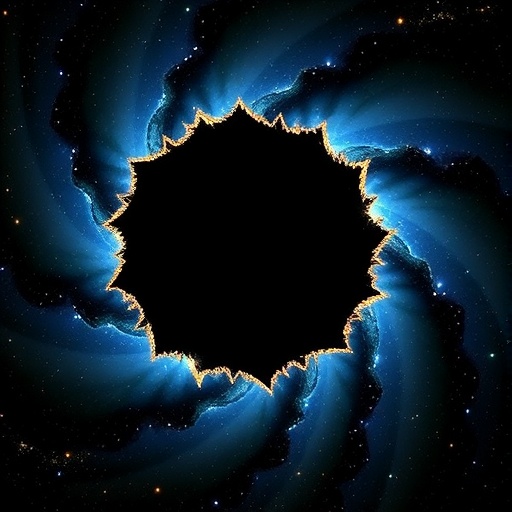
The visual representation of the data, as suggested by the accompanying image, likely showcases these fractal patterns. Imagine plots of light intensity over time with a jagged, yet patterned, appearance. Zooming into any section of these plots would reveal similar jaggedness, characteristic of fractal geometry. This visual confirmation, combined with the mathematical rigor, provides a compelling case for the existence of fractal temporal dynamics in black hole accretion. It’s a testament to how mathematics can reveal hidden order within what appears to be random, chaotic, or noisy data.
Ultimately, this work stands as a monumental achievement in astrophysics, offering a paradigm shift in how we study black holes. It implies that the universe might be speaking to us in a language of fractals, a language of self-similarity and complex order that pervades even the most extreme cosmic environments. As we continue to observe the cosmos with increasingly powerful instruments, the insights gleaned from this fractal temporal dynamics research will undoubtedly prove invaluable in deciphering the universe’s grandest secrets. This is not just about black holes; it’s about the fundamental principles that govern complexity in nature.
The authors and their published work are a critical part of this scientific advancement. Their names, the journal in which their findings are presented, and the specific publication details provide the necessary context and credibility for such a revolutionary discovery. The European Physical Journal C is a respected venue for high-impact theoretical and experimental physics research, indicating that this study has undergone rigorous peer review and is considered a significant contribution to the field. The DOI provides immediate access to the full research paper, allowing other scientists to scrutinize and build upon these groundbreaking findings.
This fundamental research offers a profound new perspective on the nature of black hole accretion disks. By revealing the fractal temporal dynamics and the scaling of Quasi-Periodic Oscillations, astronomers are provided with a powerful new toolkit. This can lead to more accurate predictions of black hole behavior, better estimates of their properties, and potentially even a unified theory that bridges the gap between quantum mechanics and general relativity by uncovering universal patterns in complexity. The universe, it seems, is not only vast but also intricately, beautifully, and mathematically self-similar.
Subject of Research: Fractal temporal dynamics in black hole accretion and quasi-periodic oscillation scaling.
Article Title: Fractal temporal dynamics in black hole accretion and quasi-periodic oscillation scaling.
Article References: Yıldız, L., Kaykı, D. & Güdekli, E. Fractal temporal dynamics in black hole accretion and quasi-periodic oscillation scaling. Eur. Phys. J. C 85, 1473 (2025). https://doi.org/10.1140/epjc/s10052-025-15228-0
Image Credits: AI Generated
DOI: https://doi.org/10.1140/epjc/s10052-025-15228-0
Keywords: Black hole accretion, Quasi-Periodic Oscillations (QPOs), fractal geometry, temporal dynamics, scaling laws, astrophysics, celestial mechanics, cosmic complexity, self-similarity.


