

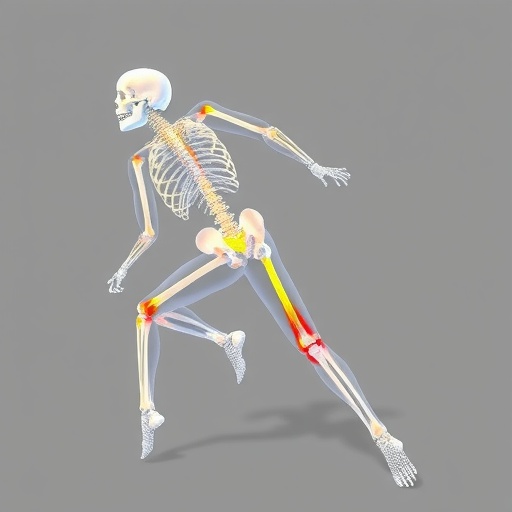
In a groundbreaking advancement in forensic biomechanics, researchers Hongmin Yang, Shuhui Gao, and Zhibin Wang have unveiled a novel biomechanical framework designed to revolutionize our understanding of skeletal injuries sustained during upright falls. Their pioneering study, published in the International Journal of Legal Medicine, integrates sophisticated models of stress propagation, fracture risk assessment, and injury clustering to provide a comprehensive picture of skeletal trauma dynamics. This transformative approach not only elevates the predictive accuracy of injury outcomes but also fuels forensic analyses with unprecedented precision, potentially redefining protocols in both legal and clinical settings.
At the heart of this new framework lies an intricate simulation of stress waves propagating through the human skeletal system upon impact. The complexity of upright falls, which involve multifactorial influences such as fall height, body orientation, and surface compliance, has historically posed significant challenges in accurately predicting fracture sites and patterns. The research team ingeniously overcomes these obstacles by employing an advanced finite element modeling technique that mimics the real-time transmission of mechanical forces throughout bones and joints during a fall. This allows for a nuanced understanding of where and how stress concentrates, thereby identifying the most vulnerable skeletal regions.
Central to the study is the development of a fracture risk model that quantifies the likelihood of bone failure in response to specific loading scenarios encountered during falls. Unlike traditional models which often rely on generalized thresholds or oversimplified assumptions, this risk assessment tool incorporates individualized bone quality parameters, including density variations and structural heterogeneity. By integrating patient-specific data, the framework moves towards personalized injury evaluation, promising greater diagnostic accuracy and more tailored treatment strategies in trauma care.
Moreover, the researchers introduce an innovative injury clustering algorithm that categorizes skeletal damage patterns based on biomechanical similarities in stress distribution and fracture characteristics. This clustering approach transcends mere cataloging of injury types; it reveals underlying biomechanical mechanisms that lead to complex injury constellations frequently observed in forensic cases. Through pattern recognition, forensic specialists can now better infer fall dynamics and reconstruct accident scenarios with greater confidence, thereby enhancing judicial outcomes.
The implications of this framework extend beyond forensic medicine into the realms of preventive healthcare and public safety. By highlighting the biomechanical pathways leading to fractures, the model provides critical insights for the design of protective gear, fall mitigation strategies, and rehabilitation protocols. For instance, understanding how stress propagates differently in varied anatomical and postural contexts can inform the customization of hip protectors or the architectural layout of public spaces to prevent severe fall-related injuries among the elderly.
Technically, the team’s methodology merges high-fidelity computational mechanics with data-driven statistical models. The finite element analysis (FEA) utilizes three-dimensional representations of bones, reconstructed via advanced imaging modalities such as CT scans, to capture microstructural details. Simulations incorporate dynamic loading conditions emulating typical upright fall impacts, while the fracture risk module interprets stress intensity and strain energy thresholds calibrated against empirical fracture data. This holistic approach ensures that the model is both biomechanically realistic and clinically relevant.
Adding another layer of sophistication, the injury clustering component employs machine learning algorithms to parse biomechanical datasets, identifying latent patterns that escape conventional analytical techniques. This data-centric strategy leverages vast amounts of fracture case histories, combined with simulated injury outputs, to build a robust taxonomy of injury mechanisms. The resultant injury clusters provide a valuable forensic toolset, enabling more objective and reproducible classifications of skeletal trauma.
Crucially, the study also addresses the variability introduced by individual differences in anatomy, bone health, and fall dynamics. The framework’s adaptability to personal physiological characteristics ensures it can be employed across diverse populations, including those with compromised bone integrity due to osteoporosis or other pathological conditions. This adaptability not only enhances forensic accuracy but also opens avenues for personalized risk assessments in clinical screenings and injury prevention programs.
The researchers meticulously validate their biomechanical framework against a comprehensive dataset of documented fall injuries, demonstrating its superior predictive capability relative to existing models. The validation process involved retrospective analysis of fall-related fracture cases, wherein predicted stress concentrations and fracture sites closely matched clinical observations. Such validation underscores the model’s potential for real-world application in both forensic investigations and medical diagnostics.
This study also contemplates future advancements, suggesting integration with real-time monitoring technologies such as wearable sensors that capture fall kinematics. Coupling these data streams with the biomechanical framework could enable immediate injury risk assessments post-fall, facilitating prompt medical interventions and improving patient outcomes. Additionally, the model’s modular design anticipates inclusion of soft tissue dynamics and neuromuscular responses, further enriching its prognostic precision.
Beyond its immediate applications, this research contributes to the broader scientific discourse on human biomechanics and injury mechanics. By harmonizing engineering principles with medical insights, it exemplifies interdisciplinary innovation that bridges gaps between computational modeling, biological understanding, and clinical relevance. The study is poised to stimulate collaborative efforts involving biomechanical engineers, forensic scientists, clinicians, and public health professionals.
In essence, the newly developed biomechanical framework represents a paradigm shift in the analysis of skeletal injuries from upright falls. It transcends traditional boundaries by combining a thorough mechanistic insight with data-driven pattern recognition, facilitating more accurate reconstructions of traumatic events. As falls constitute a major cause of morbidity and mortality worldwide, particularly among aging populations, such transformative approaches promise profound societal benefits.
Awareness of the complexities in skeletal stress propagation and fracture initiation offered by this framework could revolutionize the way fall injuries are approached—from initial medical response to judicial scrutiny in legal contexts. Its ability to deconvolute intricate injury mechanisms fosters a more nuanced appreciation of fall dynamics, which until now have been oversimplified in many forensic interpretations.
As the scientific and medical communities continue to grapple with the challenges posed by skeletal trauma, this framework’s integrative approach marks a significant stride forward. It provides a solid foundation for developing more effective injury prevention measures, refining clinical diagnostics, and enhancing forensic reconstructions. The potential ripple effects in healthcare policy and injury mitigation programs are both promising and profound.
In conclusion, the convergence of sophisticated biomechanical modeling, personalized risk evaluation, and advanced data analytics embodied in this study heralds a new era in injury biomechanics. The work by Yang, Gao, and Wang not only sets new standards for forensic injury analysis but also opens exciting frontiers for translational research aimed at improving human safety and well-being in the face of fall-related hazards.
Subject of Research: Biomechanical analysis of skeletal injuries resulting from upright falls, focusing on stress propagation, fracture risk modeling, and injury clustering.
Article Title: A biomechanical framework for skeletal injury analysis in upright falls: integrating stress propagation, fracture risk modeling, and injury clustering.
Article References:
Hongmin, Y., Shuhui, G. & Zhibin, W. A biomechanical framework for skeletal injury analysis in upright falls: integrating stress propagation, fracture risk modeling, and injury clustering. Int J Legal Med (2026). https://doi.org/10.1007/s00414-025-03697-7
Image Credits: AI Generated


