

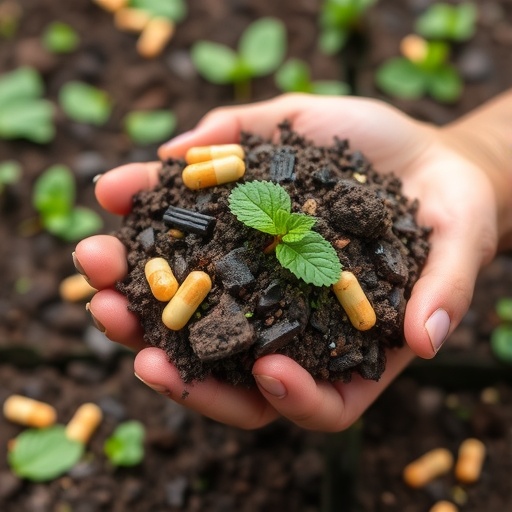
In a groundbreaking study that could reshape our approaches to waste management, researchers have delved deep into the problematic realm of antibiotic-contaminated sludge. This type of waste, notorious for its toxicity and environmental impact, poses a significant challenge for sustainable waste disposal methods. The research, led by Alves-Pereira and colleagues, investigates an innovative co-composting process that not only promises to degrade these harmful substances but also provides tangible data on its efficiency through rigorous microbiological and phytotoxicity assessments.
The contaminated sludge derived from various sources, primarily agricultural and clinical settings, often contains residues of antibiotics and various pathogens. The hazardous nature of this sludge necessitates effective and sustainable remediation strategies to mitigate risks to human health and the environment. Traditional disposal methods contribute to soil and water pollution, exacerbating the issue. Thus, alternative approaches are urgently needed to address this growing concern.
Co-composting emerges as a multifaceted solution that integrates the principles of organic waste management with the biological degradation of pollutants. In the context of the study, co-composting involves the simultaneous decomposition of antibiotic-laden sludge alongside other organic materials. This synergistic approach creates an optimal environment for microorganisms that can break down complex organic compounds, enhancing the biodegradation process.
A critical aspect of the study involves the selection of the right microbial communities that can effectively target and degrade antibiotic residues. The researchers meticulously analyzed various strains of bacteria and fungi, identifying those with the greatest potential for bioremediation. This microbial diversity plays a pivotal role in ensuring that the degradation process is efficient and that the resulting compost is safe for agricultural use.
The efficacy of the co-composting process was rigorously assessed through a series of microbiological tests. These tests included measuring the reduction of antibiotic concentrations and monitoring microbial activity throughout the composting period. The researchers employed advanced techniques, such as high-performance liquid chromatography (HPLC), to accurately quantify the residual antibiotics, ensuring that the findings would be both reliable and replicable.
In conjunction with microbiological assessments, phytotoxicity tests were conducted to evaluate the safety of the compost produced from the co-composting process. These tests focused on understanding how the compost affected plant growth and health. By planting various species in the treated compost, the researchers could ascertain whether the bioremediation process resulted in a product that contributed positively to soil quality and plant development.
Preliminary findings from the study indicate a substantial reduction in the overall toxicity of the antibiotic-contaminated sludge after undergoing co-composting. Microbial communities not only degraded the antibiotic residues but also enhanced the nutritional profile of the resulting compost, making it suitable for agricultural applications. This dual benefit of toxicity reduction and nutrient enhancement could revolutionize how we view organic waste management.
Moreover, the implications of this research extend beyond environmental remediation. In an era marked by increasing antibiotic resistance, the ability to effectively degrade these substances in waste streams could have significant public health benefits. By reducing antibiotic contamination in agricultural settings, the chances of resistant strains emerging and proliferating in the food chain could be mitigated.
As the study progresses, the researchers aim to optimize the co-composting process further, exploring varying ratios of sludge to organic materials, different environmental conditions, and alternative microbial inoculants. This iterative approach ensures that the findings remain adaptable and applicable across diverse settings, paving the way for scalable solutions that can be implemented globally.
The need for sustainable waste management strategies has never been more pressing. As urban populations continue to grow and industrial activities proliferate, the challenge of managing antibiotic-contaminated sludge will intensify. By presenting a viable co-composting solution, Alves-Pereira and colleagues contribute significantly to the broader discourse on environmental sustainability and public health.
At a time when scientific innovations are essential for addressing complex environmental issues, this study exemplifies the potential of interdisciplinary research. By combining principles from microbiology, environmental science, and agricultural studies, the research team has created a comprehensive framework for understanding and tackling antibiotic contamination in waste.
In conclusion, the research on antibiotic-contaminated sludge biodegradation through co-composting represents a significant advancement in environmental biotechnology. It underscores the necessity for continued exploration and innovation in waste management techniques, highlighting the intertwined relationship between human activity and ecological health. As the world grapples with the mounting challenges of antibiotic resistance and environmental degradation, such studies are a beacon of hope, paving the way for sustainable practices that could benefit both ecosystems and human health.
This research not only enriches our understanding of composting as a remediation strategy but also calls for urgent action by policymakers to prioritize sustainable practices in waste management. The findings highlight the responsibility of societies to adapt and evolve their waste management systems in light of contemporary challenges. As these shifts occur, the insights gained from this research will be integral to informing best practices that embrace sustainability and public health imperatives.
Ultimately, the journey towards efficient waste management is complex but necessary. Through persistent research and innovation, solutions like co-composting stand at the forefront of the quest for sustainability, heralding a future where human activities harmoniously coexist with the environment.
Subject of Research: Biodegradation of antibiotic-contaminated sludge through co-composting processes.
Article Title: Antibiotic Contaminated Sludge Biodegradation by Co-composting Processes: Using Microbiological and Phytotoxicity Tests to Assess Process Efficiency.
Article References:
Alves-Pereira, M., Testolin, R.C., Poyer-Radetski, G. et al. Antibiotic Contaminated Sludge Biodegradation by Co-composting Processes: Using Microbiological and Phytotoxicity Tests to Assess Process Efficiency.
Waste Biomass Valor (2026). https://doi.org/10.1007/s12649-025-03459-x
Image Credits: AI Generated
DOI: https://doi.org/10.1007/s12649-025-03459-x
Keywords: Antibiotic residues, co-composting, biodegradation, microbiological tests, phytotoxicity, waste management, environmental sustainability.


