

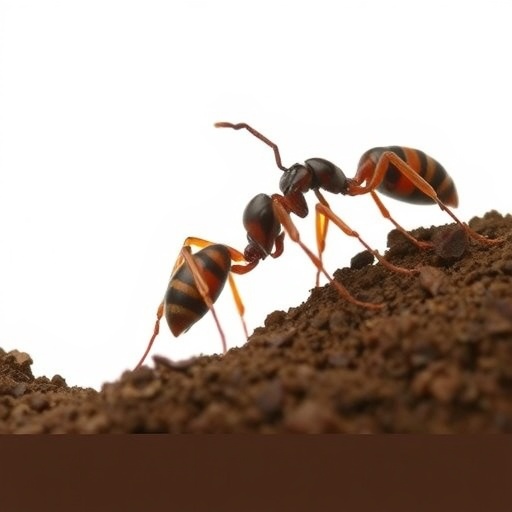
In recent years, biochar has been heralded as a groundbreaking soil amendment with the potential to revolutionize sustainable agriculture and climate-smart land management. However, new research delves deeper than simple chemical benefits, unveiling the profound influence that biochar exerts on soil animal behavior—specifically the social dynamics of ants, which are pivotal ecosystem engineers. This emerging study demonstrates that the application of biochar can dramatically reshape the social behaviors and ecological functions of the ant species Formica japonica, engendering consequential effects on soil health and broader ecosystem resilience.
Biochar, a carbon-rich product derived from pyrolyzed biomass, is widely recognized for its capabilities to enhance soil properties such as pH balance, organic matter content, and nutrient retention. Yet, soil ecosystems are complex, consisting not only of chemical and microbial processes but also of fauna whose activities are crucial for soil structure and nutrient cycling. Ants are among the most influential soil animals, performing essential roles such as aeration of soil, redistribution of nutrients, and regulation of microbial communities. Despite this key ecological role, insight into how biochar alters ant behavior has been scarce—until now.
In meticulously controlled laboratory experiments, researchers exposed Formica japonica colonies to varying biochar concentrations ranging from 0% to 10% by weight in the soil matrix. The study revealed a nonlinear, dose-dependent response in ant behavior and colony performance, following a classic hormetic curve that is frequently observed in toxicology but less commonly documented in ecological applications. Moderate biochar doses (2.5%-5%) substantially stimulated positive behavioral shifts and improved ecological functioning, whereas high concentrations (10%) induced detrimental outcomes.
At optimal intermediate concentrations, ants showcased remarkable enhancements in nest site selection specificity, nest architecture, and foraging efficiency. Specifically, nest site selection specificity increased by an astonishing 73.4%, indicating ants’ elevated ability to discern favorable microhabitats for colony establishment. Concurrently, the complexity of nest structures exhibited a 2.8-fold increase, signifying heightened architectural sophistication likely improving soil aeration and water infiltration.
In addition to structural adaptations, foraging efficiency doubled for ants inhabiting biochar-amended soils at these moderate levels. This likely amplified nutrient redistribution across the colony’s foraging range, contributing to improved nutrient cycling within soil ecosystems. Moreover, social recognition accuracy surged by over threefold. Enhanced recognition capabilities underpin colony cohesion, facilitating cooperation and reducing intruder infiltration, critical components for colony stability and territorial defense mechanisms.
Mechanistically, these positive effects are attributed to subtle yet meaningful increases in soil pH and organic matter content induced by biochar amendments. Elevated pH within an optimal range likely eases excavation by altering soil physical properties, while increased organic matter provides richer tactile and chemical signals that reinforce ant communication pathways, facilitating more effective social interaction and colony coordination.
Yet, the benefits dwindle sharply at elevated biochar concentrations. When soils contained 10% biochar, ant survival plummeted to approximately 55-60% within ten days, exposing the risks of excessive biochar application. Behavioral performance also deteriorated significantly; foraging slowed dramatically, nest construction diminished in quality, and social interactions became weakened and erratic, undermining colony cohesion and resilience.
These negative effects were linked to two major stressors induced by high biochar presence. First, soil alkalinity increased beyond the optimal physiological range for Formica japonica, disrupting homeostasis and normal behavioral functioning. Second, elevated levels of environmentally persistent free radicals generated from biochar were found to induce oxidative stress and neurotoxic effects in ants, further compromising both survival and social behaviors.
Taken together, the research highlights a classic hormetic response pattern, where low to moderate doses promote biological activity and health, but higher doses become toxic and damaging. This nuanced understanding challenges the conventional premise that “more is better” when employing biochar as a soil amendment and instead advocates for precision in application rates, especially when considering the broader biological community.
Implications of these findings ripple through ecological restoration strategies. Soil amendments cannot be judged solely on their chemical properties; they must be evaluated for their cascading impacts on soil fauna whose behaviors are critical for ecosystem function. Ants, as ecosystem engineers, modulate soil aeration, nutrient cycling, and pest control; alterations in their social behaviors have the potential to either accelerate recovery or precipitate ecological dysfunction.
Furthermore, shifts in ant aggression, cooperative behaviors, and recognition capabilities documented in this study may play pivotal roles in structuring species interactions and biodiversity outcomes in biochar-treated soils. Changes in these social parameters are likely to influence not only ant populations but also the broader web of soil biota and aboveground organisms dependent on soil health and pest control services.
The research cautions against indiscriminate biochar overapplication. While biochar holds immense promise for mitigating soil degradation and contributing to carbon sequestration efforts vital to countering climate change, its application must be carefully tailored to maintain the delicate balance of soil biological systems. As the global community accelerates efforts to restore degraded lands, integrating biological complexity into management plans emerges as a critical principle.
This study marks a milestone by linking soil chemical amendments directly to animal behavior and community-level ecological processes. Such integrative research underscores the need for interdisciplinary approaches in soil restoration—melding chemistry, ecology, and behavior—to harness biochar’s full potential responsibly.
Ultimately, these findings compel land managers, agronomists, and environmental scientists to reconsider soil remediation practices. Optimized biochar application—neither under- nor over-applied—could unlock synergistic benefits, leveraging enhanced ant ecological functions to improve soil ecosystem resilience while averting deleterious outcomes caused by biological stress. This biologically informed perspective offers a promising path forward in the quest for sustainable land management under the growing pressures of environmental change.
Subject of Research: Effects of biochar application on ant (Formica japonica) social behavior and ecological functions.
Article Title: Biochar application enhances ant (Formica japonica) ecological functions as indicated by their social behaviors.
News Publication Date: 13-Mar-2026
Web References:
DOI link to article
References:
Liu, S., Xiong, D., Zeng, L., Du, W., Liu, Y., Steinberg, C. E. W., Pan, B., Tao, S., & Xing, B. (2026). Biochar application enhances ant (Formica japonica) ecological functions as indicated by their social behaviors. Biochar, 8, 77.
Image Credits: Sha Liu, Danling Xiong, Liang Zeng, Wei Du, Yang Liu, Christian E. W. Steinberg, Bo Pan, Shu Tao & Baoshan Xing
Keywords: biochar, Formica japonica, soil amendment, ecological functions, ant behavior, soil ecology, ecosystem engineering, hormesis, soil restoration, soil fauna, neurotoxicity, oxidative stress


