

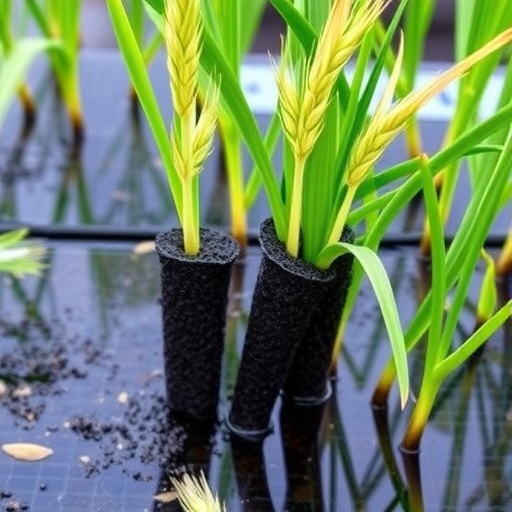
In an era marked by increasing environmental concerns, researchers are leveraging innovative approaches to tackle the pressing issues of water pollution. Among the various strategies being explored, the use of biochar has gained significant traction due to its potential to remediate pollutants, particularly nitrates and phosphates. A recent groundbreaking study conducted by Ansari, Bello-Mendoza, and O’Sullivan shines light on the efficacy of iron-modified barley straw biochar in the removal of these harmful nutrients from water sources. This research not only underscores the effectiveness of biochar as a sustainable solution but also promotes a greater understanding of its chemical interactions within aquatic environments.
The primary focus of the study revolves around the alarming rise in nitrate and phosphate levels in freshwater systems, which poses a dire threat to aquatic ecosystems and human health. Nitrates, often a byproduct of agricultural runoff, can lead to eutrophication, a process that degrades water quality and disrupts aquatic life. Phosphates, similarly, accelerate the growth of harmful algal blooms, further exacerbating the challenges faced by water treatment facilities. Given these concerns, the researchers sought to identify accessible and effective means of mitigating these pollutants through advanced material modifications.
In the investigated methodology, barley straw, a commonly available agricultural residue, served as the base material for biochar production. The researchers opted to enhance its adsorption capabilities by incorporating iron into the biochar matrix. This modification is underpinned by the principle that metal ions can improve the binding sites available for charged particles, such as nitrates and phosphates, thus amplifying the biochar’s overall effectiveness as a sorbent material in aquatic applications.
Results from the study revealed that iron-modified barley straw biochar exhibited a remarkable capacity for both nitrate and phosphate retention compared to its non-modified counterparts. Nitrate removal efficiencies recorded in various water samples were significantly higher, showcasing the synergistic effects of the iron application during the biochar production process. These findings suggest that the biochar’s surface modifications play a critical role in attracting and binding these nutrient pollutants, owing to the increased number of available active sites.
Furthermore, the study delved into investigating the kinetics of nitrate and phosphate sorption. The researchers established that the adsorption process occurred rapidly, with a significant portion of the pollutants being removed within the first few hours of contact. This characteristic is promising, as it indicates the feasibility of deploying this biochar in real-world water treatment scenarios where time is often a limiting factor.
Moreover, the researchers also explored the influence of varying environmental conditions on the biochar’s performance. Factors such as pH, temperature, and the initial concentration of nitrates and phosphates were systematically varied to simulate real-world situations. The results highlighted the adaptability of the iron-modified biochar, suggesting that it could maintain its efficacy under various circumstances typically encountered in natural water bodies.
The implications of this research extend beyond mere academic interest. As communities grapple with the reality of polluted waterways, the development of cost-effective and sustainable solutions is paramount. Biochar, particularly one that employs agricultural waste as its base material, not only offers a method for pollutant removal but also presents an opportunity for waste repurposing. This aligns perfectly with the pillars of sustainable development and circular economy models, providing an avenue for reducing waste while simultaneously addressing pollution.
Bridging the gap between lab-scale studies and field applications remains a critical challenge. Subsequently, the findings of this study advocate the need for future research to assess the long-term effectiveness of iron-modified barley straw biochar under field conditions. The transition from controlled laboratory environments to the complexities of natural ecosystems often presents unexpected variables, and thus, real-world testing is crucial in validating these promising results.
The study also suggests pathways for further enhancement of biochar production techniques. Investigating alternative sources of modifications or varying preparation temperatures can yield insights into optimizing biochar properties. This could potentially lead to biochars tailored for specific pollutants or environmental conditions, heightening their overall efficiency as a water treatment solution.
In conclusion, the research undertaken by Ansari and colleagues poses significant advancements in the quest for sustainable water treatment technologies. Their findings underscore the transformative potential of agricultural byproducts in combating environmental pollutants—a message that resonates with the increasing global momentum toward sustainable practices. As challenges related to water quality intensify, the need for innovative, economical solutions becomes increasingly pressing. This study is a compelling stride towards harnessing the power of nature and waste materials to restore the health of our water resources.
As awareness grows and initiatives amplify, the findings of this study could serve as a cornerstone for further explorations into biochar applications. By inspiring collaboration between scientists, environmentalists, and policymakers, there exists a tangible opportunity to pave the way for cleaner waterways and healthier ecosystems, addressing one of the most critical challenges of our time.
In retrospect, the work of Ansari, Bello-Mendoza, and O’Sullivan not only broadens the scientific understanding of biochar’s capabilities but also ignites a conversation about sustainable solutions in a world increasingly burdened by anthropogenic pressures. As researchers continue to unveil the multifaceted applications of biochar, society stands on the cusp of transformative environmental practices that could redefine our relationship with natural resources.
Ultimately, the success of iron-modified barley straw biochar in water remediation exemplifies how interventional strategies such as these can combat the adverse effects of water pollution. With further development, it is feasible to envision a future where such sustainable materials play a central role in global water quality management efforts.
Subject of Research: Iron-modified barley straw biochar for nitrate and phosphate removal from water
Article Title: Iron-modified barley straw biochar for nitrate and phosphate removal from water
Article References:
Ansari, S., Bello-Mendoza, R. & O’Sullivan, A. Iron-modified barley straw biochar for nitrate and phosphate removal from water. Environ Sci Pollut Res (2026). https://doi.org/10.1007/s11356-025-37358-4
Image Credits: AI Generated
DOI: https://doi.org/10.1007/s11356-025-37358-4
Keywords: Biochar, water treatment, nitrates, phosphates, sustainable practices, agricultural waste, environmental pollution, eutrophication, adsorption, iron modification.


