

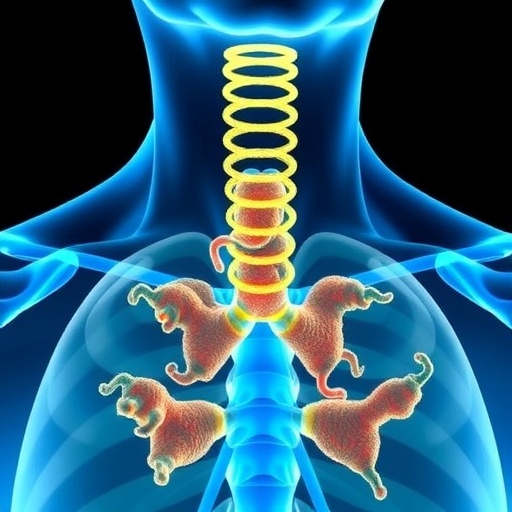
In a groundbreaking advancement at the intersection of biomaterials science and regenerative medicine, a team of researchers led by Tang, Wang, and Sun has unveiled a novel bio-adaptive physical hydrogel designed to revolutionize tracheal reconstruction. Published in Nature Communications in 2025, this innovative hydrogel promises to overcome the long-standing challenges faced in dynamic tissue engineering, bringing new hope to patients who suffer from critical airway defects. The development marks a monumental step forward in creating engineered tissues that not only integrate with host biology but also actively respond and adapt to the constantly changing microenvironment of the human respiratory tract.
Tissue engineering of the trachea has historically been impeded by the trachea’s complex functionality and unique biomechanical demands. The trachea must maintain airway patency while being flexible enough to accommodate movement during respiration and neck bending. Current scaffolding materials often fall short, suffering from poor biocompatibility, insufficient adaptability to tissue growth and remodeling, and inability to withstand mechanical stresses over prolonged timeframes. The newly developed hydrogel, termed a “bio-adaptive physical hydrogel,” addresses these limitations by mimicking the natural extracellular matrix’s physical and biochemical properties, enabling dynamic tissue development that evolves with the patient’s biology.
The hydrogel’s adaptive nature derives from its sophisticated supramolecular network, which is engineered to respond to mechanical stimuli and biochemical signals in real time. Unlike conventional hydrogels that provide a static environment, this material exhibits dynamic viscoelastic properties that modulate to mirror the stiffness and elasticity of native tracheal cartilage as tissue regeneration progresses. By shifting its mechanical characteristics on demand, the hydrogel supports cellular proliferation and differentiation at early stages while gradually enhancing structural integrity as mature tissue forms, effectively recapitulating natural healing processes.
Key to this bio-adaptive behavior is the material’s incorporation of reversible physical crosslinks between polymer chains. These non-covalent interactions allow the network to transiently reorganize its internal architecture under stress, dissipating energy and preventing scaffold failure. Moreover, the hydrogel integrates cell-responsive peptide motifs that facilitate adhesion and promote cellular signaling pathways crucial for chondrogenesis and epithelialization. Cells cultured within this matrix sense and remodel their three-dimensional microenvironment, reinforcing the physiological relevance of engineered tissue constructs.
From a clinical perspective, the hydrogel offers several pragmatic advantages. Its injectability and in situ gelation enable minimally invasive application tailored to patient-specific anatomical defects. Furthermore, the hydrogel biodegrades in a controlled manner, synchronizing with natural tissue growth to avoid fibrotic encapsulation or scaffold collapse. Preclinical models demonstrated remarkable restoration of tracheal morphology and function, with engineered tissues exhibiting histological and biomechanical characteristics closely resembling native tracheal tissue even several months post-implantation.
Another transformative feature of this hydrogel technology is its capacity for integrating bioactive factors within its matrix. Tang and colleagues incorporated a controlled release system for growth factors such as transforming growth factor-beta (TGF-β) and vascular endothelial growth factor (VEGF), which orchestrate tissue repair and neovascularization. The sustained delivery ensures a conducive microenvironment for cell survival and integration while mitigating inflammatory responses often triggered by foreign materials. This dual functionality elevates the scaffold from a mere structural support to a bioengineered niche orchestrating complex cellular activities.
Further innovation arises from the hydrogel’s ability to dynamically interface with resident immune cells and promote a pro-regenerative immune milieu. By modulating macrophage phenotypes, the scaffold fosters an anti-inflammatory environment facilitating tissue remodeling rather than scar formation. This immune-biomaterial interface represents a paradigm shift in tissue engineering strategies, highlighting the importance of immunomodulation for long-term success, especially in airway reconstruction where chronic inflammation can severely compromise outcomes.
Underlying the remarkable performance of this hydrogel is a comprehensive physicochemical characterization and computational modeling effort that guided material design. Advanced rheological assessments confirmed the hydrogel’s tunable mechanical properties, while microstructural analyses using scanning electron microscopy revealed an interconnected porous network conducive to nutrient transport and cell migration. Computational simulations provided predictive insight into scaffold behavior under physiological loading, enabling precise tailoring of material parameters to match tracheal biomechanics.
Beyond tracheal reconstruction, the implications of this dynamic hydrogel extend to various other tissue engineering applications that require adaptable scaffolds. Organs and tissues subjected to mechanical forces, such as blood vessels, cartilage joints, and even cardiac tissues, could greatly benefit from materials that evolve with healing stages instead of static biomaterials. This work sets a new benchmark for designing next-generation hydrogels that bridge the gap between synthetic scaffolds and native tissue complexity.
Looking forward, the team is advancing toward clinical translation by refining scaffold fabrication techniques for scalability and regulatory compliance. Ongoing studies are evaluating long-term biocompatibility, functional integration, and immunological outcomes in large animal models that closely approximate human tracheal anatomy. Success in these endeavors could lead to the hydrogel becoming a standard-of-care scaffold material for patients with congenital tracheal defects, traumatic injuries, or malignancies necessitating airway reconstruction.
The novel bio-adaptive physical hydrogel also opens avenues for patient-specific therapies when combined with cutting-edge biofabrication technologies such as 3D bioprinting. Integration of cellularized constructs with this hydrogel backbone allows creation of personalized grafts with precise architectural and mechanical properties tailored to individual patient needs. This synergy between material science and bioprinting heralds a new era of regenerative medicine, where dynamically functional tissues replace damaged organs rather than mere prosthetics.
In addition to its biological and mechanical ingenuity, the hydrogel’s manufacturing leverages sustainable and biocompatible polymers derived from renewable sources. This commitment to environmental stewardship aligns with broader trends in biomedical research toward green chemistry and responsible innovation. As advances in polymer chemistry continue, future iterations of this hydrogel can incorporate bioresponsive degradation pathways and multifunctional therapeutic agents for enhanced regenerative outcomes.
Ultimately, the bio-adaptive physical hydrogel represents a convergence of multidisciplinary expertise spanning polymer science, cell biology, immunology, and clinical medicine. The collaborative nature of this research underscores the complexity inherent in engineering tissues that must perform dynamically within intricate biological systems. It is a testament to human ingenuity and perseverance in addressing unmet clinical challenges through sophisticated material design.
In summary, Tang, Wang, Sun, and their colleagues have introduced a transformative hydrogel platform that dynamically adapts to the changing mechanical and biological milieu of tracheal tissue regeneration. This advance tackles core impediments in airway reconstruction by offering an intelligent scaffold that evolves with the tissue it supports, facilitating functional and durable repair. As this technology progresses from bench to bedside, it holds the promise of improving thousands of lives by restoring critical respiratory function with bioengineered tissues that truly integrate and thrive.
Subject of Research:
Bio-adaptive physical hydrogel for dynamic tissue engineering in tracheal reconstruction
Article Title:
A bio-adaptive physical hydrogel enables dynamic tissue engineering for tracheal reconstruction
Article References:
Tang, H., Wang, H., Sun, W. et al. A bio-adaptive physical hydrogel enables dynamic tissue engineering for tracheal reconstruction. Nat Commun (2025). https://doi.org/10.1038/s41467-025-67580-0
Image Credits:
AI Generated


