

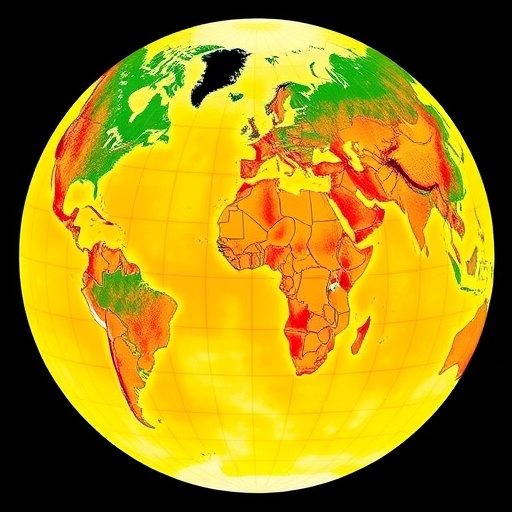
In the realm of Earth observation, the ability to accurately store, query, and analyze complex datasets is fundamental to making impactful decisions for climate science, disaster management, and environmental policy. Traditionally, these enormous and intricate data collections—comprised of measurements linked to spatial, temporal, and various parametric dimensions—have been organized using multi-dimensional grids. Although grid-based data structures have been a staple for decades, the lack of unified conceptual clarity concerning grid definitions, coordinate systems, and data interpretation has posed significant barriers to interoperability and analytical accuracy across scientific domains.
This fragmentation in the foundations of grid modeling becomes glaringly problematic as Earth datasets evolve in scope and complexity. Modern data no longer fit neatly into simple two-dimensional maps or time series; instead, they manifest as vast multi-dimensional datacubes containing spatial locations, time intervals, measurement variables, and more. This complexity strains existing frameworks, leading to inconsistent data representations, convoluted metadata, and analytical errors, underscoring an urgent need to revolutionize how Earth data grids are defined and understood.
Addressing these enduring challenges, Professor Peter Baumann of Constructor University in Bremen, Germany, has introduced a novel grid modeling framework that fundamentally reimagines the architecture of Earth observation data. Published in Big Earth Data, this innovation abandons the entrenched practice of defining grid types in favor of an axis-centric paradigm, adhering to the latest international geospatial standards, including the ISO 19123–1. By shifting focus to independently characterized axes, Professor Baumann’s framework ushers in a new era of flexibility and precision for multi-dimensional data handling.
Unlike traditional approaches, this new methodology treats each axis as a discrete entity that can embody uniform indices, regularly or irregularly spaced coordinates, warped geometries, or algorithm-driven transformations. This modularity allows axes to be combined seamlessly to represent diverse real-world datasets—from satellite imagery with perfectly aligned pixels to climate simulations with irregular temporal samples—within a singular, coherent structure. This development promises to dismantle the silos separating different data types and sources, fostering a unified Earth data ecosystem.
At the core of this framework is a critical conceptual distinction between the grid’s domain and its measured values. The domain precisely specifies where data exist, articulated through positions in space and time, while values denote the actual measurements at these positions. This separation resolves longstanding ambiguities about whether data points correspond to specific spatial coordinates, are averaged over areas, or integrate volumetric elements. By relegating constructs such as cells and shapes to visualization layers above mathematically defined positions, the framework clarifies interpretation without imposing assumptions on the data model itself.
Further enriching the model, the study rigorously formalizes how data values can be evaluated at any arbitrary point within the grid. Traditional methods often depend on implicit rules or heuristics to interpolate or estimate values between known samples, especially when dealing with irregular sampling patterns or datasets recorded in mismatched coordinate reference systems. By explicitly defining regions of validity, along with weighting and interpolation functions, the framework offers a mathematically sound and transparent approach to these challenges, enabling consistent and justifiable analytical outcomes across heterogeneous datasets.
Professor Baumann emphasizes that this innovation remedies a critical gap that has persisted for decades. “For decades, scientists have relied on grid definitions that were never designed for today’s data complexity,” he explains. “Our work provides a mathematically sound foundation that finally aligns standards with modern Earth data practice.” This alignment is expected to drastically improve the reliability and interoperability of Earth observation datasets, enabling more confident scientific conclusions and policy decisions.
Beyond its theoretical advancements, the new grid model has immediate real-world implications for Earth data services and infrastructure. It reinforces the ongoing evolution of the Coverage Implementation Schema (CIS) 1.1 and sets the stage for the forthcoming ISO 19123–2 standard, both of which modernize data encodings and embrace web-native formats such as JSON. These technical upgrades facilitate more efficient storage, transfer, and access to massive datasets, fulfilling the growing demand for scalable, high-performance datacube services capable of handling spatial, temporal, and parametric queries with unprecedented precision.
A notable application area is the rasdaman engine, a pioneering datacube platform developed under Professor Baumann’s leadership. The rasdaman system exemplifies the practical benefits of the new grid approach, allowing users to interactively explore massive multi-dimensional datasets with blazing speed and fine-grained control. The engine’s ability to support the axis-centric model enhances its scalability and adaptability, making it a critical tool for scientific and operational communities reliant on big Earth data.
Professor Baumann’s comprehensive expertise in standards development, large-scale data infrastructures, and geospatial modeling strongly underpins the framework’s robustness. Importantly, the model ensures backward compatibility, serving as a superset of previous standards. This inclusivity means that existing datasets and services remain operational while simultaneously supporting innovation and the integration of emerging data types. Consequently, the scientific community gains a future-proof foundation for the ever-expanding universe of Earth observation data.
The stakes of this advancement extend well beyond academic and technological domains. Clear and precise definitions of data grids foster trust in Earth observation products, a point Professor Baumann underscores: “When grids are defined unambiguously, scientists can combine datasets confidently, algorithms behave predictably, and decision-makers can rely on the results.” This trust is essential for evidence-based policy making, especially in climate science and disaster preparedness, where accurate, timely data can save lives and guide sustainable development.
Looking forward, the adoption of these refined Earth data grids promises transformative impacts on global environmental monitoring and forecasting. Improved clarity and interoperability will enhance the reliability of climate models, strengthen early-warning systems for extreme weather events, and support nuanced environmental policy decisions. By resolving foundational ambiguities and aligning standards with contemporary data realities, this framework catalyzes a more coherent and resilient data ecosystem to address the grand challenges facing our planet.
In summary, this innovative axis-centric grid modeling framework redefines the way we conceptualize and operate multi-dimensional Earth data. Its introduction marks a pivotal milestone in the modernization of international geospatial standards, offering a mathematically rigorous, flexible, and interoperable foundation for a future defined by data-driven insights and global collaboration. As Earth observation continues to grow in significance and complexity, this paradigm shift equips researchers, policymakers, and technologists with the tools they urgently need to transform data into decisive knowledge.
Subject of Research: Not applicable
Article Title: An introduction to the OGC/ISO coverage and datacube standard for modeling multi-dimensional, spatio-temporal Big Data
News Publication Date: 12-Dec-2025
References: DOI: 10.1080/20964471.2025.2585732
Image Credits: Pebau.grandauer from Openverse
Keywords: Space sciences, Climatology, Earth sciences, Physical sciences


