

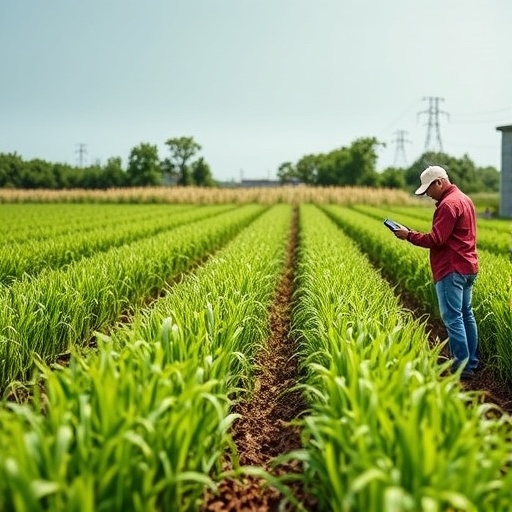
In an era where data-driven decisions are becoming increasingly vital to global agricultural practices, a groundbreaking study by Fan and Li introduces a simulated framework aimed at revolutionizing rural revitalization in China. As the nation grapples with the challenges of modern agriculture, such as food security, environmental sustainability, and rural depopulation, this innovative research leverages big data and smart agriculture techniques to propose solutions that could reshape rural landscapes. This initiative operates within the paradigm of new quality productivity, proposing that technology can significantly enhance both the efficiency and efficacy of agricultural output while also promoting the economic sustainability of rural communities.
At the core of this research is the realization that China’s rural regions are at a crossroads. Many areas are suffering from declining populations, aging farming practices, and economic stagnation. Fan and Li’s study highlights the necessity for a robust framework that not only addresses these pressing issues but also paves the way for sustainable rural development. By introducing a simulated framework, the authors provide insights into how data analytics and smart technologies can be synergistically utilized to rejuvenate these regions, thereby revitalizing both their economies and social structures.
Central to the framework proposed in the study is the integration of big data into agricultural practices. Big data analytics can provide farmers with critical insights about soil health, weather patterns, and market trends, thereby fostering improved decision-making. For instance, access to real-time data can enable farmers to optimize planting schedules, manage resources more efficiently, and reduce waste—all crucial factors in enhancing agricultural productivity. The use of predictive analytics further allows farmers to anticipate potential challenges, such as pest infestations or adverse weather conditions, thus providing them with the adaptability required in today’s changing climate.
Moreover, the authors emphasize the importance of smart agriculture technologies, such as the Internet of Things (IoT), artificial intelligence (AI), and drone technology. These innovations are reshaping the agricultural landscape by enabling precision farming techniques. Smart sensors can monitor crop health and soil conditions in real-time, while drones provide aerial imagery that can help in the timely identification of agricultural issues over large swathes of land. Implementing such technologies not only increases the yield per hectare but also promotes sustainable practices by minimizing the use of fertilizers and pesticides, which can have detrimental effects on the environment.
Fan and Li also explore the economic implications of this simulated framework. They argue that with the integration of big data and smart agriculture, rural areas can emerge as vital hubs of technological innovation. This rejuvenation could attract investment, create job opportunities, and stimulate local economies. The authors point out that by providing farmers with data-driven insights and smart tools, they can increase their economic viability and contribute to the broader national economy. The simulation proposes that if these technologies are adopted strategically, rural incomes could see a significant boost, thereby combating poverty and enhancing quality of life.
The study doesn’t shy away from addressing potential barriers to the successful implementation of this framework. It acknowledges that access to technology and data is uneven across different regions, particularly between urban and rural areas. Therefore, the implications of digital divides must be taken into account. To foster equitable rural revitalization, policies must be established to provide necessary training and resources to farmers. This includes improving infrastructure, establishing internet access in remote areas, and creating educational programs aimed at enhancing digital literacy among rural populations.
Additionally, policy-makers play a critical role in facilitating this transformation. The authors assert that a comprehensive policy framework is essential in supporting the integration of big data and smart agriculture into rural development strategies. This includes funding for research and development, incentives for adopting new technologies, and collaborations between government entities, academia, and the private sector. By fostering an ecosystem that encourages innovation and cooperation, rural areas can harness the full potential of smart agriculture and big data, ensuring a more integrated approach to revitalization.
Collaboration is a recurring theme throughout the research, as Fan and Li propose that partnerships between various stakeholders—farmers, tech companies, government agencies, and educational institutions—are crucial for the success of this framework. Such partnerships can facilitate knowledge exchange, foster innovative solutions, and ultimately result in enhanced agricultural practices. By pooling resources and expertise, these collaborations can help to overcome challenges associated with the deployment of new technologies and ensure that the benefits of rural revitalization are widely disseminated.
The research concludes by emphasizing the transformative potential of big data and smart agriculture for China’s rural revitalization, offering a glimpse into a future where technology and agriculture coalesce to create sustainable and thriving rural communities. The authors argue that if China is to meet the demands of its growing population and simultaneously address environmental concerns, this integrated approach must be prioritized. The framework presented in their study serves as a model for other nations facing similar challenges, advocating for a holistic perspective on agricultural development that considers not only productivity but also resilience, sustainability, and equity.
In reflecting on the possible future implications of this research, one can appreciate the broader trends in global agriculture. As more countries begin to recognize the potential of data-driven agriculture, there is a growing imperative for collaboration and knowledge sharing across borders. The lessons derived from Fan and Li’s simulated framework could inform international discourse and practices in agricultural innovation, thus fostering a more interconnected approach to addressing food security and rural revitalization challenges worldwide.
The study by Fan and Li not only presents a forward-thinking vision for China’s rural revitalization, but it also serves as a clarion call for stakeholders at all levels to rethink their approach to agricultural development. By embracing a mindset oriented towards innovation and collaboration, we can collectively work towards building resilient rural communities that are equipped to thrive in the face of contemporary challenges. In conclusion, as we stand on the precipice of agricultural transformation, the insights provided by this research could mark a pivotal point in our efforts to harness technology for the betterment of rural societies.
With the right investments in technology, training, and collaborative frameworks, the path to revitalizing rural China could indeed lead to a brighter, more sustainable future for millions. It is within this strategic intersection of big data, smart practices, and collaborative efforts that the true essence of modern agriculture will be defined.
Subject of Research: Rural revitalization through big data and smart agriculture in China.
Article Title: A simulated framework for China’s rural revitalization enabled by big data and smart agriculture under the perspective of new quality productivity.
Article References:
Fan, X., Li, C. A simulated framework for china’s rural revitalization enabled by big data and smart agriculture under the perspective of new quality productivity.
Discov Artif Intell (2025). https://doi.org/10.1007/s44163-025-00714-x
Image Credits: AI Generated
DOI: 10.1007/s44163-025-00714-x
Keywords: rural revitalization, big data, smart agriculture, new quality productivity, China, technological innovation, precision farming, economic sustainability.


