

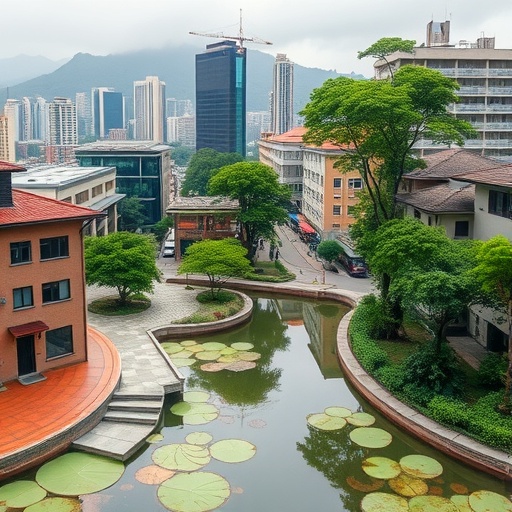
In a groundbreaking exploration poised to redefine how we perceive and categorize human settlements across the globe, a recent study published in npj Urban Sustain challenges the conventional binary distinction between urban and rural spaces. Authored by Cattaneo and Girgin, this research dives deep into the intricate tapestry of urban form, accessibility, and interconnectivity, proposing a sophisticated framework that transcends outdated classifications. Their work promises to reshape urban policy, planning, and sustainability strategies worldwide, responding to the complex realities of 21st-century human habitats.
For decades, urban studies have been constrained by a simplistic dichotomy: areas are classified as urban or rural based primarily on population density or administrative boundaries. However, this dichotomy glosses over the profound heterogeneity within these spaces and undervalues the fluid transitions occurring at their margins. Cattaneo and Girgin’s investigation illuminates the nuanced morphological features of settlements, exposing patterns that defy binary categorization. Their approach integrates spatial metrics related to form—such as building density, land use fragmentation, and spatial arrangement—with measures of accessibility, including transport networks and service proximity, as well as interconnectivity indicators reflecting socioeconomic and infrastructural linkages.
This comprehensive analysis utilized a global dataset encompassing a vast array of settlements from megacities to remote villages, incorporating satellite imagery, transport infrastructure data, and socioeconomic variables. Through advanced clustering algorithms and multidimensional scaling techniques, the researchers identified distinct typologies of settlements that cannot be framed strictly as urban or rural. These typologies reveal gradations and hybrid forms that suggest a more continuous spectrum of settlement types, each with unique spatial and functional attributes.
Fundamentally, the study exposes the limitations of relying solely on population-based thresholds for urban classification. For instance, certain peri-urban zones exhibit dense networks of accessibility and high interconnectivity with adjacent urban cores, yet are often nominally classified as rural, leading to policy oversights. Conversely, some areas categorized as urban by administrative standards may lack critical infrastructural connectivity and functional urbanism, aligning more closely with rural characteristics. This dissonance underscores the need for a multidimensional classification approach that integrates form, accessibility, and interconnectivity.
The implications of this research are profound for sustainable urban development. Urban form influences environmental outcomes, from heat island effects to green space allocation, while accessibility impacts equity in service provision and economic opportunities. Interconnectivity shapes social cohesion and resilience. By moving beyond a simplistic urban-rural dichotomy, planners can tailor interventions more precisely to the unique characteristics of each settlement type, improving resource allocation and sustainability outcomes.
Importantly, this fresh classification framework also recognizes the dynamic nature of human settlements. Urban and rural areas are not static; they evolve continuously as infrastructure develops, economies shift, and populations move. The typologies identified by Cattaneo and Girgin incorporate temporal dimensions, enabling the tracking of transition zones that exhibit shifts in form and connectivity over time. This capacity is critical for anticipatory planning in the face of rapid urbanization, climate change, and technological disruptions.
Methodologically, the study pioneers the integration of remote sensing data with transport network analysis and socioeconomic indicators, demonstrating a replicable model for holistic settlement classification. By combining these diverse data sources, researchers can overcome the siloed approaches that have historically hindered comprehensive understanding. The use of machine learning algorithms to discern patterns enables scalable analysis applicable across diverse geographies, from global north metropolises to emerging economies.
The findings resonate with current debates on urban sustainability, emphasizing that effective governance and policy must reflect the lived realities of inhabitants rather than administrative fiat. For example, infrastructure investments can be misaligned if based solely on administrative classifications that fail to capture functional connectivity and accessibility needs. Recognizing hybrid forms fosters inclusive strategies that support both high-density urban neighborhoods and transitioning peri-urban and rural areas interconnected within larger urban systems.
Cattaneo and Girgin’s research also highlights the environmental opportunities inherent in reimagining urban classifications. For example, recognizing peri-urban areas as integral components of urban systems can facilitate green corridor planning and ecosystem service preservation amid urban expansion. Moreover, understanding connectivity patterns enables better disaster risk reduction by pinpointing critical nodes in transport and communication networks essential for resilience.
The study prompts urban scholars and policymakers to rethink how smart city technologies are deployed. Smart infrastructure investments must consider the diverse settlement typologies to maximize benefits and avoid exacerbating inequalities. Mobility-as-a-service platforms, for instance, require nuanced understanding of accessibility in both densely connected urban cores and less accessible hybrid zones to be truly effective.
From a social perspective, this nuanced classification acknowledges the multifaceted nature of community identities and economies that often straddle urban and rural divides. Labor markets, cultural practices, and social networks can extend across these traditional boundaries, informed by the physical form and connectivity that shape daily life. Consequently, policies grounded in this framework can better support social cohesion and economic diversification.
Furthermore, the proposed global classification typologies provide a valuable tool for international development agencies and urban sustainability initiatives. Such organizations can deploy tailored interventions that address the specific challenges and opportunities of varied settlement types, enhancing the effectiveness and efficiency of aid and investment.
Technological advancements underpinned the synthesis of massive datasets and complex analyses fundamental to this study. The authors leveraged geographic information systems (GIS), high-resolution earth observation data, and innovative accessibility modeling platforms, reflecting the cutting-edge convergence of urban science and data technology. Their approach exemplifies the potential of interdisciplinary research to inform urban sustainability in an actionable manner.
Looking forward, Cattaneo and Girgin envision the refinement of their classification system with the incorporation of real-time mobility data and emerging socioeconomic metrics. Such enhancements could facilitate dynamic mapping of settlements, enabling real-time monitoring of urban-rural transitions and informing adaptive policymaking in rapidly changing contexts.
In summary, the study heralds a paradigm shift in urban studies by advocating a sophisticated, data-driven framework that acknowledges the intricacies of settlement form, accessibility, and interconnectivity. By moving beyond rigid urban and rural categories, the research paves the way for more nuanced policy frameworks that promote sustainability, equity, and resilience in the contemporary urban age. This innovative approach equips planners, policymakers, and scholars with the tools necessary to navigate the complex urban landscapes of the 21st century and beyond.
Subject of Research: Global urban classification based on form, accessibility, and interconnectivity beyond the traditional urban-rural dichotomy.
Article Title: Beyond urban and rural: exploring form, accessibility, and interconnectivity in global urban classifications.
Article References:
Cattaneo, A., Girgin, S. Beyond urban and rural: exploring form, accessibility, and interconnectivity in global urban classifications. npj Urban Sustain (2026). https://doi.org/10.1038/s42949-025-00304-x
Image Credits: AI Generated


