

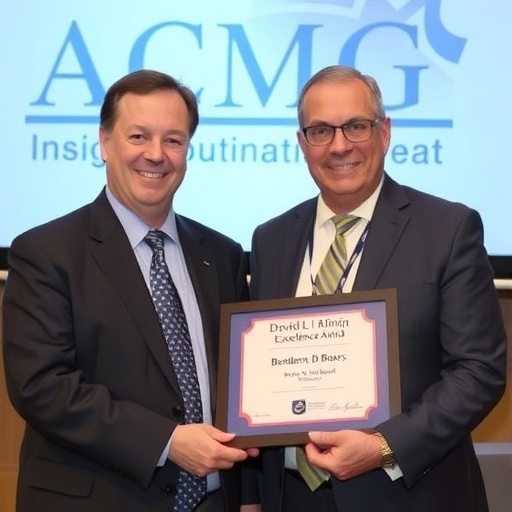
Breakthrough in Gene-Targeted Therapeutics: Dr. Benjamin Boros Awarded ACMG Foundation’s Prestigious David L. Rimoin Inspiring Excellence Award
In an exciting development that promises to reshape the landscape of genetic medicine, the ACMG Foundation for Genetic and Genomic Medicine has announced the recipient of its distinguished 2026 David L. Rimoin Inspiring Excellence Award. This year, the honor goes to Dr. Benjamin Boros, a rising star in the field of neuroscience and genetic therapy at Washington University in St. Louis. Dr. Boros’s pioneering research focuses on an innovative approach to treating autosomal dominant (AD) disorders by harnessing gene-specific antisense oligonucleotides (ASOs) targeting a shared 3′ untranslated region (3’UTR) motif within RNA molecules.
Dr. Boros’s groundbreaking platform presentation, titled “O25 Treatment for AD Disorders: Amplifying Protein Expression with Gene-specific Antisense Oligonucleotides Targeting a Common 3’UTR Motif,” was unveiled at the 2026 ACMG Annual Clinical Genetics Meeting held in Baltimore, MD. His work explores a nuanced mechanism of RNA regulation that could enable the selective amplification of protein expression, a critical strategy in combating diseases rooted in haploinsufficiency or loss-of-function mutations in dominant genetic disorders.
The backbone of Dr. Boros’s research lies in meticulous exploration of untranslated regions (UTRs) of RNA, specifically the 3’UTR, which serves as a key regulatory hub modulating RNA stability, localization, and translational efficiency. Unlike coding regions, 3’UTRs contain motifs that can be targeted by ASOs to disrupt or enhance interactions with RNA-binding proteins and microRNAs. By designing gene-specific ASOs that precisely interact with these 3’UTR motifs, Dr. Boros’s methodology aims to evade off-target effects commonly associated with broader antisense therapies, thus heightening both specificity and therapeutic potential.
Dr. Boros completed his doctoral work under Dr. Timothy Miller, a renowned neurologist and geneticist, where he investigated the epigenetic and post-transcriptional mechanisms governing brain development. This foundation in neuroscience complements his current endeavors, blending molecular biology with clinical aspirations. His innovative strategies could serve as a transformative therapeutic platform broadly applicable across multiple inherited neurological and developmental conditions characterized by dominant genetic mutations.
Notably, Dr. Boros is concurrently completing his medical training, underscoring his unique blend of clinical and research expertise. His career trajectory is poised to bridge translational gaps between bench-side discoveries and bedside interventions. With a keen interest in medical genetics residency, he is committed to harnessing gene-targeted therapies to illuminate novel treatment avenues for rare neurological diseases, many of which currently lack effective medical interventions.
The significance of this award transcends personal recognition. The David L. Rimoin Inspiring Excellence Award commemorates Dr. Rimoin’s legendary mentorship and visionary leadership in medical genetics. It celebrates emerging investigators whose contributions herald paradigm shifts in genetic and genomic medicine. Dr. Boros’s work is emblematic of the cutting-edge translational research Rimoin championed, seamlessly merging scientific rigor with compassionate patient care.
Nancy J. Mendelsohn, President of the ACMG Foundation, highlighted Dr. Boros’s research as embodying the innovation and forward momentum that the award seeks to amplify. By supporting promising clinician-scientists, the ACMG Foundation aims to seed breakthroughs that will not only elucidate disease mechanisms but also yield tangible improvements in therapeutic outcomes for affected patients and families worldwide.
Dr. Ann Garber-Rimoin, widow of Dr. Rimoin, expressed heartfelt admiration for Dr. Boros’s relentless curiosity and dedication, qualities that mirror her late husband’s ethos. She emphasized the critical synergy between pioneering translational science and profoundly empathetic medicine, which Dr. Boros exemplifies through his research and clinical ambitions.
The therapeutic strategy put forth by Dr. Boros relies heavily on the design of synthetic nucleic acid molecules, or antisense oligonucleotides, which selectively bind to RNA sequences to modulate gene expression. In the context of AD disorders—where a single defective allele can disrupt normal cellular function—this method amplifies expression from the healthy allele by preventing inhibitory interactions at the 3’UTR. This represents a paradigm shift from traditional gene replacement therapies to nuanced modulation of endogenous gene regulation.
This approach offers several advantages over existing genetic therapies, including the potential for enhanced safety profiles due to allele-specific targeting, reduced immunogenicity, and the ability to fine-tune protein abundance precisely. Furthermore, because the targeted 3’UTR motif is common across different genes implicated in distinct AD disorders, this method might provide a versatile platform adaptable to multiple genetic conditions with shared pathological mechanisms.
As gene therapies move rapidly toward clinical application, Dr. Boros’s research is at the forefront of technologies that could overcome existing limitations such as delivery efficiency, off-target effects, and long-term sustainability of therapeutic effects. His work dovetails with cutting-edge advances in RNA biology, oligonucleotide chemistry, and precision medicine, signaling a new era where targeted molecular interventions could offer durable cures for previously intractable diseases.
The ACMG Foundation and its journal partners, Genetics in Medicine and Genetics in Medicine Open, continue to serve as influential conduits for disseminating such transformative research. They provide critical educational resources, policy guidance, and clinical practice frameworks that enable the genetics community to integrate these novel scientific insights into healthcare more effectively and safely.
In honoring Dr. Boros with the David L. Rimoin Inspiring Excellence Award, the ACMG Foundation not only recognizes a remarkable talent but also highlights the potential of gene-targeted antisense oligonucleotide therapy as a beacon of hope for those affected by rare genetic neurological disorders. The scientific and medical community will eagerly watch the advancement of this research and its eventual translation into clinical success stories.
Subject of Research: Gene-targeted therapies for autosomal dominant disorders using antisense oligonucleotides targeting 3’UTR motifs.
Article Title: O25 Treatment for AD Disorders: Amplifying Protein Expression with Gene-specific Antisense Oligonucleotides Targeting a Common 3’UTR Motif.
News Publication Date: February 9, 2026.
Web References:
Image Credits: ACMG Foundation for Genetic and Genomic Medicine
Keywords: Genetics, Gene Therapy, Antisense Oligonucleotides, RNA Regulation, Neuroscience, Genetic Disorders, Medical Genetics, Translational Medicine, Rare Neurological Diseases, 3’UTR, Autosomal Dominant Disorders, Precision Medicine


