

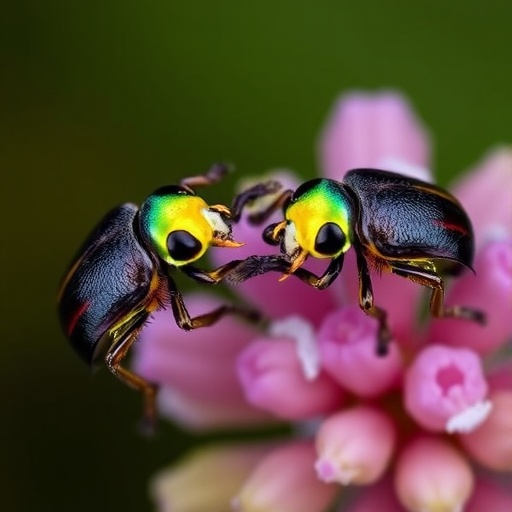
Communication among animals, particularly in the complex realm of mating behaviors, has long fascinated biologists, revealing an intricate interplay of signals that govern reproductive success. Among the most captivating examples are the Japanese scarab beetles, which employ a sophisticated chemical dialogue to ensure species-specific mating. New groundbreaking research, conducted collaboratively by scientists in the United States and China, illuminates the molecular mechanisms by which these beetles discern nuanced differences in pheromone molecules, specifically those that exist as chiral pairs, opening new avenues for pest control technologies that could revolutionize agriculture.
The Japanese beetle, Popillia japonica, stands as a notorious agricultural pest, infamous for its destructive impacts on crops. Regulatory authorities in the United States have implemented stringent import bans on this species to curtail its spread. Decades ago, researchers discovered that P. japonica females release a sex pheromone known as japonilure to attract males. This molecule possesses chirality, existing in two enantiomeric forms—R-japonilure and S-japonilure—that are mirror images of each other. Intriguingly, only the R-form effectively attracts males of P. japonica, while the S-form actually repels them, presenting an elegant natural mechanism for selective attraction.
Expanding on this phenomenon, Walter Leal, a molecular and cellular biology professor at UC Davis and senior author of the study, previously uncovered that a closely related species, Anomala osakana, reverses this pheromone response. In A. osakana, the S-form of japonilure draws males, while the R-form induces avoidance behavior. Since these species occupy overlapping habitats, such contrasting pheromone receptivity likely evolved as a reproductive isolation mechanism, preventing futile mating efforts between species and conserving valuable reproductive resources.
This exquisite discrimination between molecular mirror images raised profound questions about the underlying sensory biology. Specifically, how do these beetles distinguish between highly similar molecules differing only in their three-dimensional configuration? The challenge is compounded by quarantine restrictions imposed on P. japonica, complicating direct experimental studies. To overcome this, Leal and his collaborators turned their attention to a third species, Anomala corpulenta, also a major pest in East Asia, which utilizes japonilure as well.
The researchers applied cutting-edge molecular techniques to identify and characterize receptor genes in A. corpulenta responsible for pheromone detection. They discovered two principal receptors: one that specifically binds the R-form of japonilure to stimulate mating behavior, and another that interacts with both enantiomers but acts as an antagonist, effectively inhibiting mating signals. This dual-receptor system embodies a highly refined molecular filter, enabling precise behavioral responses to chemically similar yet biologically distinct stimuli.
Buoyed by the insights from A. corpulenta, the team conducted genomic analyses of P. japonica, even under its strict quarantine constraints. They identified homologous receptor genes, which they expressed in Xenopus laevis frog cells to assay their functional responses. One receptor exhibited a strong affinity for R-japonilure, eliciting signal activation consistent with mating attraction. Contrastingly, the other receptor functioned antagonistically, dampening the response and potentially mediating repulsion to the S-form. This molecular architecture confirms a conserved pheromone detection framework shaping mate selection across scarab beetle species.
The implications of these findings transcend academic curiosity, offering practical tools to address the logistical nightmare posed by invasive scarab beetles. These pests inflict extensive damage on fruit, ornamental plants, and turfgrass, imposing significant economic costs worldwide. Leveraging knowledge of pheromone receptor biology, scientists envision novel integrated pest management strategies harnessing synthetic japonilure analogs to monitor beetle populations with high sensitivity and specificity.
In regions like California, where invasive beetles threaten agricultural industries, airborne pheromone detection could augment conventional trapping and inspection methods. Sharp fluctuation in pheromone levels detected at ports of entry could signal the covert arrival of pest species via shipments or aircraft, enabling rapid quarantine measures to prevent establishment. Additionally, controlled deployment of pheromone traps can accurately track population fluctuations and mating cycles, informing timely application of targeted control measures.
Further futuristic prospects include deploying synthetic pheromones to disrupt mating communication directly, effectively reducing reproductive success and curbing population growth. Such approaches would reduce reliance on broad-spectrum insecticides, mitigating environmental impacts and promoting sustainable agriculture. The intricate molecular dance uncovered by Leal and colleagues thus translates into a potent strategy for protecting crops and ecosystems from invasive beetle threats.
The collaborative effort united expertise across continents and disciplines, featuring co-authors from prestigious institutions including the Chinese Academy of Agricultural Sciences, Northeast Normal University, Yangzhou University, and the Beijing Academy of Agriculture and Forestry Sciences. Funded by multiple Chinese national programs and philanthropic contributions to UC Davis, this research exemplifies the power of international cooperation in addressing critical agricultural challenges through fundamental molecular biology.
In sum, by unmasking the genetic and biochemical basis of enantiomer-specific pheromone detection in scarab beetles, this study unveils a paradigm of evolutionary innovation in insect communication. The dual receptor system crafts an elegant solution to ensure species-specific mating fidelity, safeguarding reproductive investment in complex ecological communities. Beyond academic intrigue, these molecular insights chart a promising path toward environmentally benign pest control strategies with profound agronomic significance.
This pioneering research published in the prestigious Proceedings of the National Academy of Sciences encapsulates a remarkable convergence of molecular genetics, chemical ecology, and applied pest management. It underscores how deciphering subtle biochemical cues can yield transformative tools for safeguarding global food security amidst mounting ecological and economic pressures.
Subject of Research: Animals
Article Title: Pheromone receptors for japonilure in Anomala corpulenta and Popillia japonica
News Publication Date: 20-Feb-2026
Web References: http://dx.doi.org/10.1073/pnas.2532942123
Keywords: Entomology, Insect physiology, Pheromones, Biomolecules, Molecular biology


