

In a remarkable leap forward for molecular imaging and targeted therapies, researchers have developed an innovative automated method to fluorescently label monoclonal antibodies under current good manufacturing practices (cGMP). This breakthrough streamlines the production of near-infrared (near-IR) fluorescently labeled antibodies, a crucial step toward enabling safe and high-resolution optical imaging in clinical settings. The newly described protocol represents a pivotal advancement in making optical antibody labeling more accessible, cost-effective, and scalable for investigational and diagnostic purposes.
Monoclonal antibodies have long been invaluable tools in the fight against a broad spectrum of diseases, including autoimmune disorders, infectious diseases, and various cancers. Their ability to selectively bind to molecular targets has made them central to targeted therapy regimens. However, translating these antibodies into molecular imaging agents—particularly through optical modalities—has been constrained by the complexity and cost of cGMP-compliant labeling processes. This limitation has slowed clinical uptake despite optical imaging’s promise of higher spatial resolution and safer patient experience compared to traditional nuclear imaging techniques.
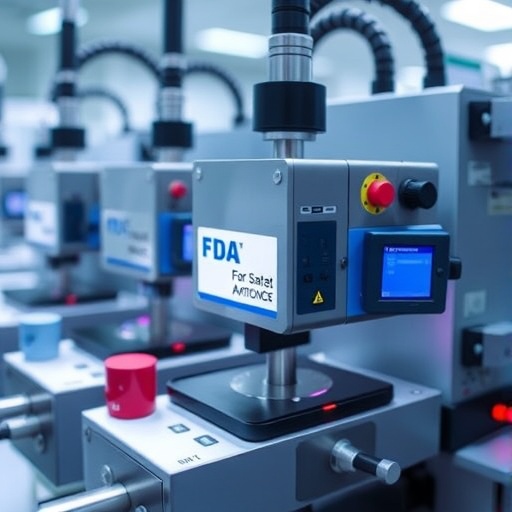
At the heart of this new approach is a clever repurposing of an existing radiolabeling cGMP technology into an automated optical labeling platform. By leveraging single-use, cassette-based production modules commonly used in radiochemistry, the method obviates the need for specialized cleanroom facilities. This not only diminishes infrastructure costs but also enhances operational simplicity and efficiency. The process integrates seamlessly into current radiochemistry setups widely available at multiple production sites, representing a rare opportunity to broaden access to advanced antibody-based imaging agents without enormous capital investment.
The core of this automated system lies in its precisely controlled reaction environment, which maintains the delicate balance required for optimal conjugation of the near-IR fluorescent dye IRDye800CW to FDA-approved monoclonal antibodies like panitumumab and nivolumab. These antibodies, already established in clinical oncology and immunotherapy applications, are now rendered visible under optical imaging platforms. Achieving consistent and high-yield fluorescent labeling while preserving antibody activity has been a longstanding challenge, but this protocol ensures both the high purity and functional integrity of the labeled products.
The researchers report that the entire labeling and purification cycle can be completed in approximately 4 hours, a substantial time reduction from conventional manual processes. When combined with downstream quality control assessments, the total turnaround remains under 10 hours. This improvement significantly accelerates batch-to-batch production, facilitating rapid preparation of clinical doses tailored for pilot studies and early-phase clinical trials. More compellingly, the automation technology cuts development costs by nearly ninety percent, potentially democratizing access to optical antibody tracers for academic centers and experimental drug developers.
Optical molecular imaging provides distinct advantages, including superior spatial resolution to localize antibody-target interactions in real time, minimal radiation exposure, and dynamic monitoring capabilities. However, until now, the laborious, non-automated production pipeline has been an insurmountable barrier to widespread clinical translation. The presented cGMP-compliant automated method directly addresses these bottlenecks, poised to revolutionize how immuno-optical probes are manufactured and deployed in human studies.
The implications extend beyond oncology. Given that monoclonal antibodies are widely employed against various autoimmune and infectious targets, the ability to fluorescently label them efficiently opens new doors for molecular diagnostics and therapeutic monitoring. This could enable clinicians to visualize disease-specific markers with unprecedented resolution during surgeries or diagnostic procedures, facilitating highly personalized patient management strategies.
Moreover, by utilizing commercially available components and existing infrastructures, the method lowers regulatory and financial hurdles for producing investigational new drug (IND) packages. This could significantly shorten the timeline from conceptual antibody imaging agent design to actual clinical application, boosting innovation pipelines in both academic and pharmaceutical sectors.
The protocol’s validation using panitumumab—an anti-EGFR antibody approved for colorectal cancer treatment—and nivolumab—an immune checkpoint inhibitor targeting PD-1 in cancer immunotherapy—underscores broad applicability across therapeutic modalities. Both antibodies were labeled with excellent radiochemical efficiency, degree of labeling, and preserved binding capability, meeting stringent cGMP quality standards that ensure patient safety and reproducibility.
In highlighting the detailed, replicable procedures necessary for industrial-scale production, the study pioneers an open framework to spur collaborative efforts in optical antibody probe development. Such accessibility could empower diverse research teams to explore novel antibody targets and fluorescent dyes, thus expanding the repertoire of clinically relevant imaging agents.
This development stands to influence not only research trajectories but also patient outcomes through enhanced molecular-guided surgeries and diagnostics. The ability to visually delineate cancerous tissues or immune targets intraoperatively could drastically improve precision while minimizing collateral damage, potentially transforming standard-of-care procedures.
Ultimately, this convergence of automated manufacturing technology and molecular imaging aesthetics presents a compelling example of how engineering ingenuity, coupled with biomedical insight, can surmount longstanding translational challenges. By lowering costs, reducing time, and maintaining rigorous quality, the approach exemplifies a new paradigm in personalized medicine where antibody-based optical tools become routine assets in clinical practice.
As clinical trials employing these optically labeled monoclonal antibodies advance, widespread adoption might follow, illuminating the future of diagnostics and targeted treatment. This enhanced visibility at the molecular level holds promise for earlier disease detection, real-time therapeutic assessment, and ultimately better management strategies that could save countless lives worldwide.
In summary, this pioneering automated cGMP manufacturing technique for near-IR fluorescently labeled antibodies offers an unprecedented opportunity to expand the clinical utility of monoclonal antibodies in molecular imaging. By bridging the gap between potential and practical implementation, it opens a new chapter in tailored diagnostics and therapies, optimizing patient care with remarkable efficiency and scalability.
Subject of Research: Automated optical labeling of monoclonal antibodies for clinical use under cGMP conditions.
Article Title: Automated cGMP optical labeling of FDA-approved antibodies for human use.
Article References:
Jouad, K., Hom, M., McAdoo, A. et al. Automated cGMP optical labeling of FDA-approved antibodies for human use. Nat Protoc (2026). https://doi.org/10.1038/s41596-026-01344-y
Image Credits: AI Generated


