

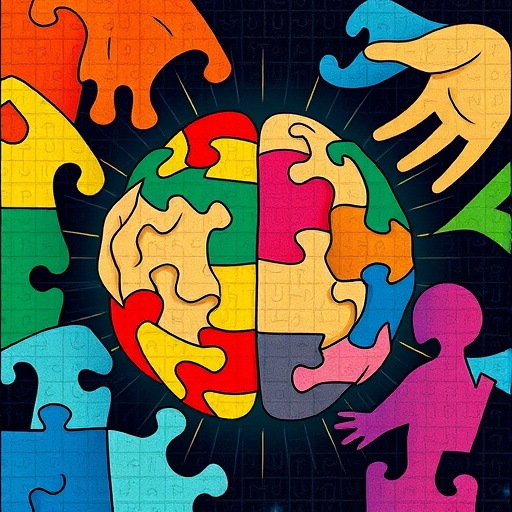
In recent years, the quest to decipher the neurobiological underpinnings of autism spectrum disorder (ASD) has been marked by intense efforts to understand the variability in brain structure and function among individuals diagnosed with the condition. Traditionally, this variability was framed as heterogeneity within the autistic brain—a broad, somewhat nebulous concept that captured the diverse manifestations of ASD across individuals. However, a groundbreaking correction published by Lin, Breakspear, and Mottron in Nature Mental Health introduces a paradigm shift, urging the scientific community to rethink this variability not simply as heterogeneity but as idiosyncrasy. This nuanced distinction carries profound implications for both research and clinical practice in ASD.
The notion of heterogeneity in autism has long posed challenges for researchers trying to pin down consistent neural correlates of the disorder. Epidemiological data suggest that ASD encompasses a spectrum of cognitive, behavioral, and neurodevelopmental presentations, each ostensibly linked to distinct neurobiological patterns. However, Lin and colleagues’ correction emphasizes that the autistic brain’s uniqueness transcends mere category-based differences, highlighting the singular, individual-specific characteristics that define each autistic brain at a granular level. This shift from viewing variability as population heterogeneity to brain-wide individual idiosyncrasy rekindles debates about how to approach ASD neuroscientifically.
Central to this new perspective is the increasing evidence from advanced neuroimaging technologies. Functional MRI (fMRI), diffusion tensor imaging (DTI), and magnetoencephalography (MEG) have consistently revealed that brain connectivity profiles in autistic individuals deviate from neurotypical norms in widely varying, often unpredictable ways. Rather than identifying a clear, universal autism-specific neural signature, these techniques unveil personalized connectivity patterns that may underlie the idiosyncratic cognitive and perceptual features observed. This realization underscores the complexities in designing one-size-fits-all diagnostic or interventional tools.
On a technical plane, the authors revisit analytical frameworks used in neuroscientific studies of ASD. Traditional group-level statistical approaches, while instrumental in defining broad trends, risk flattening individual differences into average effects, thereby obscuring the crucial idiosyncratic signatures inherent in autistic brains. Instead, the corrected framework advocates for individualized neuroimaging analyses that preserve subject-specific neural architectures, leveraging machine learning algorithms and multivariate pattern analyses to capture these unique features. This pivot could potentially transform biomarker discovery in ASD, moving it closer toward personalized medicine paradigms.
Beyond imaging, electrophysiological studies, including high-density EEG, have corroborated these findings by illustrating divergent patterns of brain oscillations and temporal dynamics among autistic individuals. Such electrophysiological idiosyncrasy further buttresses the argument that heterogeneity in ASD is not simply random variance but reflects distinct neurodevelopmental trajectories shaped by genetic, epigenetic, and environmental factors unique to each person. This multidimensional framework challenges simplistic models of autism as a monolithic condition.
The ramifications of this reconceptualization are vast for therapeutic interventions. Traditionally, clinical trials and behavioral therapies for autism have targeted group-average symptoms or neural patterns. However, shifting focus onto brain idiosyncrasies suggests the need for bespoke interventions tailored to an individual’s unique neurocognitive profile. This approach aligns with emerging trends in precision psychiatry and hints at a future where neurotechnologies could help guide adaptive therapeutic strategies on a case-by-case basis, potentially improving outcomes for many.
Critically, the paradigm shift also impacts how researchers interpret genotype-phenotype relationships in autism. The complex and variable genetic architecture of ASD, involving hundreds of possible risk loci, supports a model in which each genetic interplay may produce distinct neurodevelopmental outcomes. Viewing the autistic brain as a singular idiosyncratic entity encourages integrative models that consider cumulative, individualized genetic influences alongside environmental and developmental factors, representing a major step towards unraveling autism’s etiological labyrinth.
In parallel, this new perspective challenges the dominant clinical narratives in autism diagnosis and classification. The DSM and ICD frameworks that underpin psychiatric diagnoses emphasize categorical or dimensional models largely rooted in behavioral criteria. The emphasis on idiosyncrasy foregrounds the neurobiological individuality that behavioral criteria alone may not capture, advocating ultimately for diagnostic tools that incorporate neural phenotyping to better characterize the autism spectrum at the individual level.
Furthermore, the correction by Lin et al. serves as a methodological caution for the neuroscience community. It stresses the importance of accounting for individual variance as a signal rather than noise. This view encourages the refinement of computational models employed in brain research, pushing for frameworks that can integrate and interpret nuanced individual differences without defaulting to population averages. Such an evolution in methodology could lead to breakthroughs not only in autism but across many neurodevelopmental and psychiatric disorders.
The novel conceptualization invites interrogations about the nature of autistic cognition and perception itself. If autistic brains are idiosyncratic rather than categorically heterogeneous, this implies that the atypical sensory processing, social cognition, and executive functioning seen in ASD may be emergent properties of unique neural architectures sculpted by personal developmental experiences. This invites a reexamination of cognitive theories, moving from deficit-based models towards frameworks that value neurodivergent individuality.
Importantly, this view integrates well with current social models of neurodiversity, which reject pathologizing difference and instead embrace autistic ways of processing information as valid and often advantageous modes of cognition. Recognizing the autistic brain’s idiosyncrasy provides a neuroscientific grounding for this social perspective, potentially influencing policy and educational approaches to autism by promoting supports that respect individual brain profiles rather than conforming all to normative benchmarks.
This correction also fuels new research directions aimed at characterizing and mapping the dimensions of brain idiosyncrasy in autism. Future studies will likely leverage increasingly sophisticated multimodal imaging, computational phenotyping, and longitudinal designs to chart how these unique neural profiles emerge, stabilize, or change across development and in response to environmental inputs. These endeavors hold promise for identifying critical windows for intervention and understanding brain plasticity in autism.
Moreover, the corrected framework challenges the field to develop new theoretical constructs that capture idiosyncrasy beyond heterogeneity. Concepts from complexity science, network theory, and personalized brain mapping may find expanded applicability. As researchers refine these constructs, cross-disciplinary collaborations among neuroscientists, psychologists, geneticists, and data scientists will be essential to harness the full explanatory power of idiosyncrasy in autism.
Finally, the correction by Lin, Breakspear, and Mottron reminds us that the path to understanding autism is far from linear or simplistic. The complexities of the autistic brain demand sophisticated, individualized analyses that respect the unique neural signatures each person embodies. As the field embraces this paradigm, the hope is that science will move closer to genuinely understanding and supporting autistic individuals in all their neural diversity.
Subject of Research: Neurobiological variability and individual-specific neural signatures in autism spectrum disorder
Article Title: Publisher Correction: From heterogeneity to idiosyncrasy in the autistic brain
Article References:
Lin, HY., Breakspear, M. & Mottron, L. Publisher Correction: From heterogeneity to idiosyncrasy in the autistic brain. Nat. Mental Health (2026). https://doi.org/10.1038/s44220-026-00634-4
Image Credits: AI Generated


