

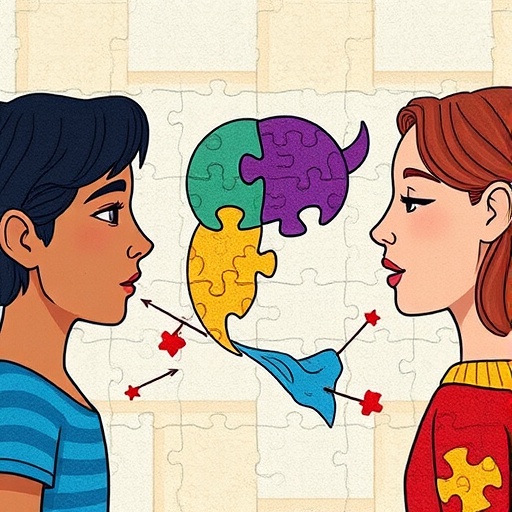
In a groundbreaking study published in Pediatric Research, scientists have unveiled intricate connections between autistic traits and social anxiety in young populations, emphasizing the critical roles played by theory of mind and social adaptive behaviors. This research offers a layered understanding of how cognitive and behavioral mechanisms intersect, creating pathways that either exacerbate or mitigate social challenges often faced by children and adolescents with autistic characteristics. By delving into the mediation effects of these psychological constructs, the study marks a significant advance in developmental psychopathology and clinical interventions.
Autism spectrum disorder (ASD) is broadly characterized by social communication difficulties and repetitive behaviors, but its symptomology manifests heterogeneously across individuals. Social anxiety, a condition marked by heightened fear of social situations and perceived judgment from others, frequently co-occurs with ASD, complicating clinical presentations and outcomes. The novel contribution of this study lies in dissecting how theory of mind—the ability to attribute mental states to oneself and others—and social adaptive behavior—skills necessary for effective social functioning—mediate the relationship between autistic traits and social anxiety, shedding light on potential intervention targets.
Theory of mind (ToM) is a foundational cognitive capacity that enables individuals to infer intentions, desires, and beliefs that differ from their own. Deficits in ToM have long been linked with the core social difficulties in ASD, but their influence on social anxiety has been less clear. This research suggests that limited or impaired ToM skills can indirectly heighten social anxiety symptoms by disrupting the young individual’s ability to navigate complex social environments effectively. When children cannot accurately interpret others’ perspectives, they are more prone to misreading social cues, leading to increased anxiety in social settings.
The researchers employed rigorous psychometric assessments to quantify autistic traits and social anxiety levels among a diverse cohort of children and adolescents. Alongside, they evaluated participants’ ToM capacities through established experimental tasks designed to test understanding of false beliefs and mental state attributions. Social adaptive behavior was measured through parent and teacher ratings, capturing pragmatic social skills such as communication effectiveness, emotional regulation, and flexibility in social contexts. This multi-method approach allowed the team to tease apart direct and indirect influences within the intertwined network of social difficulties.
The data revealed that autistic traits predicted higher social anxiety scores, consistent with clinical observations that these conditions frequently coexist. Crucially, theory of mind deficits and poorer social adaptive behaviors served as significant mediators in this relationship. In other words, the impact of autistic traits on social anxiety was substantially channeled through impairments in these cognitive and behavioral domains rather than following a simple, linear pathway. This finding nuances our understanding of how anxiety emerges within the social challenges faced by youth on the spectrum or with autistic-like tendencies.
From a neurodevelopmental perspective, these results align with emerging models positing that autism-related social difficulties are not purely static deficits but involve dynamic cognitive processes that unfold across development. Theory of mind and social adaptive faculties are malleable and can improve through targeted interventions, suggesting avenues to reduce social anxiety by enhancing these specific skills. This mechanistic insight underscores the potential for personalized therapeutic approaches that address the underlying cognitive contributors to anxiety rather than only treating symptoms in isolation.
The implications for clinical practice are profound. Screening for ToM abilities and social adaptive skills can become essential components of evaluation protocols for children presenting with autistic traits and anxiety. Interventions such as social skills training, cognitive-behavioral therapy adapted for ASD populations, and programs designed to foster mentalizing abilities could be strategically integrated to interrupt the cascade from autistic features to debilitating social anxiety. This convergent approach could promote more resilient social functioning and improve quality of life.
Moreover, the study challenges the conventional compartmentalization of autism and anxiety as separate domains, encouraging a more integrated perspective within developmental psychopathology. By illuminating the pathways through which cognitive mechanisms mediate emotional outcomes, the research invites a rethinking of diagnostic frameworks and treatment modalities. It propels a shift towards understanding neurodevelopmental profiles in a multidimensional manner, emphasizing interrelations rather than isolated symptom clusters.
On the societal level, increasing awareness about the interconnectedness of autistic traits, theory of mind deficits, social adaptive behavior, and social anxiety can reduce stigma and foster empathy. Recognizing that social anxiety in these populations is not merely a behavioral problem but a cognitive-mediated challenge opens doors for community support, inclusive education strategies, and policy reforms to accommodate diverse social-cognitive needs.
Future research directions beckon towards longitudinal studies tracking these mediating processes across critical developmental windows, from early childhood through adolescence. Investigating how environmental factors such as peer relationships, family dynamics, and educational settings interact with ToM and social adaptation to influence anxiety could reveal modifiable risk and protective factors. Furthermore, neuroimaging investigations might elucidate the neural substrates underpinning these mediational pathways, linking brain mechanisms to behavioral manifestations.
The authors highlight the importance of culturally sensitive assessments, acknowledging that manifestations of theory of mind and social behaviors can vary across cultural contexts, affecting the generalizability of findings. Cross-cultural replication studies will be essential to tailor interventions that resonate with diverse populations and avoid one-size-fits-all approaches in clinical care.
This study also contributes to the broader field of social neuroscience by delineating how cognitive empathy and social understanding relate to emotional well-being in neurodevelopmental disorders. The demonstration that enhancing theory of mind and social adaptive capacities could mitigate social anxiety broadens the scope of preventative and therapeutic strategies beyond pharmacological treatments, aligning with holistic and biopsychosocial models of care.
In conclusion, the groundbreaking findings from this research provide compelling evidence that theory of mind and social adaptive behavior mediate the association between autistic traits and social anxiety in children and adolescents. By unpacking these intricate relationships, the study advances theoretical frameworks, informs clinical interventions, and invites a more compassionate understanding of neurodevelopmental challenges. The convergence of cognitive and emotional dimensions illuminated here heralds a new era of integrated research and practice aimed at improving outcomes for youth navigating complex social landscapes.
Subject of Research:
The mediating role of theory of mind and social adaptive behavior in the relationship between autistic traits and social anxiety in children and adolescents.
Article Title:
Autistic traits and social anxiety in children and adolescents: the mediating role of theory of mind and social adaptive behavior.
Article References:
Galán Vera, I.Z., Lievore, R. & Mammarella, I.C. Autistic traits and social anxiety in children and adolescents: the mediating role of theory of mind and social adaptive behavior.
Pediatr Res (2026). https://doi.org/10.1038/s41390-026-04791-1
Image Credits:
AI Generated
DOI:
28 January 2026


