

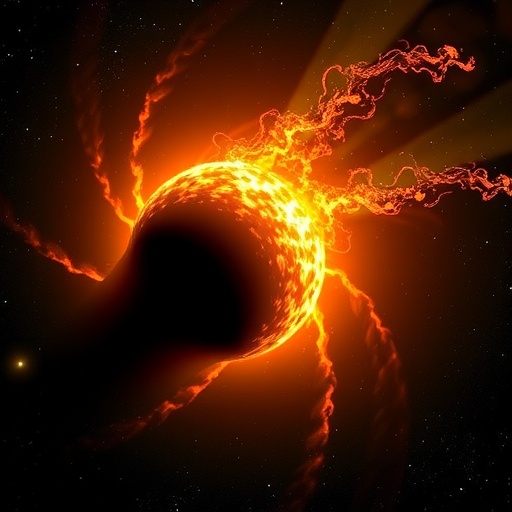
Astronomers have captured an unprecedented observation of a massive star’s final act—not in a brilliant supernova explosion, but in a silent collapse into a black hole. This extraordinary event, documented over nearly two decades of data, provides the most detailed account yet of the direct formation of a stellar black hole, breaking new ground in our understanding of how massive stars meet their ultimate fate.
The star, designated M31-2014-DS1, resided in the neighboring Andromeda Galaxy, situated approximately 2.5 million light-years from Earth. Rather than ending in the typical energetic supernova explosion that disperses stellar material into space, the star’s core imploded quietly to form a black hole, while its outer layers were progressively expelled. This slow, turbulent shedding of stellar material marks a new paradigm in star death scenarios and challenges existing theoretical frameworks.
The research team, led by Kishalay De of the Simons Foundation’s Flatiron Institute, rigorously analyzed observations from NASA’s NEOWISE mission alongside extensive archives from ground- and space-based observatories, compiling a continuous record spanning from 2005 to 2023. In 2014, M31-2014-DS1’s infrared emission began to rise, hinting at changes deep within the star. By 2016, the star’s brightness plummeted within roughly a year, reaching an extraordinary low where it became virtually undetectable in visible and near-infrared wavelengths.
By 2022 and 2023, the star had vanished from the traditional electromagnetic spectrum observable with optical telescopes, dimmed nearly ten thousand times relative to its prime luminosity. Remarkably, residual emission was still detected in mid-infrared wavelengths, albeit at just a tenth of the original brightness. This lingering infrared glow is attributed to dust formed from the ejected stellar material, which absorbs surrounding energy and re-radiates it at longer wavelengths.
The disappearance of M31-2014-DS1 aligns with theoretical models predicting that when massive stars exhaust their nuclear fuel, the gravitational collapse of the core can outpace the explosive power of neutrino-driven shock waves. Typically, neutrino emissions energize a cataclysmic supernova wave strong enough to blow away the outer layers. If this mechanism fails, the outer envelope instead falls inward, augmenting mass accumulation and forcing the birth of a black hole.
The process of black hole formation in this “failed supernova” context has been elusive until now. The data from M31-2014-DS1 provide compelling evidence that only about 1% of the star’s outer gas actually fell into the nascent black hole. Instead, a significant fraction of this convection-driven material enveloped the black hole in a chaotic swirl, reheating and slowly ejecting dust-laden gas observable for decades.
Convection—an internal circulatory mechanism driven by stark temperature gradients between the star’s hot core and cooler outer layers—is central to this behavior. The convective motion stirs the star’s atmosphere, imparting angular momentum to the gas and preventing its direct fall into the black hole. Instead, the gas orbits and interacts dynamically, forming a disk-like structure and powering a gradual outflow that cools and condenses into obscuring dust.
Andrea Antoni, a co-author on the study and a research fellow at Flatiron, emphasized the significance of the convection models: “Unlike a straightforward implosion lasting mere months, the accretion and ejection processes in this context unfold over decades. This brings about sustained brightness in infrared wavelengths as the dusty material persists.” This mechanism explains the slow fading and extended infrared afterglow that characterize these silent black hole births.
Such insights have broader implications for astrophysics. Understanding why some stars explode spectacularly as supernovae while others succumb silently to black holes fills a critical gap in stellar evolution theory. Moreover, these events shape galactic ecology by regulating how heavy elements are recycled and how black holes populate the cosmos.
Reevaluating previous observations of a similar object, NGC 6946-BH1, within this new convection-driven framework revealed parallel evolutionary pathways. Once considered anomalies, these “oddities” may represent a distinct class of stellar death, reinforcing the notion that stellar black hole formation is governed by more complex physics than previously understood.
The longevity of the infrared emission from these events, potentially observable with instruments like the James Webb Space Telescope, offers astronomers a new window into black hole formation. As dust progressively cools and dims, these cosmic beacons provide a persistent signature of a star’s quiet demise over decades, rather than the transient flash of a supernova.
This transformative discovery confirms longstanding theoretical expectations and highlights the exceptional promise of combining archival data with cutting-edge observations. As Kishalay De underscored, “Witnessing a star vanish so completely yet be visible through its dusty aftermath revolutionizes our perspective on the life cycles of massive stars and the birth of black holes.”
Ultimately, M31-2014-DS1 exemplifies the intricate interplay of gravitational collapse, convection-driven gas dynamics, and dust formation processes. It anchors a new narrative in astronomy—one where the darkest endings of stars illuminate our path to understanding the universe’s most enigmatic objects.
Subject of Research: Black hole formation in massive stars through failed supernova collapse.
Article Title: Disappearance of a massive star in the Andromeda Galaxy due to formation of a black hole
News Publication Date: 12-Feb-2026
Web References: http://dx.doi.org/10.1126/science.adt4853
Image Credits: Keith Miller, Caltech/IPAC – SELab
Keywords
Black holes, Stars, Celestial bodies, Space sciences, Astronomy, Astrophysics, Supernovae, Stellar explosions, Solar physics, Stellar dynamics, Stellar evolution, Observational astrophysics, Observational astronomy


