

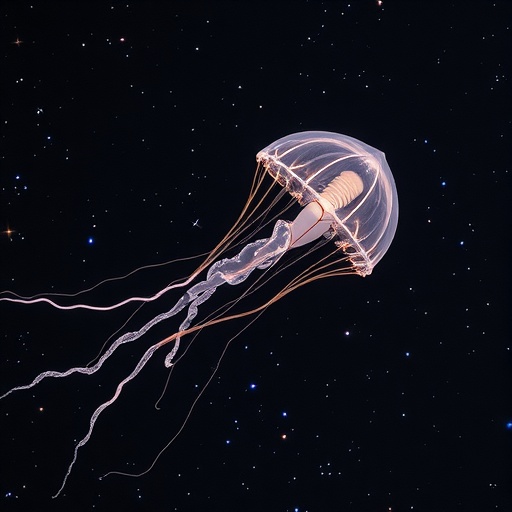
In a remarkable breakthrough that sheds light on the evolutionary processes of galaxies in the early universe, astrophysicists from the University of Waterloo have unveiled the discovery of a new jellyfish galaxy observed at an unprecedented distance. This celestial marvel is the farthest jellyfish galaxy ever documented, captured through the unparalleled capabilities of the James Webb Space Telescope (JWST). The finding propels our understanding of galaxy formation and transformation during a time when the cosmos was still in its formative stages, roughly 8.5 billion years ago.
Jellyfish galaxies are a fascinating class of cosmic entities named for their striking appearance, characterized by elongated, tentacle-like streams of gas and stars that trail behind them, reminiscent of a jellyfish’s flowing appendages. These trails form as the galaxy plunges through the dense and scorching environment of its host galaxy cluster. The intergalactic medium within the cluster acts almost like a galactic wind, exerting pressure on the galaxy’s interstellar gas and stripping it away in a process known as ram-pressure stripping. This mechanism is instrumental in reshaping the galaxy’s structure and star-forming capabilities.
Utilizing the deep field observations from the JWST, the Waterloo team scrutinized the COSMOS field—a strategically selected patch of sky that has been extensively studied due to its clear vantage unobscured by the Milky Way’s dust and star-laden foreground. This field offers an exceptional window into the distant universe, enabling astronomers to peer into epochs long past. Within this cosmic canvas, the team identified a jellyfish galaxy situated at a redshift of z = 1.156, positioning it in a time when the universe was just over a third of its present age.
The jellyfish galaxy discovered possesses a disk structure that appears remarkably ordinary at first glance, but it exhibits brilliantly luminous blue knots embedded within its trailing streams. These knots are sites of extremely young stars, which intriguingly seem to have originated outside the main galactic disk within the stripped trails of gas. This phenomenon affirms theories that star formation can be sustained in environments far removed from traditional galactic cores, stimulated by the dense, turbulent gas displaced by ram-pressure stripping.
Prior theoretical models suggested that at such a high redshift, corresponding to an early stage in cosmic history, galaxy clusters had not yet fully coalesced and that the environmental effects leading to ram-pressure stripping were comparatively rare. However, this newly observed jellyfish galaxy challenges such assumptions. The evidence presented by the Waterloo team indicates that the environmental conditions in galaxy clusters were already sufficiently hostile to not only disrupt individual galaxies but to profoundly influence their evolution much earlier than previously anticipated.
Dr. Ian Roberts, the lead researcher and Banting Postdoctoral Fellow at the Waterloo Centre for Astrophysics, articulated the significance of these findings by emphasizing that cluster environments at this epoch were already inhospitable to galaxy stability. This challenges the current paradigm, suggesting that galaxy properties were being altered by their surroundings long before cluster formation was thought to be complete, inferring a more dynamic and complex early universe.
Furthermore, the identification of such a distant jellyfish galaxy contributes critical insights into the origin of the large population of quiescent or “dead” galaxies observed in modern-day clusters. The processes observed—particularly ram-pressure stripping—likely played a pivotal role in shutting down star formation by depriving galaxies of their star-forming gas reservoirs, thus accelerating their transition from vibrant, star-forming galaxies to passive, quiescent systems.
The data gathered through the JWST’s advanced instruments show not only the stripping of gas but also the resultant young star formation in the stripped gas tails, a transformative process that redefines how scientists understand the lifecycle and morphology of galaxies under the influence of their environments. This subtle interplay between environmental forces and internal galactic processes is illuminating the complex evolutionary pathways galaxies traverse through cosmic time.
Recognizing the profound implications of their discovery, Dr. Roberts and his colleagues have already secured additional observation time on the JWST. These future observations aim to delve deeper into the physical conditions of the jellyfish galaxy, using spectroscopy and detailed imaging to dissect the composition, kinematics, and star formation activity within the gas tails. Such comprehensive data will provide unprecedented clarity on the mechanisms driving galaxy transformation during one of the universe’s most formative epochs.
This discovery underscores the transformative power of the JWST in astrophysical research. By enabling the detection and examination of such distant objects with exquisite detail, this telescope is revolutionizing our comprehension of the cosmos, opening avenues to answer longstanding questions about galaxy evolution and the role of environment-induced processes like ram-pressure stripping.
The findings were documented in the paper titled “JWST Reveals a Candidate Jellyfish Galaxy at z=1.156,” published in The Astrophysical Journal. This work marks a milestone in observational astronomy, contributing a vital dataset that is expected to influence theoretical models and further studies of galactic ecosystems throughout cosmic history.
As the scientific community anticipates more discoveries akin to this, the unveiling of these ancient jellyfish galaxies promises to catalyze a deeper understanding of how the universe’s colossal structures and their constituent galaxies have matured, revealing the cosmic interplay that shapes the visible universe we observe today.
Subject of Research: Not applicable
Article Title: JWST Reveals a Candidate Jellyfish Galaxy at z = 1.156
News Publication Date: 17-Feb-2026
Web References: https://doi.org/10.3847/1538-4357/ae3824
References: Scientific article in The Astrophysical Journal
Image Credits: University of Waterloo
Keywords
Jellyfish galaxy, ram-pressure stripping, James Webb Space Telescope, galaxy clusters, early universe, star formation, COSMOS field, galaxy evolution, astrophysics, distant galaxies, deep field observation, galaxy transformation


