
Sunday, March 22, 2026
Science
No Result
View All Result
  • Login
  • HOME
  • SCIENCE NEWS
  • CONTACT US
  • HOME
  • SCIENCE NEWS
  • CONTACT US
No Result
View All Result
Scienmag
No Result
View All Result
Home Science News Mathematics

Artificial intelligence improves lung cancer diagnosis

August 23, 2024
in Mathematics
Reading Time: 3 mins read
0
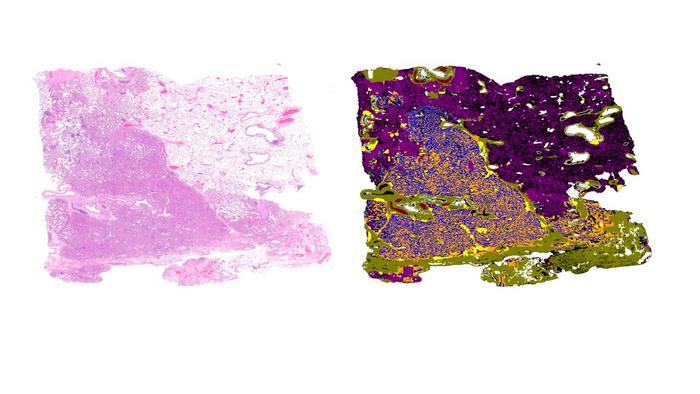
The image shows how the algorithm processes the typically coloured tissue section (left) and creates a map in which different types of tissue can be seen in different colours
66
SHARES
601
VIEWS
Share on FacebookShare on Twitter
ADVERTISEMENT

A team of researchers from the University of Cologne’s Faculty of Medicine and University Hospital Cologne, led by Dr Yuri Tolkach and Professor Dr Reinhard Büttner, has created a digital pathology platform based on artificial intelligence. The platform uses new algorithms developed by the team and enables fully automated analysis of tissue sections from lung cancer patients. The platform makes it possible to analyse digitized tissue samples on the computer for lung tumours more quickly and accurately than before. The study ‘Next generation lung cancer pathology: development and validation of diagnostic and prognostic algorithms’ has been published in the journal Cell Reports Medicine.

The image shows how the algorithm processes the typically coloured tissue section (left) and creates a map in which different types of tissue can be seen in different colours

Credit: Dr Yuri Tolkach

A team of researchers from the University of Cologne’s Faculty of Medicine and University Hospital Cologne, led by Dr Yuri Tolkach and Professor Dr Reinhard Büttner, has created a digital pathology platform based on artificial intelligence. The platform uses new algorithms developed by the team and enables fully automated analysis of tissue sections from lung cancer patients. The platform makes it possible to analyse digitized tissue samples on the computer for lung tumours more quickly and accurately than before. The study ‘Next generation lung cancer pathology: development and validation of diagnostic and prognostic algorithms’ has been published in the journal Cell Reports Medicine.

Lung cancer is one of the most common tumours/cancers in humans and has a very high mortality rate. Today, the choice of treatment for patients with lung cancer is determined by pathological examination. Pathologists can also identify molecularly specific genetic changes that allow for personalized therapy. Over the past few years, pathology has undergone a digital transformation. As a result, microscopes are no longer needed. Typical tissue sections are digitized and then analysed on a computer screen. Digitalization is crucial for the application of advanced analytical methods based on artificial intelligence. By using artificial intelligence, additional information about the cancer can be extracted from pathological tissue sections – something that would not be possible without AI technology.

“We also show how the platform could be used to develop new clinical tools. The new tools can not only improve the quality of diagnosis, but also provide new types of information about the patient’s disease, such as how the patient is responding to treatment,” explained physician Dr Yuri Tolkach from the Institute of General Pathology and Pathological Anatomy at University Hospital Cologne, who led the study.

In order to prove the broad applicability of the platform, the research team will conduct a validation study together with five pathological institutes in Germany, Austria and Japan.

Media Contact:

Dr Yuri Tolkach

Institute of General Pathology and Pathological Anatomy, University Hospital Cologne

+49 221 478 87023

iurii.tolkach@uk-koeln.de

Press and Communications Team:

Mathias Martin

+49 221 470 1705

m.martin@verw.uni-koeln.de

Publication:

DOI: 10.1016/j.xcrm.2024.101697

Press Spokesperson: Dr Elisabeth Hoffmann – e.hoffmann@verw.uni-koeln.de


Journal

Cell Reports Medicine

DOI

10.1016/j.xcrm.2024.101697

Method of Research

Imaging analysis

Subject of Research

Cells

Article Title

Artificial intelligence improves lung cancer diagnosis

Article Publication Date

22-Aug-2024

Share26Tweet17
Previous Post

US water reservoirs are shrinking and becoming less reliable

Next Post

TriMedSoc Alliance renews collaboration to unify voice of Singapore medical students

Related Posts

blank
Mathematics

Gerd Faltings Awarded 2026 Abel Prize

March 19, 2026
blank
Mathematics

Physicists and Computer Scientists Combine Quantum and Classical Computing to Achieve Unmatched Accuracy

March 19, 2026
blank
Mathematics

A Decade of Baseball Data Reveals Designated Hitter System Has No Impact on Team Victory Outcomes

March 19, 2026
blank
Mathematics

From Bell-Bottoms to Miniskirts: Math Uncovers Fashion’s 20-Year Comeback Cycle

March 17, 2026
blank
Mathematics

Comparing Restrictive and Liberal Physical Restraint Approaches in Critically Ill Patients: Implications for Care

March 17, 2026
blank
Mathematics

Qubits Developed from Unconventional Materials

March 17, 2026
Next Post
TriMedSoc Alliance

TriMedSoc Alliance renews collaboration to unify voice of Singapore medical students

  • Mothers who receive childcare support from maternal grandparents show more parental warmth, finds NTU Singapore study

    Mothers who receive childcare support from maternal grandparents show more parental warmth, finds NTU Singapore study

    27627 shares
    Share 11047 Tweet 6905
  • University of Seville Breaks 120-Year-Old Mystery, Revises a Key Einstein Concept

    1029 shares
    Share 412 Tweet 257
  • Bee body mass, pathogens and local climate influence heat tolerance

    671 shares
    Share 268 Tweet 168
  • Researchers record first-ever images and data of a shark experiencing a boat strike

    535 shares
    Share 214 Tweet 134
  • Groundbreaking Clinical Trial Reveals Lubiprostone Enhances Kidney Function

    520 shares
    Share 208 Tweet 130
Science

Embark on a thrilling journey of discovery with Scienmag.com—your ultimate source for cutting-edge breakthroughs. Immerse yourself in a world where curiosity knows no limits and tomorrow’s possibilities become today’s reality!

RECENT NEWS

  • UK Study Reveals No Additional Advantage of Surfactant Therapy in Severe Bronchiolitis Cases in Infants
  • Social Isolation Lessons from Nursing Home COVID-19 Relatives
  • Pseudoexfoliation Syndrome in Northwest Ethiopia Cataract Patients
  • Bridging Generations: Talking Advance Care Planning Together

Categories

  • Agriculture
  • Anthropology
  • Archaeology
  • Athmospheric
  • Biology
  • Biotechnology
  • Blog
  • Bussines
  • Cancer
  • Chemistry
  • Climate
  • Earth Science
  • Editorial Policy
  • Marine
  • Mathematics
  • Medicine
  • Pediatry
  • Policy
  • Psychology & Psychiatry
  • Science Education
  • Social Science
  • Space
  • Technology and Engineering

Subscribe to Blog via Email

Enter your email address to subscribe to this blog and receive notifications of new posts by email.

Join 5,191 other subscribers

© 2025 Scienmag - Science Magazine

Welcome Back!

Login to your account below

Forgotten Password?

Retrieve your password

Please enter your username or email address to reset your password.

Log In
No Result
View All Result
  • HOME
  • SCIENCE NEWS
  • CONTACT US

© 2025 Scienmag - Science Magazine

Discover more from Science

Subscribe now to keep reading and get access to the full archive.

Continue reading