

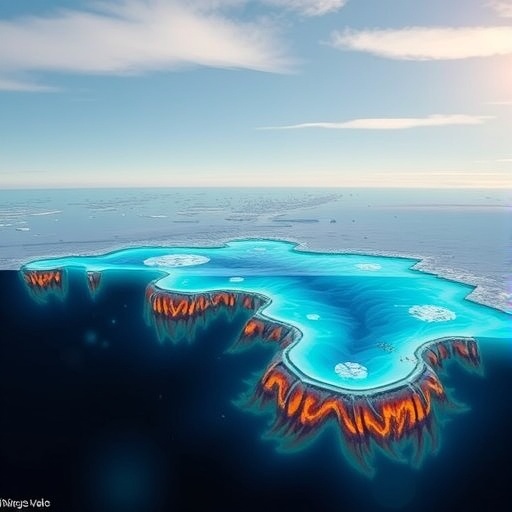
In the rapidly evolving narrative of climate change and its impact on the Arctic, a groundbreaking study has emerged, illuminating an astonishing facet of the Arctic sea ice ecosystem that has long been obscured by the formidable and dynamic nature of its environment. Recent research spearheaded by Müller et al. reveals that Arctic sea-ice ridges are not just simple frozen formations but are vibrant biomass hotspots, teeming with diverse microbial communities. This revelation challenges preconceived notions of the Arctic as a barren icy expanse and reframes sea-ice ridges as crucial reservoirs of microbial life, potentially pivotal in global biogeochemical cycles.
The Arctic region has for decades been understood through a lens focused predominantly on its physical characteristics—ice thickness, coverage, and seasonal fluctuations driven by polar warming. However, beneath and within the frozen surfaces, researchers have started to uncover complex biological interactions and ecosystems that may be more influential than previously imagined. This latest study dives into the intricate microbial ecosystems residing in sea-ice ridges, which are accumulations of ice blocks piling up, forming ridges often extending well above the sea surface.
Using innovative sampling methodologies that overcome the challenges posed by extreme cold and ice mobility, the team analyzed the microbial biomass embedded within these ridges. Their findings revealed exceptionally high concentrations of microbial life relative to the surrounding ice and open waters. This microbial population included a rich diversity of bacteria, archaea, and microscopic eukaryotes, which collectively contribute to substantial biomass. Such a discovery is critical, as biomass density correlates closely with ecological productivity and nutrient cycling in polar regions.
This study employed cutting-edge molecular techniques including metagenomic sequencing to unravel the complex community structure within the sea-ice ridges. It was found that these microbial assemblages are not only diverse but also highly specialized, adapting to the unique physicochemical gradients within the ice. The ridges offer environments with variable salinity, temperature, and light penetration, structuring microbial communities in microhabitats that provide refugia against harsh external conditions.
One of the most striking implications of this research lies in the role these microbial hotspots may play in Arctic biogeochemical cycles. Microbes within sea ice can drive carbon and nitrogen transformations, influencing the flux of these elements not only locally but potentially on a broader scale through exchange with the atmosphere and ocean. The ridges act as biogeochemical reactors, where nutrient cycling might be intensified compared to the surrounding diffuse ice cover, indicating that sea-ice ridges could strongly modulate Arctic ecosystem functioning.
Moreover, the microbial inhabitants of these sea-ice ridges include previously uncharacterized taxa that may possess novel metabolic pathways optimized for survival in such extreme environments. This points to an unparalleled reservoir of genetic and enzymatic diversity with potential applications ranging from biotechnology to understanding extreme life adaptations. The discovery also raises questions about how these communities may respond to ongoing Arctic warming and the consequent reduction in multiyear ice and ridge formation.
The ongoing retreat of Arctic sea ice poses a significant threat to these microbial refuges. As the ridges decline or alter in structure due to warming temperatures, the biogeochemical processes they host could be disrupted. This may lead to cascading effects throughout the Arctic food web, given that microbial communities form the foundation of this ecosystem. The shifting dynamics could further influence carbon sequestration in the polar oceans and feedback loops affecting global climate patterns.
Intriguingly, the study highlights the resilience of microbial communities in sea-ice ridges, which appear to persist through seasonal melt and refreeze cycles. This resilience underscores the importance of these habitats as stable niches in an otherwise highly variable environment. Understanding the mechanisms behind this persistence could provide insights into microbial survival strategies under climate stress, informing broader ecological models.
The researchers emphasize the need to integrate microbial ecology with physical and chemical oceanography to build a holistic understanding of the Arctic polar ecosystem. Such interdisciplinary approaches are essential for predicting the future trajectories of these microbial communities and their ecosystem services amid accelerating climate change. The Arctic sea-ice ridges thus emerge not only as physical features but as biotic hotspots crucial to the resilience of polar life.
To quantify the microbial biomass and diversity, the team analyzed samples through a combination of cell counts, biomass estimations, and high-throughput DNA sequencing. They found that biomass within ridge cores could be orders of magnitude greater than surrounding ice matrices, underscoring their status as concentrated biological oases amid the Arctic expanse. These findings necessitate the reevaluation of Arctic microbial ecology frameworks to incorporate ridge-associated processes more explicitly.
From a methodological standpoint, accessing and sampling these sea-ice ridges demanded rigorous logistical coordination and technological innovation. The study showcases how advances in in situ sampling devices, combined with molecular and bioinformatic tools, enable the exploration of previously inaccessible environmental niches. This methodological leap forward holds promise for other polar and extreme environment microbiology studies, broadening our capacity to detect and understand remote ecosystems.
The discovery also serves as a poignant reminder that even in the planet’s most extreme and seemingly inhospitable environments, ecosystems thrive in surprising complexity and richness. It encourages continued exploration and preservation efforts for Arctic environments, which are increasingly vulnerable to anthropogenic pressures. Protecting these microbial hotspots could have implications beyond biodiversity conservation, including climate regulation and maintaining ocean health.
Overall, Müller and colleagues’ work fundamentally enhances our comprehension of the Arctic ecosystem. It underscores the critical significance of microbial life in sea-ice ridges and their broader role in Arctic ecology and global environmental processes. As the climate crisis continues to accelerate, such insights emphasize the urgency to monitor and protect not just the visible ice, but also the invisible microbial communities that dwell within and upon it.
This study not only expands the scientific frontier regarding Arctic microbial diversity but also invites a reevaluation of ice-covered polar habitats as active sites of biological and chemical interaction. The findings could reshape how policymakers, conservationists, and researchers approach environmental stewardship in fragile polar regions, stressing the interconnectedness of microbial life and planetary health.
In summary, the identification of Arctic sea-ice ridges as concentrated microbial biomass hotspots opens a new chapter in polar science. It challenges existing paradigms, enriches our ecological knowledge, and demands a sophisticated climate response that integrates biological considerations into the management and preservation of the Arctic’s frozen realms. This remarkable microbial biodiversity beacon, embedded within the ice, could be central to understanding and mitigating the far-reaching consequences of environmental change at the poles and beyond.
Subject of Research:
Microbial diversity and biomass distribution in Arctic sea-ice ridges and their ecological and biogeochemical significance.
Article Title:
Arctic sea-ice ridges are biomass hotspots harboring diverse microbial communities.
Article References:
Müller, O., Gardner, J., Olsen, L.M. et al. Arctic sea-ice ridges are biomass hotspots harboring diverse microbial communities.
Commun Earth Environ (2026). https://doi.org/10.1038/s43247-026-03364-8
Image Credits: AI Generated


