

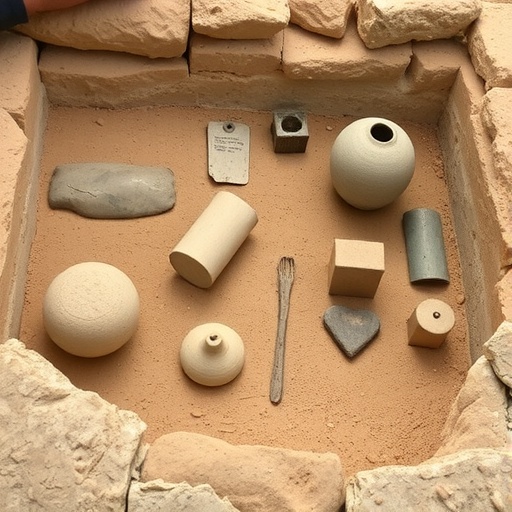
A groundbreaking archaeological study from Bar-Ilan University is revolutionizing our understanding of the elderly in ancient societies, a demographic historically neglected within the archaeological discourse. Although women and children have increasingly gained attention in recent research, older adults have largely remained invisible, primarily understood through skeletal remains with scant insight into their lived experiences. This pioneering research adopts an innovative method, focusing on household artifacts to identify and comprehend the social roles and daily lives of older individuals, challenging longstanding assumptions about age and status in Iron Age Israel.
The focal point of the study is Building 101 at Tel ʿEton, a site nestled in Israel’s southeastern Shephelah region. This well-preserved, architecturally complex residence offers a rare snapshot of domestic life just prior to its destruction during an Assyrian military campaign in the late eighth century BCE. This destruction event effectively sealed hundreds of pottery vessels and various domestic artifacts within debris layers, allowing archaeologists an unparalleled glimpse into the household’s organization, use of space, and occupants’ social dynamics.
Professor Avi Faust and his interdisciplinary team implemented a multifaceted analytical framework that transcended conventional archaeological approaches. By integrating artifact typology, spatial distribution, architectural layout, and ethnographic analogies from contemporary aging studies, they reconstructed the quotidian realities of this ancient family’s elder members. This approach reveals a dramatically different perception of elderly individuals from what skeletal analysis alone could provide, presenting them as active agents with significant social influence within their household.
One of the most compelling discoveries was Room B within Building 101, hypothesized to have housed the oldest members of the household. This room’s characteristics were notably distinct: it was the largest chamber, situated on the ground floor, and uniquely served as a living and sleeping area, unlike other rooms dedicated to specialized functions such as storage or cooking. Its strategic placement opposite the entrance afforded the residents a commanding vantage point over the courtyard and adjoining rooms, suggesting a role associated with oversight and social engagement rather than mere seclusion.
The difficulty elders would face climbing ladders to upper-story quarters aligns with ethnographic insights regarding mobility in aging populations, supporting the interpretation that the most senior family members occupied the ground floor living space. Material culture within this room included rare and symbolically charged objects: a footbath indicative of social hospitality rituals, and remnants of burnt cedar wood potentially belonging to a substantial chair. These artifacts imply the patriarch’s prominent position as a household head who presided over activities and guests, while the matriarch orchestrated domestic tasks.
Adjacent spaces illuminate the matriarch’s domestic and managerial roles further. An adjoining room contained a large loom, linking her to textile production, child care, and food preparation areas. These domestic industries, vital for household sustenance and social cohesion, underscore the elder woman’s centrality within household economic and social frameworks. This nuanced perspective challenges reductive narratives of elderly individuals as passive or marginalized in traditional archaeological interpretations.
The study underscores the limitations inherent in relying solely on skeletal remains for identifying the elderly in Iron Age Israel, where burial records are frequently incomplete or fragmented. By shifting focus to household context and material culture, the research reveals the elderly as embedded within family hierarchies, participating dynamically in resource management and decision-making processes. This approach moves beyond chronological age to apprehend elderhood as a lived social identity marked by authority, responsibility, and integration.
Professor Faust emphasizes the transformative potential of this methodology. “For decades, archaeological narratives have omitted the elderly, rendering them invisible in reconstructions of ancient societies,” he notes. Through careful artifact analysis and contextual interpretation, the research expands archeological capabilities to recover the voices and agency of older adults, enriching broader historical understandings of kinship, residence, and social structure in the Iron Age.
Beyond rewriting age-related social histories at Tel ʿEton, the implications of this research ripple across archaeology more generally. It foregrounds the importance of household archaeology in elucidating aspects of quotidian life inaccessible through skeletal or textual records alone. Through a synergistic combination of material studies and ethnographic parallels, researchers can now explore social gerontology in antiquity with unprecedented depth and nuance.
Importantly, this study also challenges modern perceptions surrounding aging and social value. Ancient elders at Tel ʿEton were not relegated to the periphery but functioned as pivotal figures ensuring family cohesion, supervising labor, and maintaining resource stewardship. This reflects a complex social fabric where age conferred respect and responsibility, a perspective that enriches contemporary debates about ageism by highlighting its historical variability and contextual specificity.
By opening this new archaeological avenue, the study from Bar-Ilan University equips scholars to investigate elderhood in other ancient contexts worldwide. The meticulous study of small domestic finds within their spatial and cultural matrix, paired with ethnographic insights, has potential to illuminate neglected social dimensions across temporal and geographic boundaries, creating a more inclusive and vibrant understanding of ancient social landscapes.
This research ultimately exemplifies the capacity of archaeology to rethink past social identities through innovative interdisciplinary lenses. It rekindles awareness that daily life—especially the nuanced roles of those often overlooked—leaves tangible traces awaiting discovery. In doing so, it challenges both scholars and the public alike to reconsider the narratives through which we interpret human history and social complexity.
Subject of Research: The social roles and daily lives of elderly individuals in Iron Age Israel, as revealed through household archaeology at Tel ʿEton.
Article Title: The Archaeology of the ‘Elderly’, ‘Elders’, ‘Fathers’ and ‘Mothers’ in Iron Age Israel: Building 101 at Tel ʿEton as a Case-Study
News Publication Date: 7-Jan-2026
Web References: https://www.cambridge.org/core/journals/cambridge-archaeological-journal/article/archaeology-of-the-elderly-elders-fathers-and-mothers-in-iron-age-israel-building-101-at-tel-eton-as-a-casestudy/8554ED3A4AD156172976DBBF8A7EC2D2
Image Credits: Vered Yacobi
Keywords: Archaeology, Iron Age, Elderly, Household Archaeology, Social Roles, Tel ʿEton, Bar-Ilan University, Domestic Life, Material Culture, Ethnography, Assyrian Destruction, Social History


