

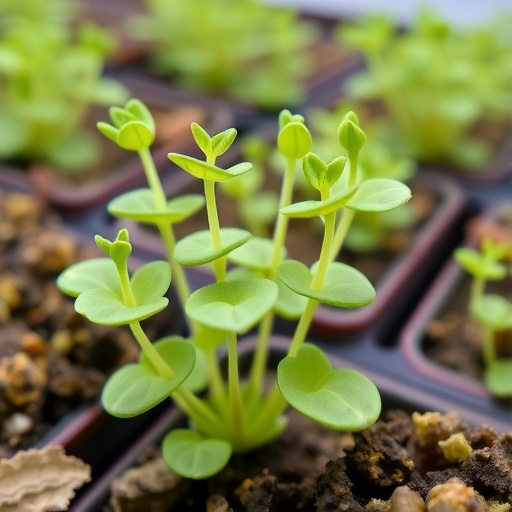
In a groundbreaking study published recently in Nature Plants, researchers have uncovered crucial molecular mechanisms behind calcium uptake in plants, spotlighting a previously obscure family of ion channels. Calcium (Ca²⁺) is a fundamental macronutrient involved not only in the structural integrity of plant cell walls but also in myriad signaling pathways that govern growth and stress responses. Despite its significance, the precise proteins and channels responsible for calcium acquisition from soil have remained elusive. This new research illuminates the function of a group of plant-specific ion channels – the IONIC CURRENT FAMILY A (ICA) proteins – which mediate calcium uptake essential for stress resilience in Arabidopsis thaliana.
Calcium’s critical role in plant health is well-established, influencing cell division, elongation, and adaptation to environmental stimuli. However, understanding how plants dynamically regulate and absorb this vital element has challenged botanists and molecular biologists for decades. Previous electrophysiological studies identified non-selective cation channels (CNCCs) that permit calcium entry into root cells, but the molecular identities of these channels were largely unknown. Filling this gap, the investigation led by Ren et al. utilized a combination of bioinformatics and electrophysiological screening techniques to pinpoint the ICA family as key contributors to CNCC activity.
The study reveals that ICA proteins, unique to plants, can form calcium-permeable channels when expressed in heterologous systems, indicating their role as bona fide ion conductors. In Arabidopsis thaliana, four homologous genes – AtICA1, AtICA2, AtICA3, and AtICA4 – were shown to express predominantly in root cells, precisely where calcium uptake from soil occurs. Intriguingly, protein localization experiments demonstrated that these ICA channels reside in the plasma membrane, perfectly positioning them to mediate extracellular calcium influx.
Genetic manipulation of Arabidopsis provided compelling functional evidence for the ICA proteins’ importance. Quadruple mutants lacking all four ICA genes (ica1/2/3/4) displayed altered responses to external calcium concentrations. Under calcium-limited conditions, these mutants were hypersensitive, reflected by stunted root growth. Conversely, when exposed to excess calcium environments, the mutants exhibited reduced sensitivity, implying a defective calcium uptake mechanism. These observations underscore the ICA channels’ role in fine-tuning plant growth relative to environmental calcium availability.
Moreover, the ica quadruple mutants showed heightened vulnerability to a variety of abiotic stresses such as salt, drought, and oxidative stress when grown under standard calcium conditions. This increased sensitivity hints at a broader physiological impact of impaired calcium homeostasis, emphasizing calcium’s signaling function beyond structural roles. The study effectively links ICA channel function to stress tolerance, suggesting that adequate calcium acquisition is fundamental for a robust defense against environmental challenges.
Crucially, electrophysiological recordings in root cells of wild-type versus ica mutants revealed the absence of the characteristic CNCC-mediated currents in the mutants. This loss of ionic current corroborates the electrophysiological identity of ICA proteins as components of the calcium-permeable non-selective cation channels. Consequently, the reduced calcium uptake observed in mutants aligns with the loss of these channel activities, reinforcing the notion that ICA proteins form or regulate these channels in vivo.
Molecular characterization of ICA channels revealed their non-selective nature, allowing not only calcium but also other cations to permeate, although calcium is the physiologically relevant ion in this context. This property might provide plants with the flexibility to adjust ion flux under fluctuating soil conditions. The current study spotlights the molecular basis for these currents, marking a significant stride in plant ion channel biology.
These findings have transformative potential for agriculture and plant biotechnology. Enhanced understanding of calcium uptake mechanisms is critical for developing crops capable of thriving in marginal soils with deficient or imbalanced calcium content. Through targeted manipulation of ICA channel activity, it might be possible to enhance crop resilience to both biotic and abiotic stresses, a pressing need in the era of climate change and increasing food demands.
Ren et al.’s research describes a sophisticated interplay between soil calcium availability and internal cellular signaling mediated by ICA channels. The adaptive modulation of root ion channel activity optimizes calcium uptake, ensuring homeostasis under diverse environmental pressures. The ICA family thus represents a critical node in this regulatory network, interfacing external nutrient status with intracellular physiological processes.
The authors employed rigorous bioinformatic analysis to identify ICA proteins across multiple plant species, suggesting evolutionary conservation of this calcium uptake pathway. This conservation hints at ICA channels being fundamental to plant physiology broadly, beyond Arabidopsis, potentially extending to major crops and important plant models.
In addition to electrophysiological and genetic experiments, subcellular localization studies utilized fluorescent protein tagging to confirm plasma membrane residency of ICA proteins. This method provided direct visual confirmation, solidifying the channel’s expected positioning for mediating extracellular calcium influx.
The study also integrates abiotic stress assays, revealing that ICA-deficient plants exhibit compromised growth and survival in salt and drought conditions. These functional assays demonstrate the physiological relevance of ICA-mediated calcium uptake in real-world environmental contexts, bridging molecular findings with whole-plant phenotypes.
This research opens new avenues for exploring the molecular architecture of calcium-permeable channels in plants. While ICA proteins account for significant CNCC activity, additional accessory factors or regulatory subunits may exist. Future work could decipher how ICA channels are regulated post-translationally or transcriptionally in response to fluctuating environmental cues.
In sum, the work conducted by Ren and colleagues provides the first comprehensive molecular evidence identifying plant-specific ICA proteins as critical components of calcium-permeable non-selective cation channels in root cells. Their research establishes a direct mechanistic link between calcium uptake, ion channel function, and environmental stress tolerance in plants, paving the way for novel strategies to improve crop performance in challenging ecosystems.
This pioneering study enhances our understanding of calcium nutrition in plants, shifting the paradigm from indirect observations to molecularly defined mechanisms. Given calcium’s pivotal role in plant development and defense, the unveiling of ICA channel functions will undoubtedly stimulate further research into calcium signaling pathways and nutrient acquisition.
As global agriculture faces mounting pressures from climate variability and soil degradation, insights into fundamental nutrient uptake processes such as those revealed here will be invaluable. Fine-tuning calcium uptake through molecular breeding or biotechnology holds promise for creating resilient crops able to maintain growth and productivity despite hostile environmental conditions.
The identification and characterization of IONIC CURRENT FAMILY A proteins mark a milestone in plant physiology research. These findings deepen our comprehension of ion channel diversity and specificity in plants and highlight the elegant molecular solutions plants employ to thrive in complex environments.
Subject of Research: The molecular mechanisms regulating calcium uptake in Arabidopsis thaliana roots, focusing on the role of plant-specific IONIC CURRENT FAMILY A (ICA) proteins as components of calcium-permeable non-selective cation channels essential for environmental calcium acquisition and stress tolerance.
Article Title: Arabidopsis IONIC CURRENT FAMILY A proteins facilitate environmental calcium acquisition essential for stress tolerance.
Article References:
Ren, Z., Liu, Z., Xi, Y. et al. Arabidopsis IONIC CURRENT FAMILY A proteins facilitate environmental calcium acquisition essential for stress tolerance. Nat. Plants (2026). https://doi.org/10.1038/s41477-025-02179-3
Image Credits: AI Generated


